Human dominion over creation
Paradise LostHuman dominion over creation is the divinely granted charge that makes humanity the appointed governor of the created world. Given to Adam at the completion of creation, it establishes human beings above the other creatures while insisting that their authority comes from God, depends on obedience, and must not be confused with an unlimited right to rule other human beings.
Definition and Divine Foundation
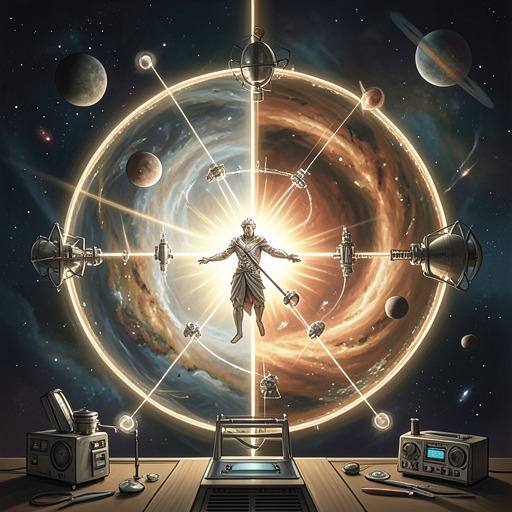
Human dominion appears at the climax of the sixth day, when the world is already filled with birds, fish, beasts, insects, and the many forms of terrestrial life. The remaining “Master work” is a rational creature who can stand upright, know himself, govern the rest, and respond to Heaven with gratitude and worship. God therefore declares that Man is made in the divine image and that humanity shall rule over the fish of the sea, the birds of the air, the beasts of the field, the whole Earth, and every creeping thing upon it.
The mandate is thus both political and theological. Humanity is made chief among God’s works, but not self-originating or self-authorizing. Adam is formed from the dust of the ground, receives the breath of life from God, and is placed in the Garden of Eden only after God has created and evaluated the world as entirely good. Dominion is consequently a delegated office within a created order, not an independent sovereignty.
Scope, Practice, and Naming
God blesses mankind and commands it to be fruitful, multiply, fill the Earth, subdue it, and hold dominion over its living inhabitants. The language joins reproduction, settlement, cultivation, and rule into a single human vocation. The Earth is not merely a backdrop for Adam’s existence; it is the field entrusted to his race, including its sea, air, land, and creatures.
Adam’s authority is enacted through knowledge as well as force. God brings the birds and beasts before him in pairs so that he may receive them, recognize their kinds, and give them names. The animals approach with gestures of submission, while Adam’s sudden apprehension enables him to understand their natures. Naming therefore functions as an inaugural form of governance: Adam classifies the living world, speaks it into an intelligible order, and receives its fealty. Yet the scene also exposes the limits of dominion, because no animal can provide the rational and reciprocal fellowship Adam seeks.
The provision of food further defines the mandate. Adam is free to eat the pleasant fruit of every tree in the Garden of Eden, and the abundance of creation is described as sufficient to answer human need. But the Tree of Knowledge of Good and Evil is excluded. Human rule therefore operates inside a prior command: appetite must be governed, and dominion over creation cannot cancel obedience to God.
Authority, Freedom, and Its Limits
The rule over creation is sharply distinguished from rule over humanity. In the later account of the Tower of Babel, Adam condemns the attempt of an ambitious descendant to impose dominion on his brothers. God gave mankind absolute authority over beasts, fish, and birds, but did not make one man lord over other men; that title remains reserved to God, leaving human beings free from one another’s ownership.
This distinction becomes a central measure of legitimate authority. Satan challenges the divine order by objecting to the Son of God’s kingship and treating equality and freedom as grounds for rejecting commanded submission. Abdiel answers that freedom is not destroyed by rightful order: the Son of God’s headship unites the angelic powers, and the honor shown to him returns glory to the whole created hierarchy. By contrast, the human usurper at Babel converts a delegated office into tyranny, seeking mastery over rational equals and even directing his tower toward defiance of Heaven.
The mandate is also inseparable from free will. Raphael explains to Adam that happiness depends on God, but continued happiness depends on Adam’s obedience; God made him perfect, not immutable, and left perseverance within his freely ordained will. Humanity’s government of the world therefore presupposes self-government. When reason is obscured and desire takes command, inward freedom is lost, and God may justly permit outward rulers to enslave those who have already admitted unworthy powers within themselves.
The Fall and the Damaged Mandate
The prohibition against eating from the Tree of Knowledge of Good and Evil reveals the danger built into human authority. Adam possesses broad freedom over the Garden and the wider Earth, but the single prohibition marks the boundary between delegated rule and attempted self-enlargement. Eating the forbidden fruit brings knowledge of good and evil at the cost of the good previously possessed, and makes mortality the condition of human existence.
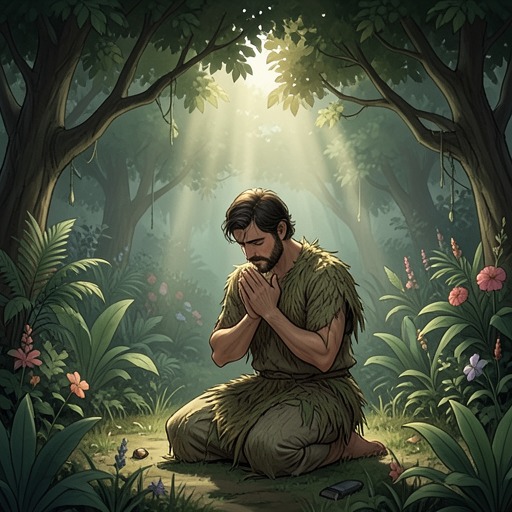
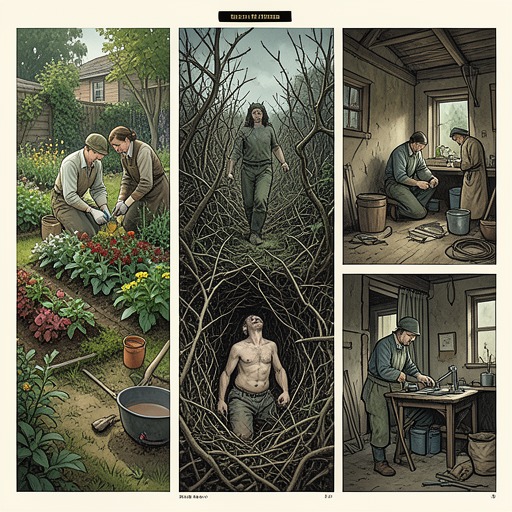
After the Fall, Adam’s dominion is not simply revoked, but transformed by labor, suffering, and dependence. He and Eve are expelled from the Garden of Eden, and Adam must earn bread through labor on the ground from which he was taken. Eve receives the pain of childbirth, while both face changing seasons, cold, rain, ice, hail, and snow. They must seek shelter and learn to make fire as remedies for evils produced by their own misdeeds. The world remains inhabitable, but governance now occurs within material vulnerability rather than effortless abundance.
Adam’s response to Eve’s proposal of suicide shows the mandate’s continuing orientation toward the future. He rejects self-destruction and childlessness because the woman’s seed is destined to bruise the Serpent’s head, a promise he connects with the punishment of Satan. To abandon life would be to abandon the possibility of redemptive history. Human dominion thus survives the Fall not as unchanged mastery, but as responsibility toward descendants, work, endurance, and the future defeat of evil.
Judgment, Restoration, and Significance
The divine judgment after the Fall confirms that humanity cannot use dominion to escape mortality. God sends Michael to drive the sinful pair from Paradise and assigns Cherubim with a flaming sword to guard the way to the Tree of Life, preventing fallen humanity from seizing immortality and eternizing its corrupted condition. Death becomes a final remedy rather than merely an arbitrary penalty: after a life of tribulation refined by faith and faithful works, it may give way to a renewed life in the renovation of the just, when Heaven and Earth are renewed.
The mandate therefore develops from possession toward moral stewardship. In its original form, humanity rules an ordered and abundant creation, receives its creatures by name, and enjoys its fruits under one prohibition. After disobedience, the same vocation is burdened by labor, weather, mortality, and the need for repentance. Adam’s final instruction is that obedience, dependence on providence, patience, temperance, virtue, and love are superior to limitless knowledge or universal empire. The hoped-for restoration is not a return to unexamined power, but the recovery of a rightly ordered relation among God, humanity, and the world.
At its widest scale, human dominion is framed by the entire history of creation and renewal. God creates humanity to govern the living Earth; human sin disorders that vocation; and the promised Redeemer will finally dissolve Satan’s perverted world and raise new Heavens and a new Earth founded in righteousness, peace, and love. Dominion is therefore neither a license for exploitation nor a simple badge of superiority. It is a delegated office whose legitimacy depends on the character of its exercise: gratitude rather than self-glorification, care rather than arbitrary possession, and obedience rather than rebellion.