Incarnation
Paradise LostIncarnation is the decisive meeting of divine justice, human mortality, and redeeming love. The Son of God does not save humanity by overlooking its transgression, but by joining human nature to his own, entering Adam’s place as a second root of mankind, fulfilling the obedience that Adam lacked, and accepting the death owed by the fallen race. Through this descent, death itself becomes the passage toward resurrection, and the destruction initiated by sin is answered by a greater restoration.
Definition and Theological Necessity
Incarnation arises from the judgment that Adam’s disobedience has placed the whole human race under death. Humanity cannot repair its own condition: once dead in sins, it has no adequate atonement or offering to bring, and no merely human effort can satisfy the rigid demand of justice. God declares that man must die, unless another being both able and willing to pay the forfeiture through “death for death.” The problem is therefore not simply weakness or ignorance, but a broken relation to the supreme authority of Heaven, a breach that requires a satisfaction proportionate to the crime.
The Son of God supplies what humanity lacks. He offers himself as “life for life,” asking that divine anger fall upon him and consenting to leave the Father’s bosom and heavenly glory for mankind’s sake. The offer is voluntary rather than coerced: his sacrifice is presented as an act of immortal love joined to filial obedience. In this economy, grace does not abolish justice; it creates a way for justice to be fulfilled by one who can bear humanity’s penalty and transform its consequences.
Assumption of Human Nature
The Father accepts the Son’s proposal but establishes that redemption must occur through genuine solidarity with humanity. The Son is to join man’s nature to his own, become flesh through the wondrous birth of a Virgin, and stand “in ADAMS room” as the Head of all mankind. The structure is explicitly representative. As all men perish in Adam, those who are restored are restored through the Son as a second root; Adam’s crime makes his descendants guilty, while the Son’s merit is imputed to those who renounce their own deeds and live in him.
This descent does not diminish the Son’s divine status. Although enthroned in the highest bliss and equal to God, he relinquishes that glory for a time in order to save the world from utter loss. The Father interprets this humiliation as an exaltation: because love has abounded in the Son more than glory, his assumed manhood will be raised with him. He will reign as both God and man, receive universal power, and become the anointed King before whom every knee in Heaven, Earth, and Hell will bow.
The Incarnation therefore changes the meaning of human nature within the poem’s cosmic order. Flesh is not merely the site of punishment or decay. Joined to the divine nature, it becomes the instrument through which humanity can satisfy for humanity, die, rise, and be lifted toward a restored creation. The movement is downward and upward at once: the Son descends into mortality, but that descent prepares the elevation of the human nature he assumes.
Obedience, Death, and Resurrection
The Son’s saving work depends on more than a symbolic appearance among men. Michael explains that the Son must fulfil the law that Adam failed to obey, and must also endure the death imposed as the penalty for transgression. His obedience is both active and sacrificial: he lives in love and conformity to God’s law, then accepts a reproachful life, condemnation, and a cursed death on the Cross. His own nation seizes him, judges him, and nails him to the Cross, even though he comes to bring life.
The Cross gathers the consequences of the Fall into the Son’s death. He bears the punishment due to Adam and to the sins that proceed from Adam, while the law standing against humanity and the sins of mankind are figuratively fastened there with him. The benefit belongs to those who trust in his satisfaction through faith, not to those who rely on legal works as though their own performance could purchase salvation. Faith, however, is not empty: the promised redemption is received through faith joined to a life responsive to its grace.
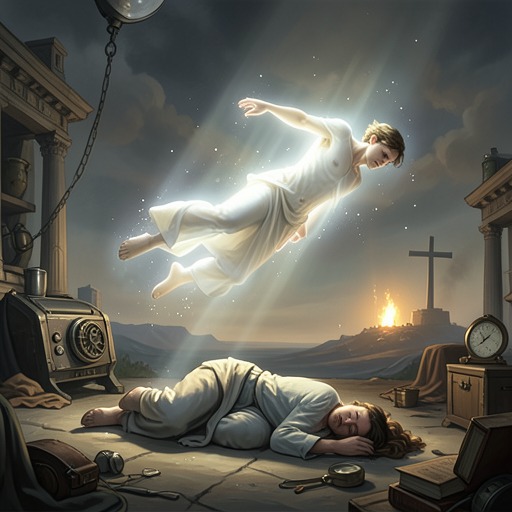
Death cannot retain the incarnate Son. Although he yields himself to death and allows the mortal part of him to become its due, the Father does not abandon his unspotted soul to corruption. Before the third dawning light returns, the Son rises from the grave, fresh as the light of morning. His resurrection turns the apparent defeat into victory: death is wounded by the death it inflicted, and its power over him is broken. Human death is consequently reinterpreted as a sleep-like passage for the redeemed, a gentle movement toward immortal life rather than an irrevocable descent into ruin.
Historical Revelation and Universal Reach
The Incarnation is first announced through the promise of a woman’s seed and later clarified in Michael’s revelation to Adam. Adam initially imagines the conflict with the Serpent as a direct duel, expecting a literal wound to the head or heel. Michael corrects that expectation. The Son does not defeat Satan merely through superior force or by destroying Satan’s person; he defeats the enemy’s works within Adam and Adam’s seed by fulfilling the law and enduring the penalty of death. The “bruise” is therefore moral, legal, and redemptive before it is physical.
Michael further discloses the manner of the birth. A Virgin is the Son’s mother, while the Power of the Most High is his Father. A star previously unseen announces his arrival and guides Eastern sages bearing incense, myrrh, and gold. An angel tells shepherds where he is born, and a choir of angels sings over the event. These signs join heavenly proclamation with humble earthly witnesses, presenting the Incarnation as both a cosmic intervention and a human birth.
Its scope extends beyond the descendants of Abraham. After rising, the Redeemer appears to his disciples and commissions them to teach all nations, baptizing believers as a sign of cleansing from guilt and passage into pure life. Salvation is preached not only to the sons of Abraham’s body but to the sons of Abraham’s faith wherever they live. The promise that all nations will be blessed in Abraham’s seed thus reaches its universal form through the incarnate Son.
Ascension and Final Restoration
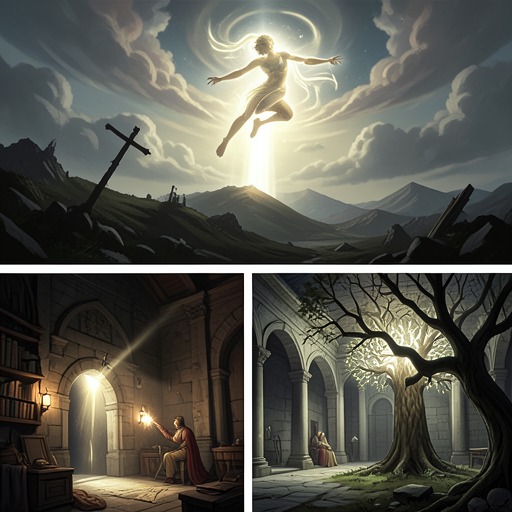
The incarnate Son remains on Earth only for a limited time after the Resurrection, long enough to appear to his disciples and entrust them with the teaching of salvation. He then ascends through the air in triumph over the enemies of God and humanity. The Serpent, described as the Prince of the air, is surprised and dragged in chains through his realm before being left confounded. The Son resumes his seat at God’s right hand, exalted above every name in Heaven.
The Incarnation also governs the poem’s final horizon. When the world’s dissolution is ripe, the Son will return in glory and power to judge the living and the dead. The faithful will be received into bliss, while the unfaithful will face judgment. After the world burns, a new Heaven and Earth will rise from its ashes, and the Earth will become a Paradise happier than Eden. Incarnation thus links the first loss of human life to the final renewal of creation: the Son enters the damaged world, defeats Sin and Death, ascends in victory, and returns as judge and universal king.
Its deepest significance lies in the reversal of the Fall’s economy. Hellish hate destroys easily, but heavenly love gives itself to redeem what hate has ruined. Adam’s forbidden reach toward knowledge cannot restore him; the Son’s willing descent into flesh restores those who accept grace. The same history that begins with disobedience, guilt, and death is redirected toward obedience, reconciliation, resurrection, and joy. In the Incarnation, divine justice and mercy are not competing endings but successive movements of one redemptive design.