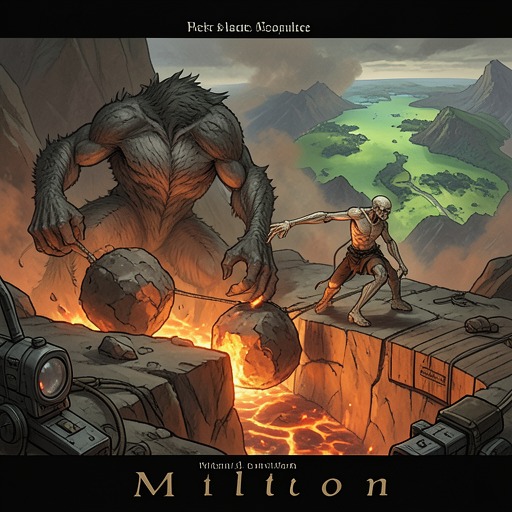
Key of Hell
Paradise LostThe Key of Hell is the unique instrument by which Sin opens the adamantine gates of Hell, releasing the passage through which Satan can leave the infernal prison and seek the newly created world. Its decisive significance lies in the way a small, delegated object transforms an apparently absolute boundary: the gates are shut by divine command, yet the key makes their opening possible and allows the consequences of rebellion to move outward from Hell into Chaos and beyond.
Custody and Divine Authority
Sin possesses the key as an office imposed upon her by Heaven’s command. After the War in Heaven and the fall of the Rebel Angels, she is cast down into the profound gloom of Tartarus and confined there as the keeper of Hell’s gates. The key is therefore not originally a private possession or a freely chosen weapon. It is placed in Sin’s hand with the charge of keeping the gates forever shut, and she remains bound to an authority she resents while exercising the authority that authority has granted her.
This contradiction defines the object’s power. Sin describes herself as an inhabitant born for Heaven but condemned to a hateful office in Hell, surrounded by the offspring that feed upon her. She asks whom she should obey—Heaven’s King, who has thrust her down, or Satan, whom she recognizes as her father. Her decision to give the key to Satan is thus both a personal act of allegiance and a reversal of the function assigned to her. The instrument remains empowered by divine command even as it is used against the purpose of that command.
The Opening of the Gates
When Sin agrees to release Satan, she takes the fatal key from her side and rolls it toward the gate, followed by her bestial train. The scene presents the object as indispensable: the huge portcullis could not be moved by all the Stygian powers, but Sin alone can operate it. She turns the key in an intricate lock, and the wards, bolts, and bars of massive iron and solid rock come undone with ease.
The key’s action is described through a sudden change in the material world. The infernal doors fly open with an impetuous recoil and a harsh thunder that shakes the lowest bottom of Erebus. The object does not merely signify permission; it performs the release. Through its mechanism, stone and iron lose their resistance, and a barrier that seemed permanent becomes an open route. The gates are so wide that a bannered host with horses and chariots could march through them, while smoke, red flame, and furnace-like heat pour outward.
Sin can open the gates, but she cannot shut them again. This asymmetry makes the key more than a neutral device. It creates an irreversible breach in the structure of confinement. Once the lock yields, the object has accomplished its immediate purpose, while Sin lacks the power to restore the previous enclosure. The key therefore converts a controlled threshold into an uncontrolled opening.
Passage into Chaos
Beyond the opened gates lies not a bounded road but the dark, immeasurable ocean of Chaos. Length, breadth, height, time, and place are lost there; Night and Chaos hold an eternal anarchy in which hot, cold, moist, and dry contend for mastery. The key consequently connects two radically different spaces: the penal architecture of Hell and the formless abyss that precedes the ordering of created worlds.
For Satan, the opening changes the value of his situation from confinement to possibility. He has promised Sin and Death access to the new world, where they may feed upon living creatures, and the key makes the first stage of that promise physically attainable. Yet freedom does not bring stability. After crossing the threshold, Satan must confront a void filled with tumultuous forces, and the journey begins with uncertainty rather than triumph.
At the brink of Hell, Satan pauses before attempting the passage, measuring the immense expanse before him. He spreads his sail-like wings and rises through surging smoke, only to encounter a vast vacancy and fall ten thousand fathoms when the support beneath him fails. A fiery, nitrous cloud later drives him upward again. The key has opened the way, but it cannot govern what lies beyond the way; the instrument of escape leads directly into a realm where movement is exposed to Chaos, chance, and unstable matter.
Object, Threshold, and Consequence
The Key of Hell concentrates the poem’s tension between command and disobedience. It is an object of delegated power used in a rebellious transaction. Sin’s custody demonstrates that Hell is not outside the reach of Heaven’s sovereignty, while her decision to unlock the gates shows how authority can be redirected through those required to administer it. The instrument thus makes the political structure of the infernal world visible: even rebellion depends upon powers and offices inherited from the order it opposes.
Its physical function also gives material form to the spread of evil. Before the key is turned, Satan’s designs remain enclosed within Hell and must be carried through a guarded boundary. Afterward, the gates stand open, Chaos is exposed, and Satan has a route toward the world intended to be inhabited by the new race of creatures. The key is therefore the hinge between a local catastrophe and a wider one. It does not itself choose the destination or carry Satan across the abyss, but without its intervention the voyage could not begin.
The object’s final significance lies in this combination of precision and disproportion. It is small enough to be carried at Sin’s side, yet its turning releases a gate vast enough for armies and opens upon an abyss without dimension. A single mechanical action produces consequences that exceed the scale of the instrument: imprisonment becomes access, Hell becomes a departure point, and Satan’s private rebellion acquires a path toward the larger history of creation and its threatened inhabitants.