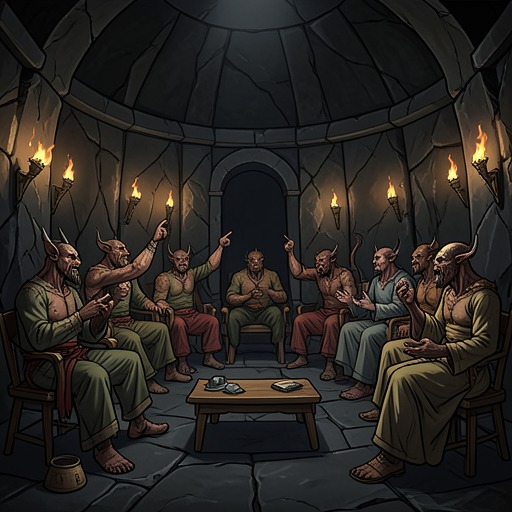
Mammon
Paradise LostMammon is a fallen spirit defined by a gaze fixed downward: even in Heaven he admired the gold beneath the feet of the Heavenly Host more than anything divine or holy. In Hell, that material fixation becomes both practical talent and political doctrine. He leads the excavation of a fire-belching hill, turns its ore into a magnificent palace, and argues that the defeated angels should prefer hard liberty in Hell to splendid servitude in Heaven. His significance lies in this conversion of rebellion from a lost military cause into an economic and architectural project of self-sufficiency.
Identity and Material Imagination
Mammon is introduced as the least erect of the spirits who fell from Heaven, a physical description that expresses a moral orientation: his looks and thoughts were always bent toward the ground. He valued the pavement of Heaven as trodden gold and placed its riches above the divine vision available to celestial spirits. The association is not merely personal. The poem connects Mammon’s suggestion with the later human practice of ransacking the center of the Earth and rifling its depths for concealed treasure, making him an ancestral figure for acquisitive mining and the desire to turn creation into property.
His imagination therefore operates through substance, extraction, and manufacture rather than worship or contemplation. Where other fallen spirits continue to measure themselves against celestial power, Mammon sees the resources immediately available in their new environment. Hell’s darkness and fire do not appear to him as only punishments; they are conditions that can be adapted, organized, and put to use. His characteristic downwardness becomes a method for finding value in a place the rebels initially experience as ruin.
The Builder of Pandemonium
After the rebel host resolves to continue resistance, Mammon leads a numerous brigade toward a hill whose summit belches fire and rolling smoke, while its surface glitters with mineral crust that signals hidden metallic ore. The labor is presented on an immense scale, resembling pioneers with spades and pickaxes moving before a royal army to trench a field or cast a rampart. Mammon is not a passive counselor: he directs the practical transformation of Hell and makes collective labor the first instrument of the new infernal order.
His workers open a spacious wound in the hill and dig out ribs of gold. Other companies sluice liquid fire from the Lake of Fire through underground veins, found the massive ore, separate its kinds, skim away the dross, and pour the refined metal into elaborate molds. The process is coordinated through successive divisions of labor, with molten material conveyed through the subterranean cells as an organ distributes sound from one breath across many pipes. The result is a huge fabric rising from the earth like an exhalation, its music and voices accompanying the emergence of a temple-like structure.
The building’s magnificence surpasses the monuments associated with Babel, the Memphian kings, Babylon, and Alcairo. Its pilasters, Doric pillars, golden architraves, cornice, frieze, sculpted surfaces, and fretted roof turn extracted wealth into public display. Within, the level pavement opens beneath an arched roof hung with rows of starry lamps and blazing lights fed by naphtha and asphaltus. Mammon’s materialism thus acquires an institutional form: the resources of Hell become architecture, ceremony, illumination, and the capital of a political community.
Counsel for Independence
In the infernal debate, Mammon rejects both possible returns to Heaven. To overthrow the King of Heaven seems impossible unless everlasting Fate yields to chance and Chaos judges the conflict; to regain their former place by submission would be equally intolerable. If Heaven offered grace on the condition of renewed subjection, the rebels would have to stand humbly before their sovereign, obey strict laws, sing forced hymns, and perform servile offerings before an authority they hate. Mammon treats this imagined restoration as splendid vassalage rather than salvation.
His alternative is to seek their own good from themselves and live for themselves, free and accountable to none within Hell’s vast recess. He prefers hard liberty to an easy yoke of servile pomp. The argument changes the meaning of the rebels’ defeat. Since they cannot recover Heaven by force and refuse to recover it by submission, they can make their greatness conspicuous by producing useful things from harmful ones, prosperity from adversity, and ease from pain through labor and endurance.
Mammon also argues that Hell need not remain merely a realm of horror. The darkness of their environment can imitate the darkness surrounding the throne of the King of Heaven, while the desert soil contains hidden gems and gold and the fallen spirits possess enough skill and art to raise magnificence. Even their torments, he suggests, may become elements: the piercing fires could eventually feel soft once the spirits’ temper changes to match their surroundings. His program is therefore not peace in a reconciliatory sense. It is adaptation, organization, and the construction of an autonomous infernal society whose prosperity would stand in emulation of Heaven.
Political Consequences and Relationships
Mammon’s speech receives strong applause from the assembly. The fallen angels fear another battlefield more than Hell itself, still remembering the thunder and the Sword of Michael, and they desire an empire that can rise through policy and the long process of time. Mammon gives language to both motives: avoidance of renewed military catastrophe and pride in building a rival power. His counsel helps turn the assembly away from immediate open war and toward the consolidation of Hell as an empire.
That proposal is then challenged by Beelzebub, who recognizes the popularity of continuing in Hell and constructing a growing empire but exposes the limitation beneath it. The King of Heaven has not abandoned jurisdiction over Hell; the rebels remain prisoners under an inevitable curb, and the divine empire extends there with an iron scepter just as it rules Heaven with a golden one. Mammon’s independence is therefore politically potent but metaphysically incomplete. He can organize labor and create splendor, yet he cannot make the rebels truly free from the power they oppose.
Mammon’s connection with Satan is consequently one of alignment rather than equality. Satan’s larger project seeks a means of damaging Heaven through fraud or guile after force has failed, whereas Mammon supplies the internal program by which the fallen host can survive and flourish in Hell. The palace he helps create becomes the capital of Satan and his peers, and the summons to a solemn council at Pandemonium follows the completion of this monumental civic space. Mammon’s labor makes infernal politics possible even though it does not determine the final strategy.
Thematic Significance and Limits
Mammon embodies the poem’s association between rebellion and a distorted economy of value. He looks upon gold where celestial vision should dominate, treats liberty as preferable to obedience even when liberty means confinement in Hell, and imagines pain as something that labor can convert into endurance and eventual comfort. His reasoning is practical, coherent, and rhetorically persuasive, but it is also marked by reduction: spiritual freedom becomes non-accountability, magnificence becomes material production, and adaptation becomes a substitute for release.
His role also illuminates the poem’s larger contrast between self-generated wealth and divine grace. Mammon’s counsel insists that the fallen spirits must create their own good from their own resources. By contrast, the later account of redemption describes human salvation through the willing life-for-life offering of the Son of God, whose obedience, death, and resurrection satisfy the penalty that humanity cannot pay for itself. Mammon’s infernal economy depends on extraction, manufacture, and endurance; the redemptive economy depends on an unearned sacrifice that restores those who receive its benefit by faith. The contrast makes Mammon’s program more than a political speech: it is a counter-model of value, one that seeks to overcome loss by production rather than by grace.
Mammon does not receive a personal conversion or a separate final punishment in the supplied narrative. His lasting outcome is collective and architectural. He remains identified with the infernal empire whose foundations he helps establish, a realm that can display extraordinary art and wealth while remaining under divine sovereignty. His gold therefore carries a double meaning: it proves the fallen spirits’ capacity to organize, build, and imitate heavenly magnificence, yet it also reveals the limits of a rebellion that can transform its prison without escaping it.