Michael
Paradise LostMichael occupies a decisive place in Paradise Lost as Heaven’s principal warrior and the appointed mediator of revealed history. He first appears as the commander who leads the faithful Heavenly Host against Satan and the Rebel Angels; later, by divine commission, he becomes the guardian of Eden and Adam’s teacher. His authority is therefore both martial and interpretive. He does not merely defeat rebellion by force: he explains its consequences, places human suffering within Divine Providence, and directs Adam toward patience, faith, and hope beyond the Fall.
Identity and Authority
Michael is identified as the Prince of the Celestial Armies and as second in military prowess to Gabriel. When the war in Heaven reaches its crisis, the voice of God commands Michael and Gabriel to lead the armed Saints against the rebellious host. Michael’s office derives from service to God and from his role within the ordered hierarchy of Heaven, not from private ambition. His command represents legitimate sovereignty in contrast with Satan’s claim that equality and freedom invalidate obedience to the Son of God.
That political and theological contrast is central to Michael’s characterization. Satan treats hierarchy as an insult and rule as an imposed yoke; Michael’s side understands the Son’s kingship as the expression of divine order. In this framework, freedom is not separation from rightful authority but a condition sustained by reason, obedience, and union with the source of being. Michael’s later instruction to Adam develops the same principle in human terms: when reason is obscured and disordered passions rule within a person, inward freedom is already weakened, making outward tyranny possible. His character thus links the battlefield of Heaven with the political and moral history of Earth.
Commander in the War in Heaven
Michael leads the faithful armies after God declares that the Son of God shall reign and that the Rebel Angels must be driven from Heaven. Under Michael and Gabriel, the forces of Heaven advance in immense, disciplined formations. The conflict is not a small duel but a cosmic war in which millions of angels fight with powers capable of disturbing the structure of Heaven itself. Every warrior acts with the confidence of a commander, and the battle moves between ground combat and combat in the air, remaining for a long time in an even balance.
Michael’s individual prowess becomes visible in the clash with Satan. His Sword of Michael cuts down entire squadrons, and Satan recognizes the danger of the archangel’s attack. When Satan raises his vast shield of adamant, Michael pauses and addresses him as the author of evil, condemning the rebellion for disturbing Heaven’s peace and introducing misery into nature. The exchange makes Michael more than a weapon of divine violence. He articulates the moral meaning of the war: rebellion has transformed a previously blessed order by making suffering and violence part of created experience.
The battle escalates when the Rebel Angels abandon ordinary weapons and tear up the hills of Heaven, hurling mountains against one another and burying whole legions beneath them. The disorder threatens to ruin Heaven, but God has permitted the struggle within limits and reserves its conclusion for the Son of God. Michael’s campaign therefore establishes the limits of angelic force. Even immense military power cannot finally settle the conflict without a higher act of judgment. The Son then takes responsibility for the final punishment, while Michael’s army is ordered to stand and witness.
Michael’s role in the combat is consequently both active and subordinate. He leads, strikes, and organizes, but he does not claim the final sovereignty that belongs to the Son of God. Once the Son enters the field, Michael gathers the faithful army beneath the Messiah’s sign. The uprooted hills return to their places at the Son’s command, and the order of Heaven is restored. Michael’s authority is confirmed not by independent mastery but by his readiness to serve the greater decree.
The Expulsion of Satan and the Rebel Angels
The decisive defeat belongs to the Son of God, who drives the Rebel Angels toward the crystal wall of Heaven. The wall opens into the Deep, and the rebels fall headlong through Chaos for nine days before Hell receives them and closes over them. Michael’s military leadership has prepared the way for this expulsion, and he stands within the larger structure of divine judgment that turns rebellion into punishment.
The result is more than the removal of an enemy army. The expulsion separates Heaven from violence and establishes Hell as the habitation of the fallen. It also demonstrates the political theology Michael later teaches Adam: sovereignty is legitimate when it fulfills the order of creation, while domination born from pride becomes tyranny and self-destruction. Satan’s boast that he can turn Heaven into Hell is answered by the fact that his rebellion carries Hell within its own logic. Michael’s victory is therefore inseparable from the restoration of rightful boundaries.
Guardian of Eden and Guide to Adam
After the Fall, God commands Michael to take selected Cherubim and drive Adam and Eve from Paradise. The order is severe but not without mercy. God sees the pair softened by tears and instructs Michael to conceal the full terror of the sentence, reveal what will come in future days, and send them from Eden sorrowing yet in peace. Michael is thus both executioner and compassionate guide. He enforces banishment while ensuring that punishment does not become despair.
Michael explains that God’s presence is not confined to Paradise. Adam has lost the preeminence of dwelling in Eden as the central seat from which generations might have gathered, but the whole Earth remains under divine care. In valley and plain, as in Eden, signs of God’s presence will continue to surround humanity. This teaching transforms exile from the loss of all sacred relation into a change of sacred geography: the former garden is closed, yet divine providence is not absent from the world beyond it.
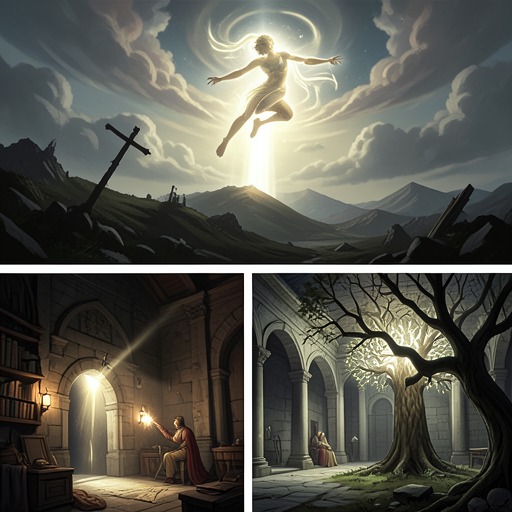
Michael’s treatment of Adam also reveals his pedagogical method. He directs Adam to climb the highest hill of Paradise while Eve sleeps below, and then opens before him a succession of visions. He first gives Adam’s sight a greater capacity, using Euphrasie, Rue, and three drops from the Well of Life before restoring his attention. The images that follow are not detached spectacles. They are arranged as a moral education, moving from the immediate consequences of original crime through violence, disease, tyranny, covenant, law, and redemption.
Revealer of Human History
Michael’s first major revelation concerns Cain and Abel. Adam sees a farmer and a shepherd bring offerings to an altar. Heaven accepts the shepherd’s sincere sacrifice, while the farmer’s offering is rejected; enraged by envy, Cain strikes Abel with a stone and kills him. Michael identifies the two men as brothers descended from Adam and explains that the unjust has slain the just. The scene makes death historically visible to Adam and shows how sin passes into later generations even among those who did not personally eat the forbidden fruit.
Michael then broadens the lesson by displaying the many forms of death and disease. Violent blows are only one avenue to mortality; fire, flood, famine, intemperance, and bodily maladies also arise within the fallen condition. His explanation connects human suffering to the consequences of disobedience without reducing every particular death to a simple personal offense. Adam is made to understand mortality as a pervasive condition of postlapsarian existence, one that affects bodies, families, and the whole history of human society.
When Adam sees the rise of an ambitious ruler who refuses fraternal equality and claims dominion over other men, Michael interprets the event as the political extension of the Fall. The tyrant wages war against those who resist subjection and builds a city and tower in an attempt to secure his name and challenge Heaven. God confounds the builders’ language, and the unfinished work becomes Babel. Michael explains that true liberty is joined to right reason; once reason is darkened and passions govern within, human beings become vulnerable to external lords. Tyranny remains unjust, but the tyrant’s power is connected to humanity’s prior inward enslavement.
The same historical teaching moves from Babel toward covenant. Michael foretells that God will select a nation from one faithful man, Abraham, who will leave Ur of Chaldaea and its idols without knowing the land to which he is going. From Abraham’s seed will arise a mighty nation, and through that seed all nations will be blessed. Michael’s narration gives human history a structure in which judgment and mercy continually contend. The record is not a simple progress from sin to perfection: rebellion, captivity, restoration, faction, and renewed corruption recur, yet divine covenant remains active.
Michael describes the Exodus, the passage through the divided sea, and the journey toward Canaan. Moses leads the chosen people, while an angel guides them through cloud and pillar of fire. At Mount Sinai, God gives laws governing civil justice and religious rites, and the people receive the Tabernacle, the Ark containing the testimony of the covenant, the golden mercy-seat between Cherubim, and lamps representing heavenly fires. These institutions make divine presence visible among mortal people while also demonstrating the need for mediation: the people fear the direct voice of God and ask Moses to report the divine will.
Theology of Redemption and Final Significance
Michael’s most important revelation concerns the Son of God’s future incarnation and redemptive work. The Son will be born from a virgin mother, unite Godhead with humanity, fulfill the law through obedience and love, and endure a reproachful life and cursed death. He will be seized, judged, and nailed to the Cross by his own nation, yet his death will defeat Sin and Death rather than merely destroy Satan as a person. The Son will rise before the third dawn, and his obedience will be counted for believers through faith, while faith remains inseparable from faithful works.
This prophecy changes the meaning of Adam’s banishment. Michael does not cancel the sentence of mortality, but he places it within a larger sequence of trial, purification, and renewed life. Death becomes a final remedy for the fallen condition rather than an unqualified triumph of evil; after a life tested by suffering and refined by faith, the just may awaken to a second life in a renewed Heaven and Earth. Michael therefore guards the boundary of Paradise while revealing a future in which restoration exceeds the lost state of innocence.
As a character, Michael combines the archetypes of warrior, threshold guardian, judge, and mentor. His thresholds are literal and conceptual: he helps drive Satan from Heaven, guards the way to the Tree of Life, and leads Adam from the closed world of Eden into historical time. Yet his most enduring victory is interpretive. By giving Adam a vision of violence, tyranny, law, covenant, and redemption, Michael turns catastrophe into knowledge disciplined by hope. His final lesson is not that suffering can be avoided, but that humanity may endure it with patience, faith, and an understanding of the divine purpose moving through history.