Moloch
Paradise LostMoloch is one of the principal rebel angels in Paradise Lost, defined by martial ferocity, contempt for fear, and an uncompromising appetite for open conflict. Once a powerful spirit who fought in Heaven, he becomes both a leader within Satan’s infernal council and, later, a false god remembered among human nations for blood sacrifice. His career joins celestial rebellion, political violence, idolatrous worship, and the destructive logic of revenge.
Identity and Reputation
Moloch first appears among the innumerable fallen angels assembled in Hell after their defeat. The rebel host gathers at the command of Satan, whose uplifted spear directs the multitudes to the brimstone plain. Among the leaders are beings who once held thrones in Heaven but whose names have been erased from the heavenly records because of their rebellion. Moloch belongs to this dispossessed aristocracy of spirits, retaining the grandeur of a former celestial power while existing in a realm of punishment.
His defining quality is strength. He is presented as the strongest and fiercest spirit who fought in Heaven, and despair has made him fiercer still. His courage is not grounded in hope, prudence, or confidence in eventual victory. Instead, he has lost fear itself: he does not care whether he faces God, Hell, or a fate worse than Hell. That indifference makes him a particularly dangerous figure in the infernal hierarchy, because pain and annihilation no longer function as effective restraints upon his will.
Moloch also has a second identity in human history. Before the rebel angels acquire the various names by which later peoples worship them, they are described as wandering through Earth and corrupting humanity through false religions and images of beasts. Moloch becomes the horrid king associated with human sacrifice, blood, and the tears of parents whose children are passed through fire before his idol. The drums and timbrels that accompany his rites are imagined as drowning out the children’s cries. He is worshiped by the Ammonites in Rabbah and its surrounding regions, including Argob and Bashan, extending toward the Arnon.
Voice in the Infernal Council
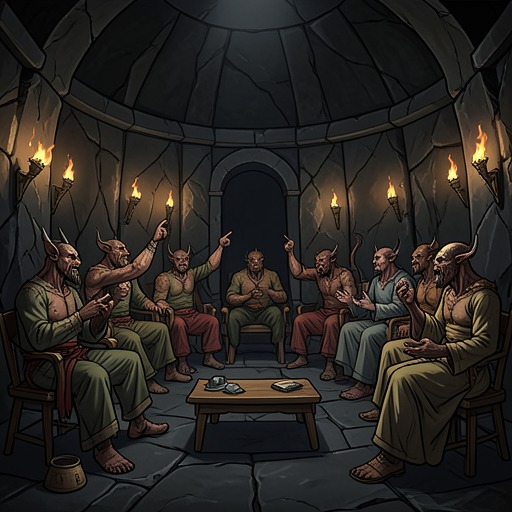
When Satan proposes that the fallen powers debate whether to attack Heaven openly or employ covert guile, Moloch is the first major counselor to speak. His position is immediate war. He admits no special skill in schemes and rejects delay while millions of armed spirits wait for a signal in Hell. To him, remaining in the infernal prison means accepting the victory and tyranny of the power who rules it; action, even desperate action, is preferable to passive endurance.
Moloch’s proposal converts the rebels’ instruments of punishment into weapons. He imagines the armies of Hell arming themselves with flame and fury, transforming their tortures into means of assault against the heavenly towers. He would answer divine thunder with infernal thunder, oppose lightning with black fire and horror, and mingle Heaven’s throne with the very sulphur and strange fire devised for the rebels’ torment. His rhetoric is therefore built on reversal: punishment becomes weapon, defeat becomes motive, and the machinery of suffering becomes an instrument of revenge.
He recognizes that the ascent toward Heaven may be difficult, but he argues that descent was the unnatural movement. The rebels had been forced downward through the Deep by their victorious enemy; returning to their native height should therefore be easier than the fall. His confidence is less a prediction of triumph than a challenge to despair. Even if Heaven cannot be conquered, repeated incursions could disturb its throne. In this reduced form, revenge becomes a substitute for victory: if conquest is impossible, perpetual alarm may still count as success.
The extremity of his argument appears in his treatment of annihilation. Moloch asks what could be worse than dwelling in Hell, condemned to endless pain and subjected to inexhaustible fire. If God’s wrath destroys the rebels completely, he reasons, nonexistence would be preferable to eternal misery; if their spiritual substance cannot cease to be, then their power remains sufficient to trouble Heaven through perpetual attacks. He ends with a look that openly announces desperate revenge and a battle dangerous to any opponent short of a god. His speech gives the council its most direct expression of militant nihilism: destruction is acceptable, provided it can be converted into retaliation.
Conflict with Satan and Other Counselors
Moloch’s advocacy of open war establishes one pole of the infernal debate. Satan’s larger strategy remains more flexible, and the council hears opposing recommendations from figures such as Belial, whose polished speech makes caution appear rational. Belial warns that Heaven is guarded, that force could fail, and that a repulsed assault might provoke the Almighty to destroy the rebels altogether. Against such hesitation, Moloch represents impatience, bodily force, and the refusal to preserve a life already judged intolerable.
His argument also illuminates the political structure of the rebel host. Satan’s authority is described as having been restored after the fall, with the fallen powers consenting to his leadership. Moloch’s position is not a private complaint but a policy for the entire army: the millions who stand armed and await direction should rise together rather than remain fugitives in Hell. He treats delay as another form of servitude and imagines collective violence as the recovery of a lost inheritance.
The broader rebellion, however, is challenged by Abdiel, who defends the decree that the Son of God should reign and receive the knee of every heavenly spirit. Abdiel argues that divine monarchy does not destroy angelic liberty because the Son of God is their rightful head and the source through whom they were created. Moloch is not the direct speaker in this exchange, but his militant program belongs to the same ideology of resistance that rejects obedience to divinely established hierarchy. His politics therefore contrast with the poem’s distinction between legitimate rule derived from God and rebellious power that mistakes equality or strength for a right to sovereignty.
Battle and Defeat
Moloch’s commitment to battle is later embodied in the war between the loyal angels and the rebel host. When the fighting reaches its decisive phase, Gabriel confronts Moloch, who has challenged him and threatened to drag him bound at his chariot wheels. Moloch’s blasphemy extends even against the Holy One of Heaven, making the encounter a personal expression of the larger conflict between obedient celestial power and insurgent pride.
Gabriel defeats him with overwhelming violence. Moloch is cleft down to the waist, his arms shattered, and he flees bellowing in grotesque pain. The defeat reverses the image of the invincible warrior that had supported his counsel in Hell. The spirit who urged the rebels to turn torture into weapons now becomes a wounded body retreating from the field. His rout occurs amid the collapse of the Satanic forces, whose armor, chariots, charioteers, and fiery horses lie overturned as the rebel army gives way.
The battle also exposes the limits of Moloch’s theory of force. He had claimed that the rebels possessed enough power to disturb Heaven and had treated fear as weakness; yet the fallen angels, newly vulnerable to pain and flight because of disobedience, are eventually driven into ignominious retreat. The loyal angels, protected by innocence, remain firm and invulnerable. Moloch’s strength is real, but separated from truth and justice it cannot secure victory or lasting honor.
Thematic Significance and Legacy
Moloch embodies the most explicit form of warlike rebellion in the poem. His preferred answer to political and theological conflict is immediate force, and his logic proceeds from a stark alternative: either strike at Heaven or accept eternal degradation. Because he regards annihilation as potentially preferable to submission, he represents a will that has made revenge more valuable than survival. His speech is therefore not merely military advice; it is a theory of action formed by despair.
His human afterlife extends that theory into religious practice. As the recipient of child sacrifice, Moloch turns domination into ritual and makes parental grief part of his public cult. The later account of Israel repeatedly forsaking the living God for bestial gods links such worship to political and military humiliation: those who bow before false powers are themselves bowed down in battle before contemptible enemies. Moloch’s idolatry thus reproduces the same structure as his celestial rebellion, replacing rightful worship with coercive spectacle and converting submission into a technology of power.
Moloch also stands in contrast with the poem’s account of redemption. The Son of God offers life for life, accepts mortal suffering, and dies to satisfy the penalty owed by humanity; Moloch’s sacrificial order instead consumes the vulnerable without restoring them. The difference is between self-offering for the rescue of others and the destruction of others to sustain an idol. In that contrast, Moloch becomes a dark inversion of sacrificial love: sacrifice remains central, but its direction, purpose, and moral meaning are reversed.
The poem’s later history preserves Moloch as an emblem of violence that claims sacred authority. Human rulers and communities may invoke sovereignty, war, or religious magnificence, but the narrative repeatedly distinguishes dominion granted by God from domination arrogated by force. Moloch’s career—from celestial champion, to infernal advocate of open war, to defeated combatant, to bloodstained false deity—traces the degradation of power when strength breaks from obedience, justice, and the good.