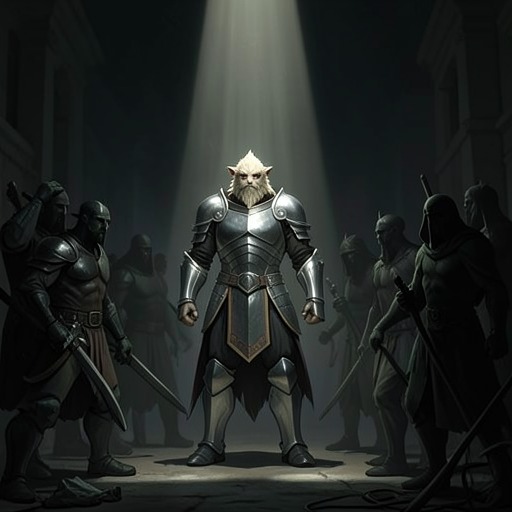
Mount of Congregation
Paradise LostMount of Congregation is the elevated meeting place in Heaven where Satan assembles the Rebel Angels and attempts to convert a sacred site of divine order into a stage for political revolt. Its decisive significance lies in this inversion: a mountain associated with the Son of God's public recognition becomes the setting from which Satan argues against the very authority that gave the place its meaning.
Setting and Appearance
Mount of Congregation stands in the northern region of Heaven, reached by Satan and his innumerable host after they cross the realms of the Seraphim, Potentates, and Thrones. Satan's royal seat rises high on the mountain, blazing like a mount raised upon another mount. Its palace is constructed from diamond quarries and rocks of gold, with pyramids and towers that make the summit an architectural emblem of concentrated power. The location is therefore more than a natural height: it is a monumental court, a visible center toward which the rebellious host can be summoned and from which a rival sovereignty can be proclaimed.
The mountain's grandeur also carries an explicitly imitative force. Satan has shaped his seat in imitation of the mountain where the Son of God was declared before Heaven, and the narrative identifies that sacred precedent as the Mount of Congregation. The resemblance makes the rebel structure a counterfeit of divine ceremony. Its splendor borrows the visual language of Heaven while redirecting that language toward Satan's claim to equality with God.
Satan's Assembly and Political Use
Satan gathers his followers at Mount of Congregation while pretending that they have been commanded to consult about the reception of their king. The proposed gathering appears to concern ceremony, honors, and public acknowledgment, but Satan uses the occasion to prepare resistance. He addresses the Thrones, Dominations, Princedoms, Virtues, and Powers, asking whether their titles have become merely titular now that another has absorbed universal authority under the name of an anointed King.
His argument turns the mountain into a forum for ideological persuasion. He presents the required knee-tribute and prostration to the Son of God as an intolerable yoke, and he recasts equality among angels as a justification for refusing monarchy. Orders and degrees, he argues, can coexist with liberty, but no being who regards himself as the equal of another should accept an absolute ruler. The height of Mount of Congregation thus supports a rhetoric of elevation: Satan speaks as though physical eminence confirmed the political independence of those gathered around him.
The setting also enables a theatrical substitution of identities. Satan's palace is called the palace of Lucifer in the dialect of men, while the mountain itself recalls the sacred site of the Son's declaration. This doubling allows Satan to present himself as a king already entitled to loyalty, even though his kingship is produced by imitation, accusation, and assembly rather than by divine appointment. The mountain becomes the spatial form of that counterfeit authority.
Sacred Precedent and Reversal
The power of Mount of Congregation depends on the contrast between legitimate and illegitimate elevation. In Heaven, the Son of God receives the regal scepter by the decree of God, and Abdiel insists that every soul in Heaven must acknowledge him as rightful King. The Son's headship, in that account, does not diminish the glory of the angelic orders; it unites and increases their dignity because their honor is understood to return to the divine source.
Satan reverses this logic at the mountain. He treats the Son's elevation as an act of unjust appropriation and describes obedience as servility. Abdiel answers that service is not degrading when directed toward one whom God and nature ordain as worthiest; genuine bondage consists in serving the unwise or in being enthralled to oneself. Mount of Congregation therefore becomes the physical site where two definitions of freedom confront one another: Satan's freedom is independence from superior rule, while Abdiel's freedom is rational obedience to rightful order.
The reversal is especially pointed because Satan's argument is delivered at a place whose very name and associations testify against it. The mountain recalls public recognition of the Son, but Satan uses it to question the Son's right to reign. Its architecture displays abundance and magnificence, yet its political meaning is founded on resentment of another's authority. The site exposes the instability of rebellion that borrows the symbols of the order it rejects.
Relation to the Wider Cosmic Geography
Mount of Congregation belongs to a larger geography in which elevation, proximity, and access express political and theological rank. Satan's host travels across the ordered regions of Heaven before reaching the northern limits, and the mountain offers a conspicuous center from which the rebel powers can be addressed. By contrast, Satan's later movement carries him away from the celestial seat through Chaos toward the newly created world. The movement from mountain to abyss and then toward Earth marks the collapse of a rival heavenly court into an outward journey of revenge.
The mountain also stands against the locations associated with punishment and exile. In Hell, Satan sits on a throne and convenes the Infernal Council, but that throne is already an adaptation of the royal form displayed at Mount of Congregation. The site in Heaven supplies the imagery of centralized rule that rebellion later reproduces in Hell. When Satan finally crosses Chaos, the passage becomes easier after the Fall of Man, as Sin and Death pave a bridge from Hell toward the world; the mountain's fixed height is thereby replaced by a network of illicit movement between realms.
Its significance reaches forward into human history as well. The later visions shown to Adam include the construction of a tower intended to reach Heaven and to establish human fame, while Adam condemns the builder's attempt to usurp authority over other human beings and to besiege Heaven. The tower's upward ambition echoes the mountain's architecture, but the comparison reveals a recurring pattern: height can signify divine revelation and legitimate rule, or it can become the instrument of self-exalting domination.
Narrative Significance
Mount of Congregation condenses the poem's concern with sovereignty, imitation, and the difference between liberty and self-enslavement. It is a sacred height occupied by a rebel court, a place of consultation that conceals mobilization, and a monument whose splendor cannot grant the authority it imitates. Satan's use of the mountain demonstrates how political language and ceremonial space can be appropriated to make rebellion appear like the defense of ancient freedom.
At the same time, the mountain's dramatic force comes from the fact that the rebellion does not remain confined to rhetoric. Satan's challenge is answered by Abdiel, who stands alone against the assembled opposition and declares that the rebel leader is enthralled to himself. The subsequent conflict confirms the limits of the mountain's counterfeit sovereignty. Its towers and gold can gather followers and magnify a claim, but they cannot alter the divine order that the site originally commemorates. Mount of Congregation therefore remains an image of elevated defiance whose grandeur intensifies, rather than resolves, the contradiction at the heart of Satan's revolt.