Obedience and Disobedience
Paradise LostObedience and Disobedience is one of Paradise Lost’s central organizing concepts. The poem does not treat obedience as mere submission to force: it is a voluntary alignment of will and reason with a rightful order, made valuable precisely because disobedience remains possible. Against this, disobedience presents itself as liberty, equality, and self-rule, yet its consequences reveal a movement from chosen revolt to inward enthrallment, political tyranny, suffering, and death. The final wisdom offered to Adam is therefore not passive resignation but an instructed form of freedom: to obey, to love, to exercise patience and virtue, and to depend upon God’s providence.
Freedom as the Condition of Obedience
The poem’s theological foundation is that created beings are free. God explains that he made the angelic powers, including those who remained faithful and those who fell, with will and reason capable of choice. If they had been compelled by necessity, their service could not have demonstrated sincere allegiance, constant faith, or love; obedience performed without freedom would have no moral value. The decisive distinction is consequently not between action and inaction, but between willing service and behavior imposed by fate. Freedom makes praise possible, but it also makes revolt possible.
God applies the same principle to humanity. Adam was made just and right, sufficient to stand, but not immutable. His continued happiness depends upon himself, specifically upon obedience, and his will is not overruled by inextricable fate or strict necessity. The created condition is therefore precarious without being defective: perfection does not mean inability to change, and goodness must be persevered in through choice. The poem assigns responsibility to the creature without making divine foreknowledge the cause of the fault. Those who revolt author their own choices; foreknowledge does not compel what free will chooses.
This distinction also shapes the relation between obedience and love. Raphael tells Adam that the angels retain their blessed state only while their obedience holds, and that they freely serve because they freely love. Their fall demonstrates the same structure negatively: love and obedience are connected, but neither can exist as genuine virtues where the will is forced. The poem thus makes freedom the ground both of loyalty and of catastrophe.
Angelic Revolt and the Rhetoric of Liberty
Satan’s disobedience is first articulated as a political argument. After the angelic defeat, he seeks to convert loss into a new order, presenting the depths of Hell as a realm in which the defeated can live for themselves, answerable to none, and prefer hard liberty to an easy yoke. Mammon similarly rejects the prospect of returning to Heaven under renewed submission, imagining eternity spent in worship before a ruler they hate as splendid servitude. Their language turns obedience into degradation and treats independence as the highest good, even in a place of torment.
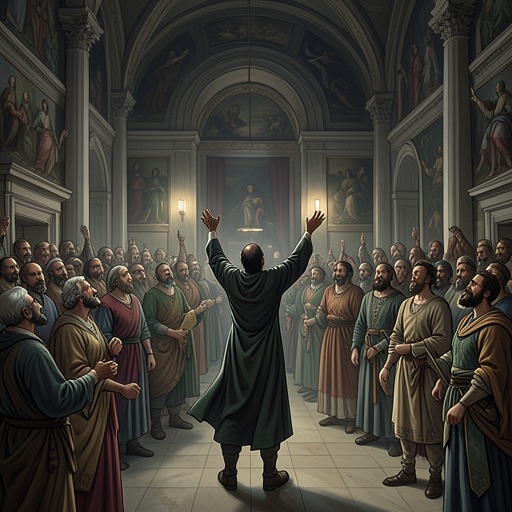
The argument is persuasive because it addresses real humiliation and fear. The fallen powers have been expelled, punished, and confined; the memory of Heaven makes their present condition intolerable. Yet the proposed liberty is already compromised by ambition. Satan sits on a throne raised by merit and uses the language of equality to seek supremacy. He gathers the rebel angels at the Mountain of Congregation by claiming that a consultation is required for the reception of the anointed King, while secretly redirecting their resentment toward the decree that appoints the Son of God. His appeal to freedom is therefore also a strategy of leadership and control.
The central contradiction becomes explicit when Abdiel answers him. Serving the one whom God appoints is not servitude when that ruler is worthier and excels those governed; genuine servitude lies in serving the unwise or the rebel, as Satan’s followers now serve Satan. Abdiel’s freedom is compatible with obedience because it is ordered by reason and acknowledged merit. Satan’s supposed independence is instead a form of bondage to himself. His phrase that he will reign in Hell exposes the substitution at work: a kingdom is accepted as the compensation for lost freedom, although its ruler remains enthralled to pride and revenge.
The revolt’s political language also carries material consequences. Satan’s challenge to the Son of God’s authority becomes armed conflict, and Abdiel’s isolated resistance is followed by the clash of millions of angels. Satan’s disobedience does not remain a private refusal; it fractures communal unity and transforms a dispute over rightful rule into war. The poem thereby distinguishes liberty from mere resistance to command: a rebellion can oppose domination in words while reproducing domination in practice.
Law, Command, and the Human Test
Human obedience is concentrated in a single command. In the Garden of Eden, God gives Adam and Eve every pleasant fruit for food, but forbids the fruit of the Tree of Knowledge of Good and Evil. The prohibition functions as the sole pledge of their obedience, and its penalty is death. Because the command is singular within an abundance of permitted pleasures, obedience is represented as a deliberate exercise of appetite and judgment rather than as deprivation under a regime of universal restriction.
The command also establishes the terms of human dominion. Adam and Eve are given authority over fish, birds, beasts, the Earth, and every creeping thing, but their rule over the created world does not authorize rule over other human beings. The distinction later becomes politically important when Adam condemns the ambitious son who attempts to dominate his brothers and to build a tower in defiance of Heaven. God grants humanity dominion over nonhuman creation, while human beings remain free from one another’s natural lordship. Disobedience thus appears both as violation of an explicit divine command and as the usurpation of authority not granted.
The human prohibition is linked to the larger structure of moral knowledge. To obey is to acknowledge a limit within a world otherwise marked by variety and plenty; to disobey is to treat desire or self-assertion as entitled to abolish that limit. The command does not erase freedom but makes freedom visible. Without a real possibility of transgression, obedience would be indistinguishable from instinct or necessity.
Disobedience as Self-Enslavement and Disorder
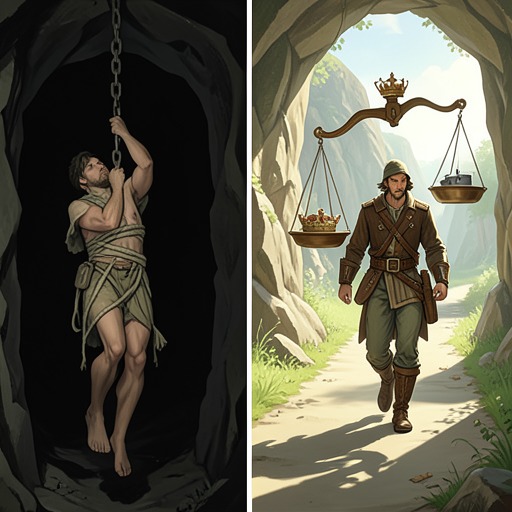
Michael’s explanation of human history gives disobedience a political and psychological consequence. After the original lapse, true liberty is lost because it always dwells with right reason. When reason is obscured or disobeyed, inordinate desires and rising passions seize government within the person and reduce someone who was free to servitude. External tyranny then follows as a judgment: those who permit unworthy powers to rule inwardly may be subjected to violent lords outwardly. Tyranny is not thereby excused, but the poem connects political bondage to the prior disorder of the will.
The story of the builder who seeks dominion over his brothers illustrates the same law on a national scale. He rejects fraternal equality, uses war and hostile snares against those who resist, and attempts to establish a second sovereignty by constructing a city and tower whose top may reach Heaven. God answers not merely with physical destruction but with linguistic division. The builders can no longer understand one another; their common project collapses into rage, noise, and confusion. Disobedience destroys the shared language and cooperation on which collective action depends.
Satan’s rebellion follows this pattern in its most concentrated form. He rejects the Son of God’s appointed headship in the name of equal freedom, but he turns that rejection into a hierarchy centered on his own power. His rhetoric therefore moves from liberation to command, from opposition to sovereignty, and from sovereignty to war. The poem repeatedly shows that disobedience does not simply remove a ruler; it creates new forms of dependence when the rebel’s will becomes the law for others.
Consequences, Mercy, and the Education of Adam
The consequences of disobedience are severe, but the poem differentiates between kinds of revolt. God declares that the angels who fell through self-temptation and self-depravity will receive no grace, whereas humanity, deceived by the earlier rebel, will find grace. Justice remains present, but mercy will shine first and last. Human disobedience is not excused; it is placed within a history in which judgment and deliverance coexist.
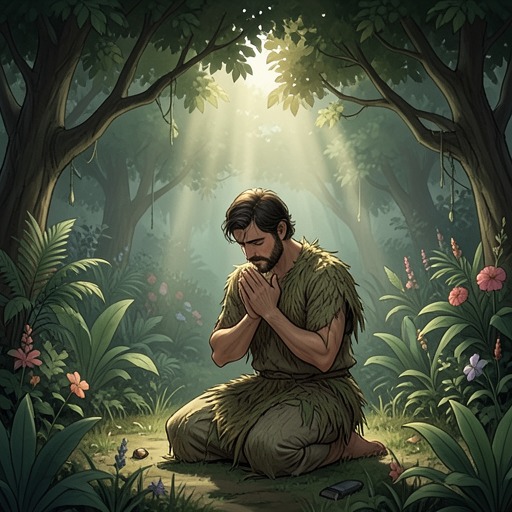
Adam’s later response shows obedience being rethought after catastrophe. When Eve proposes self-destruction or deliberate childlessness as ways to escape future suffering, Adam rejects both as further acts of defiance. He remembers the promise that her seed will bruise the Serpent’s head and understands that suicide or barrenness would allow Satan to escape his ordained punishment while increasing the human penalty. Instead, Adam chooses repentance, prayer, labor, and dependence upon divine instruction. The curse itself is interpreted through this posture: Eve’s pains in childbirth will be followed by joy, Adam’s labor will sustain him, and God has already provided clothing while judging with pity.
At the end of Raphael’s instruction, Adam recognizes obedience as the summit of wisdom. He resolves to love and fear the one God, walk as in God’s presence, observe providence, depend upon God alone, overcome evil with good, and understand suffering for truth as fortitude leading toward victory. Obedience here is not the recovery of the unfallen state by denial of experience. It is a learned discipline formed after knowledge of loss, and it joins faith with virtue, patience, temperance, and charity.
The final image is inward rather than merely geographic. Raphael tells Adam that knowledge without corresponding deeds is insufficient, and that the virtues must be added to learning so that Adam will not be unwilling to leave Paradise but will possess a happier Paradise within himself. Obedience and Disobedience therefore organize the poem’s deepest reversal: disobedience promises enlargement through self-exaltation but produces confinement and pain, while obedience appears as limitation yet becomes the condition of durable freedom, moral knowledge, grace, and hope for restoration.