Original sin
Paradise LostOriginal sin is the inherited condition created by Adam and Eve’s disobedience in Eden. It is not merely a private mistake but the decisive breach through which death enters the world, human powers become corrupted, the created order turns hostile, and the whole human race falls under judgment. Yet the condition also forms the theological problem that the poem’s larger history of grace and redemption must answer: humanity is condemned through its first ancestor, but may be restored through the obedience and sacrifice of the Son of God.
Definition and Origin
Original sin begins with the violation of the prohibition against eating from the Tree of Knowledge. The poem presents the first disobedience as the source of “Death into the World, and all our woe,” together with the loss of Eden. Adam and Eve possess dominion over the rest of creation, but one restraint remains; their fall therefore arises not from deprivation of every good, but from refusal to accept a defined limit imposed by God. The offense is an act against divine authority as such, since the desire behind it reaches toward forbidden knowledge and Godhead.
The immediate act is performed by Eve after the Serpent persuades her that the fruit will open the way to wisdom. She reasons that the prohibition itself advertises the fruit’s value and doubts that death will follow when the Serpent appears to have eaten and survived. Her judgment turns ignorance into an alleged injury and obedience into an obstacle to self-development. When she reaches out, plucks, and eats, the poem marks the act as a wound felt by Earth and Nature: the consequences extend beyond the individual eater to the whole structure of creation.
Adam’s participation differs from Eve’s. He is not deceived in the same manner; after hearing what she has done, he understands the danger but chooses to share her fate. His attachment to Eve overcomes his better knowledge, and he eats from the fruit she gives him. Original sin therefore combines deception, desire, and deliberate solidarity in disobedience. Adam’s act becomes especially consequential because he is treated as the representative root of mankind: what occurs in him is transmitted to his descendants.
The Fall’s Immediate Effects
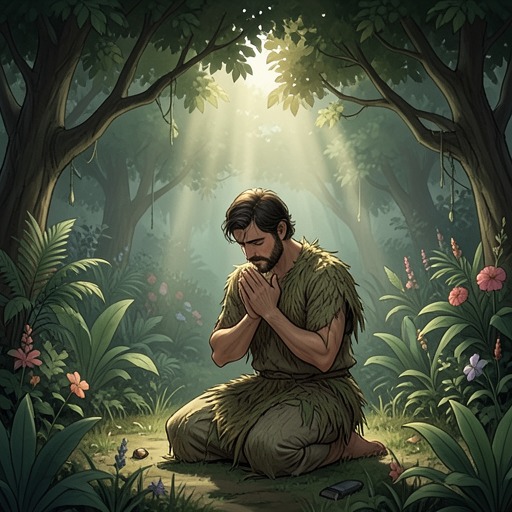
The fruit does not produce the divine wisdom Eve expects. Instead, after the initial exhilaration fades, it awakens shame, lust, and divided consciousness. Adam and Eve discover that their eyes are opened while their minds are darkened: innocence, which had shielded them from the knowledge of evil, is gone. Their new awareness is therefore not a simple enlargement of understanding but a damaged form of knowledge, marked by self-consciousness and disorder.
The change also alters their relationship. Before the fall, their union belongs to an innocent order; afterward, desire becomes charged with carnality and mutual exposure. The fruit’s first displayed operation is not godlike elevation but the ignition of lust. Their later sleep is troubled by conscious dreams, and awakening brings recognition of inward loss rather than the promised ascent above the Earth.
Original sin simultaneously disturbs the nonhuman world. Discord, described as the daughter of Sin, enters among irrational creatures. Beasts turn against beasts, birds against birds, and fish against fish; creatures cease merely grazing and begin devouring one another. Animals no longer stand in uncomplicated relation to Man, fleeing him or looking upon him with hostility. The disorder in nature makes visible the moral disorder introduced by human disobedience: creation becomes a field in which antipathy and violence circulate.
Transmission and Judgment
The heavenly narration insists that Adam and Eve possess free will and are not forced into the fall. God permits Satan to tempt them with their powers intact, so that their failure remains their own act rather than the automatic execution of a divine decree. Because they knowingly disregard the command, the penalty of death follows as justice rather than arbitrary retaliation. Original sin thus has both a historical cause and a judicial status: it begins in an act of disobedience and persists as guilt under divine law.
Adam himself recognizes the hereditary consequence with increasing horror. He fears that whatever he eats, drinks, or begets will carry the propagated curse, and that future generations will curse the ancestor through whom their misery has come. His reasoning finally turns against his attempts at evasion: all corruption of mind and will proceeds from him as its source and spring. The inherited condition does not mean that later humanity merely repeats an isolated ancient action; it means that humanity descends from a damaged root and receives corruption as the condition of its existence.
The judgment scenes give the inherited condition distinct forms. The Serpent is cursed and placed in enmity with the Woman and her seed. Eve is sentenced to multiplied sorrow in conception and childbirth and to submission within marriage. Adam receives a curse upon the ground: labor, thorns, thistles, sweat, and eventual return to dust. Mortality is therefore both bodily and historical. Adam’s descendants inherit not only the fact of death but a world in which labor, reproduction, sexuality, social relations, and the natural environment are all marked by the consequences of the first transgression.
Grace, Debt, and Redemption
The poem does not treat original sin as an unsurmountable verdict. In Heaven, the problem is defined as a debt that humanity cannot pay for itself. Once Adam has broken faith with the divine supremacy, he has nothing adequate to offer as satisfaction; without another willing and capable substitute, mankind would be lost to death and Hell. The silence of the heavenly choir emphasizes the uniqueness of the required act: no ordinary heavenly being offers to assume human mortality and bear the forfeiture on humanity’s behalf.
The Son of God then offers life for life. He agrees to become Man, leave the glory nearest to the Father, endure death, and accept divine anger in humanity’s place. His sacrifice is not presented as a simple cancellation of consequence. It satisfies justice through voluntary obedience, and its effectiveness depends upon the Son’s becoming human: as all perish through Adam, restoration proceeds from a second root through the Son of God. Original sin is thus answered by an opposite structure of representation, in which inherited guilt is met by merit that may be imputed to those who renounce their own claims to righteousness and live through him.
The later prophetic account clarifies that redemption requires both obedience and death. The Son of God fulfills the Law of God by obedience and love, then suffers a reproachful life and a cursed death on the Cross. His death is described as the ransom that answers the death humanity should have died; his resurrection follows before the third dawn, preventing death from retaining permanent power. The result is not merely individual escape from punishment. The sacrifice defeats Sin and Death, the principal forces through which original sin exercises its dominion, and converts the threatened sentence into a passage toward immortal life for those who receive the benefit by faith joined to works.
Theological and Narrative Significance
Original sin supplies the poem’s central causal chain: disobedience produces corruption, corruption produces death and disorder, and the inherited condition makes redemption necessary. It also establishes the poem’s governing contrast between two kinds of freedom. Adam and Eve are free enough to obey or disobey, but after the fall their freedom is bent by sinful desire; God’s promised restoration renews their lapsed powers so that human beings may again stand against their mortal foe and recognize that deliverance comes from grace rather than self-sufficiency.
The condition is tragic because the fall is both voluntary and larger than the first actors can comprehend. Eve seeks knowledge and receives a darkened mind; Adam chooses companionship in guilt and becomes the source of hereditary corruption; humanity gains the history it never individually chose. Adam’s lament makes the paradox explicit: he is made responsible for a patrimony that he must leave to his sons, while those sons inherit a world already damaged before their own actions begin. The poem’s justice therefore remains inseparable from its account of representation, descent, and consequence.
At the same time, original sin becomes the ground on which the poem’s vision of grace is displayed. God’s judgment does not erase mercy, and the Son of God’s voluntary assumption of human nature makes restoration possible without denying the seriousness of the first offense. The final horizon is consequently not a return to an untouched Eden but a renewed creation: after resurrection, ascension, and final judgment, the Earth itself is promised as a Paradise happier than Eden. Original sin names the wound that begins human history, but the poem makes that wound the point from which justice, mercy, sacrifice, and restoration unfold.