Pandemonium
Paradise LostPandemonium is the high capital of Satan and his peers, the central architectural achievement of the fallen angels and the setting in which their defeated force becomes an organized political power. Its magnificence does not heal the ruin of Hell; it gives that ruin a throne, a court, and a language of empire. The city therefore embodies the poem’s recurring contrast between outward splendor and inward rebellion: it is a monument to ingenuity, but also a monument to the will that has turned every gift toward resistance.
Foundation and Architecture
Pandemonium rises after the fallen angels have gathered on the burning plain and begun to recover from their fall. The construction is presented as an almost instantaneous triumph of collective skill. One group prepares cells beneath the ground and channels veins of liquid fire from the infernal lake; another separates the molten ore from its dross; a third forms moulds and fills every hollow with the boiling metal. The labor resembles the coordinated production of an enormous organ, in which one breath sends sound through many pipes. Hell’s fire, rather than merely destroying, becomes the energy of an industrial and architectural enterprise.
The completed structure rises from the earth like an exhalation and takes the form of a temple. It has encircling pilasters, Doric pillars, golden architraves, cornices, friezes, sculpted reliefs, and a roof worked in gold. Its scale and opulence are measured against the greatest monuments of human imperial culture: Babylon, Alcairo, Egypt, Assyria, and the shrines of Belus and Serapis are declared unable to equal it. Within, bronze doors open onto broad and level spaces, while rows of starry lamps and blazing lights, fed by naphtha and asphaltus, hang from the vaulted roof and make an artificial sky.
The building also carries the history of its principal architect, Mulciber, whose name was known in Heaven for the towers he had constructed there. In ancient Greece he was associated with the figure called Mulciber, and human fable incorrectly imagined his fall as a punishment by Jove onto Lemnos. The poem corrects that story: he fell with the rebellious host long before, and his former heavenly engineering could not save him from being sent into Hell to build for the rebels. Pandemonium thus preserves a paradox at its foundation: its architect’s excellence survives, but his work is now placed in the service of apostasy.
The Infernal Council
Pandemonium becomes the designated site of the great council through a formal summons. Heralds, acting under sovereign command, proclaim that a solemn council is to be held at the capital of Satan and his peers. Worthiest representatives are called from every regiment, and hundreds and thousands advance until the gates, porches, and central hall are crowded. The scene gives the city the functions of a capital: it gathers dispersed military units, ranks their representatives, and transforms a defeated host into a deliberative body.
The immense scale of the hall is compared to a covered field in which champions might assemble for armed contests before a ruler’s chair. Yet the crowd is not fixed in one monumental form. The fallen spirits, whose natural dimensions exceed those of Earth’s giants, reduce themselves to the size of the smallest dwarfs so that they can fit within the confined interior. Their reduction produces a striking reversal of scale: numberless beings who had seemed individually gigantic become a dense throng, comparable to swarming bees, Pygmies, or Elves glimpsed in a dream. The architecture therefore regulates bodies as well as political speech, forcing vast spiritual powers into a compressed civic space.
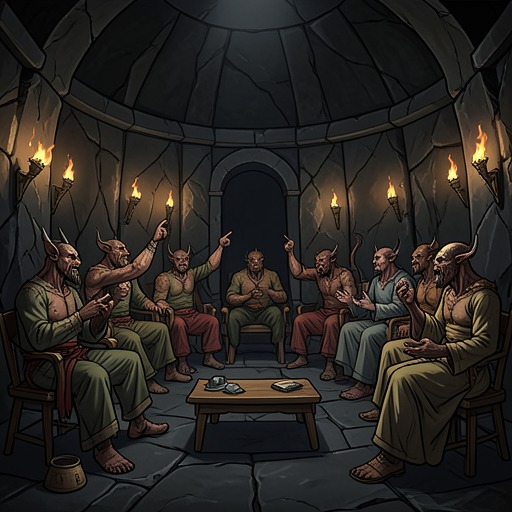
The reduction does not erase hierarchy. Far within the hall, in a secluded recess, the great Seraphic lords and Cherubim retain their full dimensions and sit in secret conclave on golden seats. Pandemonium contains both mass assembly and restricted deliberation, public congestion and elite interiority. Its political order is consequently not simple equality. The rebels invoke liberty and common dignity, but the council is still arranged around rank, access, and the authority of a central ruler.
Satan’s Throne and Counterfeit Sovereignty
Satan presides over Pandemonium from a royal throne whose wealth is said to outshine the treasures of Ormus and Ind. His elevation is described as having been secured by merit, leadership, counsel, and achievements in war, while despair has lifted him beyond hope into renewed ambition. From this throne he declares that the loss of Heaven has not destroyed the rebel cause and invites debate over whether open war or covert guile will best recover what they regard as their inheritance.
The capital gives physical form to Satan’s political rhetoric. In the council, the rebels argue about whether submission to God would be worse than continued suffering in Hell. Mammon rejects the prospect of returning to Heaven as a form of splendid vassalage and prefers a hard liberty in which the fallen can live for themselves and create advantage from adversity. Elsewhere, Satan contests the decree that the Son of God should rule Heaven, presenting angelic orders as compatible with equality and freedom. Pandemonium is the chamber in which these claims acquire institutional shape: rebellion is no longer only a battlefield action but a system of deliberation, persuasion, and command.
The city’s grandeur nevertheless exposes the instability of that claim to freedom. The rebels have escaped neither hierarchy nor sovereignty; they have reproduced them under Satan’s rule. The hall is crowded by regiments, the worthiest are selected, the great lords occupy a privileged conclave, and Satan speaks from a throne. Their language opposes servitude, but their political form depends on an emperor, an infernal court, and a capital. Pandemonium therefore materializes a counterfeit commonwealth whose rhetoric of liberty remains entangled with ambition and domination.
Place in the War and the Wider Cosmos
Pandemonium stands inside Hell, but its political reach is directed outward. The fallen angels debate there how to repair their loss, offend their enemy, and obtain reinforcement from hope or resolution from despair. Their council is one response to the fact that brute force has failed. Heaven has expelled them, and the burning lake has become a place of punishment; the capital allows them to convert calamity into a continuing project.
The city’s existence also depends on a wider cosmic order that it cannot overturn. The rebels’ schemes are presented against the providence of God, which permits their repeated crimes while bringing good from their evil and judgment upon themselves. Their council may plan, but it does not control the final meaning of its actions. The architecture appears autonomous and imperial, yet its inhabitants remain within the consequences of a decree they oppose.
When Satan later returns from his journey through Chaos and the created world, he passes through the Gates of Hell and finds the approaches largely deserted because the appointed guards have gone toward the upper world. The remaining legions have withdrawn inland around the walls of Pandemonium while the Infernal Council waits for its emperor. Satan enters in the appearance of a low-ranking militant angel, ascends invisibly into the hall, and then reveals his bright head and form from concealment. The sudden transformation produces amazement, followed by acclamation, as the assembled peers rush from their dark council to welcome him.
Narrative Significance
Pandemonium is the poem’s clearest image of political organization born from catastrophe. Its construction demonstrates the fallen angels’ extraordinary powers of coordination and craft; its council demonstrates their capacity to debate, persuade, and make collective plans; its throne demonstrates their determination to replace defeat with sovereignty. At the same time, every feature is shadowed by displacement. The city imitates heavenly magnificence while standing in Hell, imitates a temple while serving rebellion, and invokes liberty while arranging itself around a monarch.
The location also establishes a spatial pattern that recurs throughout the poem. Heaven gathers its powers beneath divine authority, while Pandemonium gathers the Rebel Angels beneath Satan. The difference is not the existence of order but the source and legitimacy of order. In Heaven, the Son of God’s headship is presented as decreed by God and as a means of uniting the celestial hierarchy; in Pandemonium, authority is assembled through defeat, ambition, persuasion, and resistance. The infernal capital is consequently both impressive and hollow: a place where evil can produce magnificence, but where magnificence cannot make evil into freedom, justice, or true sovereignty.