Prohibition against eating from the Tree of Knowledge
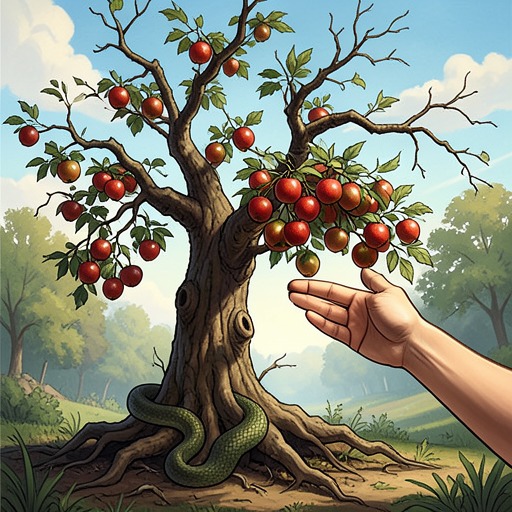
Paradise LostThe Prohibition against eating from the Tree of Knowledge is the decisive moral boundary placed within the abundance of Paradise. Adam and Eve receive nearly unrestricted access to the garden's innumerable fruits, but must not eat from the Tree whose fruit produces knowledge of good and evil; the stated penalty is death. The rule therefore converts a world of plenty into a field of meaningful choice, and its violation becomes the originating wound of human history.
Definition and Place in Creation
The prohibition is introduced as part of God's completed order of creation. After forming Adam from dust, breathing life into him, and creating Eve as his female consort, God blesses humankind with the command to be fruitful, multiply, fill the Earth, subdue it, and exercise dominion over fish, birds, beasts, and every living thing. Adam is then brought into the Garden of Eden, where every kind of pleasant fruit is freely provided. Against this vast permission stands one exception: the Tree whose fruit gives knowledge of good and evil.
The rule is not presented as a restriction imposed upon an otherwise deprived creature. The garden contains variety without end, and all its pleasant fruit is available for food. The prohibition is consequently small in physical scope but immense in moral meaning. Adam and Eve possess the world, yet their possession is not absolute: one tree remains marked by God's command. In that contrast, the poem defines dominion as a delegated trust rather than independent sovereignty.
Function as a Test of Freedom
Adam explains the command to Eve as the only easy charge among their many signs of power and rule. Their obedience has not been made difficult by scarcity, labor, or competing obligations; they may choose freely among manifold delights and continue their joyful work of tending the plants and flowers. The prohibition therefore serves as the remaining sign that their freedom includes the capacity to obey or disobey.
The rule also gives their innocence a visible form. Without an alternative to obedience, gratitude and submission would have no tested reality. The command distinguishes the created order from the Creator's authority while leaving Adam and Eve ample room for action, pleasure, labor, and mutual affection. Its simplicity makes the eventual transgression more morally legible: the disaster does not arise from confusion about a complicated system of laws, but from crossing one clearly stated boundary.
The Temptation to Cross the Boundary
The prohibition becomes the center of Satan's strategy when he approaches Eve in the form of the serpent. Having entered the Tree of Knowledge, he claims that its fruit has enlarged his reason and speech, enabling him to discern things in their causes and to contemplate the operations of higher agents. He uses his continued life as apparent evidence against God's warning and recasts the command as an unjust limitation on human advancement.
The serpent first leads Eve through praise, promising that the tree can raise her toward a condition of knowledge and superiority. When Eve identifies the prohibition, stating that God has forbidden both eating and touching the fruit lest they die, the Tempter turns to denial. His rhetoric transforms obedience into timidity and transgression into daring achievement. The command remains unchanged, but its meaning is rhetorically displaced: what God defines as the boundary of life, Satan presents as the barrier to a fuller life.
The scene reveals why the rule is vulnerable to temptation. It does not merely forbid an object; it asks Adam and Eve to accept that their present condition is good enough and that knowledge must be received on God's terms. Satan exploits the desire to pass beyond an assigned lot, and the Tree becomes the material focus of that desire. The prohibition thus links appetite, interpretation, ambition, and distrust: the act begins in a changed understanding of what the command means.
Consequences in Human History
The Tree of Knowledge is called the Tree of prohibition and the root of all human woe. Its command is therefore not an isolated garden regulation but the hinge on which the poem's historical vision turns. Once Adam's original crime has occurred, Michael shows him descendants who never touched the forbidden tree and never conspired with the serpent, yet derive corruption from Adam's sin and produce more violent deeds. The prohibition's breach consequently extends beyond the original act into inherited moral damage.
Michael's vision makes the first violation intelligible through the later history of death and violence. Adam sees Cain kill Abel after Abel's offering is accepted and Cain's is rejected. Michael identifies the brothers as descendants from Adam's loins and explains that the unjust has slain the just through envy. The scene gives visible historical form to the command's warning: death, first glimpsed as a brother's violent destruction, is not confined to the original offenders but becomes a recurring condition among their descendants.
The consequences also include bodily misery. Michael explains that death takes many forms, including violent blows, fire, flood, famine, intemperance, and diseases. A place filled with the diseased and afflicted appears before Adam, showing how the disobedience of Eve will bring misery upon humankind. The prohibition thus establishes a causal chain from one act of forbidden appetite to mortality, violence, illness, and the broad corruption of human life.
Relation to Law, Mediation, and Redemption
The later revelation of human history clarifies that the prohibition anticipates a larger structure of law. Michael tells Adam that sin will reign among his descendants, and that law will be given to expose their natural depravity by stirring sin against law. Law can disclose sin but cannot remove it through ceremonial observance alone; sacrifices of bulls and goats are described as shadowy expiations that point toward a more precious blood paid for humanity.
This development does not erase the original command's significance. Instead, it expands its logic. The first prohibition establishes that human beings are answerable to divine instruction; later laws make that answerability public, communal, and ritualized. Through Moses, divine law is proclaimed amid thunder, lightning, and trumpets from Mount Sinai. The Tabernacle is then established among obedient people, with a sanctuary of cedar overlaid with gold, an Ark containing the records of the covenant, a golden mercy-seat between two Cherubim, and seven lamps representing heavenly fires.
The prohibition also stands within a redemptive history that Adam cannot yet fully understand. Michael explains that the law's sacrifices cannot provide complete justification or peace of conscience, so a greater mediator and a more precious payment are required. Adam recognizes that the promised Seed will bless all nations and understands this favor as unmerited, since he sought forbidden knowledge by forbidden means. The command therefore has a double narrative force: it exposes the seriousness of disobedience while preparing the poem's movement toward mercy, faith, and deliverance.