Satan
Paradise LostSatan is the poem’s great adversarial intelligence, at once fallen archangel, defeated military leader, monarch of Hell, tempter of humanity, and advocate of a counterfeit freedom. Cast from Heaven after attempting to rival God, he converts punishment into a program of revenge: he will not repent, will not submit, and will seek to turn every good into evil. Yet the narrative steadily makes his resistance self-defeating. His pride gives him extraordinary energy and eloquence, but the same pride imprisons him within the identity he has chosen, so that his apparent independence repeatedly serves the purposes of Divine Providence.
Identity and Fall
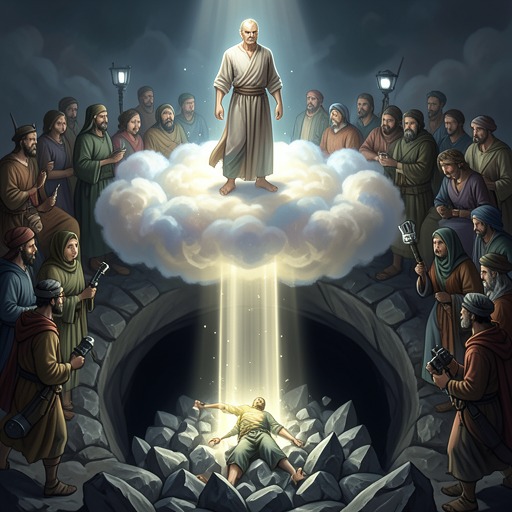
Satan first appears after the War in Heaven as the leader of the Rebel Angels. God has hurled him and his host from Heaven into Hell, where they lie amid fire, darkness, sulphur, and endless pain. The fall has changed his outward splendor, but not erased his immortal substance or military authority. He is described as having led innumerable spirits against Heaven, and as being second only to Beelzebub in the infernal hierarchy of companionship and crime. His physical scale is correspondingly colossal: chained upon the burning Lake of Fire, he resembles the gigantic beings of classical myth and the enormous Leviathan mistaken by sailors for an island.
The decisive feature of Satan’s identity is not merely his defeat but his interpretation of it. He acknowledges that God’s force has prevailed, yet refuses to regard that fact as a reason for repentance. Loss becomes the occasion for defiance; pain becomes proof that his will remains unconquered. He treats submission as humiliation and imagines that an immortal spirit cannot finally be overcome. His resolve is therefore built from revenge, hatred, and the refusal to yield rather than from any realistic prospect of victory.
Leadership in Hell
Satan’s first political achievement is to convert scattered suffering into collective purpose. He raises himself from the burning Lake of Fire, reaches the solid ground of Hell, and addresses Beelzebub as his nearest companion. He argues that the defeated host has retained its courage and strength, and that evil may be pursued as a deliberate counterforce to God’s designs. If Providence brings good from evil, Satan declares, the rebels must try to pervert that outcome and make evil arise from good.
In Pandemonium, Satan sits on a throne and presides over an Infernal Council. His elevation is presented as both earned through merit and made secure by the very danger of his position: he will stand foremost against God’s power and bear the greatest share of Hell’s pain. The argument gives political form to his pride. He claims that leadership means accepting hazard as well as honor, but his authority also depends on theatrical magnificence, persuasive speech, and the willingness of others to praise him as almost divine.
The council reveals the instability of Satan’s ideology. Moloch urges open war, preferring immediate violence to delay. Belial recommends inaction disguised as prudence, while Mammon advocates building a self-sufficient order in Hell and choosing hard liberty over heavenly service. Satan absorbs these debates into a more ambitious plan: rather than attack Heaven directly, the rebels will seek a newly created world and corrupt the human race at its root. The plan is not simply military revenge. It is an attempt to damage God by damaging what God loves and to claim the created world without confronting Heaven’s defenses.
The Journey from Hell to Eden
When no other spirit volunteers to cross the abyss, Satan undertakes the perilous voyage alone. He presents the decision as proof that a monarch must accept danger in proportion to authority, and he refuses to let any rival acquire honor by offering a service he himself would reject. His departure wins the admiration of the infernal host, which rises before him and treats him with reverence. The scene turns sacrifice into political capital: Satan’s courage is genuine, but it also strengthens his claim to rule.
The journey carries him through the Gates of Hell, Chaos, and the unbounded darkness separating Hell from the created universe. His escape is possible only because the all-ruling power of Heaven permits him to pursue his designs. That permission is central to his tragic irony: Satan experiences himself as an autonomous agent, while the larger narrative presents his freedom as contained within a providential order that will use his crimes to produce good.
Before reaching Eden, Satan’s inner conflict becomes visible. He is not a simple embodiment of fearless evil. Rage, doubt, conscience, despair, and the memory of his former glory torment him. He looks toward Eden and Heaven, recognizes what he was, and remembers that God had created and honored him without imposing an unbearable service. He admits that gratitude should have been easy and that pride transformed received goodness into resentment. Nevertheless, recognition does not become repentance. He returns to his chosen course because abandoning revenge would require surrendering the identity through which he now understands himself.
Satan also appears in calculated disguises. He first approaches Eden as a fugitive from Gabriel’s vigilance, then searches the world for the creature best suited to conceal his suggestions. After examining the works of creation, he chooses the Serpent, whose natural subtlety can make diabolic intelligence appear to be merely animal cunning. The choice demonstrates his method: he does not rely only on force but works through concealment, insinuation, and the manipulation of appearances.
Seduction and the Fall of Humanity
Satan’s assault on humanity is aimed at Adam and Eve’s obedience to God’s prohibition against eating from the Tree of Knowledge of Good and Evil. He exploits the serpent’s apparent innocence and turns the forbidden fruit into an image of advancement. The temptation promises enlarged knowledge and an ascent toward divinity, making disobedience appear not as betrayal but as self-improvement.
After Eve eats, Adam recognizes the catastrophe but chooses solidarity with her over obedience to God. His reasoning gives Satan’s act a wider consequence: the human fall becomes inseparable from love, fear of separation, and the desire to remain one flesh. Satan has not merely induced an isolated violation; he has entered the intimate structure of human attachment and redirected it toward shared guilt.
Satan later boasts before the infernal assembly that he has seduced Adam and gained the human world for Sin and Death. He presents the achievement as an inexpensive victory achieved without further danger or labor, though the narrative makes clear that the apparent triumph carries its own punishment. God has placed enmity between Satan and humanity, and the future Seed of the woman will bruise Satan’s head even as Satan bruises the heel of the human race.
Political Rhetoric and Counterfeit Freedom
Satan’s speeches repeatedly transform rebellion into a language of liberty. In Hell he prefers independence to submission and imagines that a hostile realm can become a self-sufficient commonwealth. In Heaven, before the battle, he argues that angelic beings are naturally free and equal, and that no monarch may impose law upon equals. The rhetoric is attractive because it borrows the vocabulary of freedom, dignity, and resistance to tyranny.
The poem exposes the contradiction beneath this language. Abdiel answers that serving God is not servitude when the ruler is worthiest, whereas serving an inferior rebel is genuine enslavement. Satan’s supposed independence is therefore compromised by his own passions: he is not free from rule but enthralled to himself. His rebellion also reproduces the hierarchy he condemns. He claims to reject monarchy while accepting the title of monarch, demanding loyalty from the spirits who follow him and treating his own will as the standard of political legitimacy.
The same contradiction appears in human history. Michael explains that after the fall, reason becomes obscured and disorderly desire assumes government within the individual; external tyrants then dominate people whose inward freedom has already been weakened. Satan’s rebellion thus becomes a model for later political domination. The language of liberty can resist rightful authority, but when severed from reason it can also authorize self-exaltation, conquest, and tyranny.
Change, Defeat, and Thematic Significance
Satan begins as a ruined but commanding spirit who converts defeat into purpose. His early speeches preserve traces of grandeur: he can endure suffering, organize a council, accept danger, and inspire a vast following. Yet his trajectory also narrows. The more completely he identifies freedom with opposition, the less capable he becomes of recognizing goodness except as an obstacle. His memory of Heaven survives, but as fuel for resentment rather than as a path toward return.
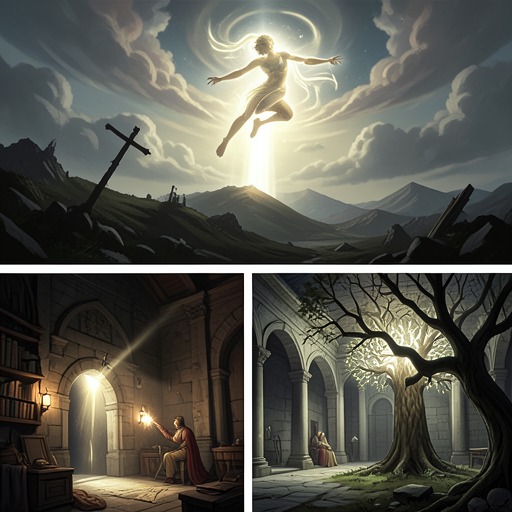
His apparent success in Eden is eventually absorbed into a greater economy of loss and restoration. God declares that humanity need not remain wholly lost, while the Son of God offers life for life and accepts death to redeem mortal crime. The Son’s obedience, Incarnation, death, resurrection, and triumph over Sin and Death reverse the logic of Satan’s rebellion. Satan seeks to make good serve evil; Divine Providence makes the evil he initiates serve grace, mercy, and redemption.
For this reason Satan functions as both antagonist and negative hero. His journey resembles a quest, but it is an inverted one: instead of leaving the familiar world to gain wisdom and return with a healing gift, he leaves Hell to spread corruption and returns proclaiming a victory already containing the conditions of his defeat. His role is also tragic in the Aristotelian sense of a great fall intensified by a governing error, but his recognition remains incomplete. He can identify his former glory, his ingratitude, and the consequences of pride, yet he converts every recognition back into justification.
Satan’s most enduring significance lies in the tension between heroic appearance and moral disintegration. His courage, eloquence, endurance, and strategic intelligence make him compelling, but the poem continually separates magnificence from goodness. The rebel who claims to be self-created and self-raised is in fact dependent upon the order he denies; the liberator who condemns service establishes his own dominion; and the enemy who believes he has purchased a world for Hell becomes the unwitting means by which a greater redemption is disclosed.