Satan and God
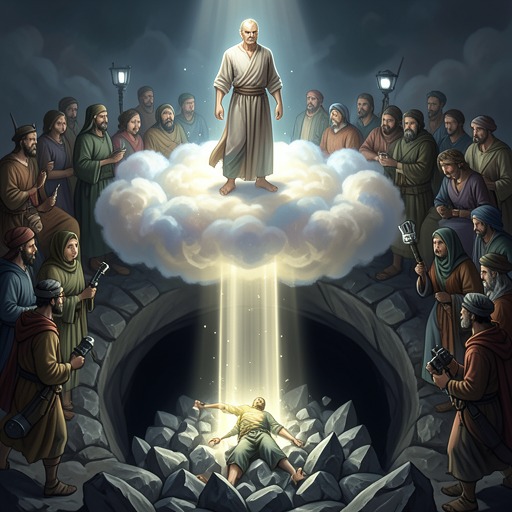
Paradise LostSatan and God is the poem’s central antagonistic relation: the created rebel against the Creator, the challenger to divine monarchy against the source of all legitimate rule. Satan’s revolt begins in envy, revenge, and an ambition to rise above his peers and equal the Most High. God answers by casting him and the Rebel Angels from Heaven into Hell, yet the conflict does not end with military defeat. It becomes an enduring contest over whether force, freedom, law, and providence belong to God alone, and whether Satan’s resistance can do more than deform the purposes it opposes.
Origin of the Conflict
The opposition begins before the human Fall. Satan, once a glorious angel, is moved by envy and revenge to challenge God’s throne and monarchy. He raises impious war in Heaven, gathers innumerable armed Spirits, and attempts to oppose divine power in battle. The rebellion fails: God hurls Satan headlong from the ethereal sky into bottomless perdition, where he and his host lie amid penal fire and adamantine chains. Their immortality makes the punishment more terrible rather than less, because their existence continues under torture, separated from God and the light of Heaven.
The first scene after the defeat establishes the unequal terms of the relation. Satan and Beelzebub remain capable of speech, thought, and action, but their strength is no proof that they have escaped judgment. Satan’s eyes register affliction and dismay, yet his pride and hatred remain fixed. He refuses repentance and interprets continued existence as the basis for renewed resistance. His declaration that the field may be lost while all is not lost turns defeat into a program: the unconquerable will, revenge, immortal hate, and courage never to submit replace the lost glory of Heaven.
Sovereignty, Freedom, and Rebellion
Satan presents the conflict as a political struggle against tyranny. In his own account, the fallen angels fought because God’s empire appeared vulnerable and because their own power seemed sufficient to oppose it. He rejects submission as humiliation and proposes an eternal war pursued by force or guile. Later, when the divine decree concerning the Son of God becomes the subject of debate, Satan again translates hierarchy into the language of liberty. He argues that the angels are free and that no monarch should rule equals by law or demand adoration.
This argument gains force from its political vocabulary, but the poem exposes its contradiction. Satan’s appeal to equality is delivered from a position of command: he leads the third part of Heaven’s Host, summons subordinate powers, manipulates their interpretation of the decree, and expects them to follow his direction. His rhetoric makes freedom mean exemption from a higher authority while leaving his own authority intact. Abdiel identifies the concealed premise, defending the decree that the Son of God should receive the regal scepter and that divine law is not an arbitrary insult to freedom. God created the angelic orders and gave them their distinct being; obedience to the rightful head does not diminish their dignity but orders it.
God’s account of freedom supplies the theological counterargument. He declares that the Angels who stood and those who fell were created with free will, because compelled obedience could produce neither sincere allegiance, faith, nor love. Foreknowledge does not cause revolt: the rebels themselves determine their own fall through what they judge and choose. God therefore remains providentially sovereign without becoming the author of Satan’s crime. The relation is thus not a contest between two equal principles. Satan’s freedom is real, but it is creaturely freedom turned against the source that made it possible.
Guile Against Providence
After military defeat, Satan changes the method of opposition. He recognizes that force has failed and concludes that fraud or guile may succeed where arms did not. His aim is not merely to damage God’s creatures but to pervert divine purposes: if Providence brings good out of evil, Satan will labor to draw evil out of good. The strategy defines his antagonism as parasitic. He cannot create a rival order independent of God; he can only corrupt what God has made and attempt to make providence appear frustrated.
That strategy directs him toward the newly created World and the first human beings. God foresees Satan’s approach and states that the adversary intends either to destroy Man by force or, more likely, to pervert him through deceptive speech. God also foresees that Man will listen to the false argument and transgress the single command given as the pledge of obedience. Yet the foreknowledge does not remove human responsibility. Adam and Eve are created sufficient to stand, though free to fall, and Satan’s deception does not become God’s causation.
The temptation makes the antagonism intimate and rhetorical. In the form of the Serpent, Satan presents the forbidden fruit as a source of knowledge and accuses God of withholding godlike understanding in order to keep human beings low and ignorant. His reasoning turns prohibition into evidence of divine envy and obedience into servility. Eve accepts the argument, and Adam chooses to share her fate rather than remain separated from her. Satan’s victory is therefore real in its immediate effects: through an Apple he seduces Man from the Creator, and Sin and Death gain dominion over the fallen world.
Judgment and the Limits of Victory
Satan’s apparent triumph does not deliver the universal victory he imagines. He tells the infernal court that God has given Man and the whole World over as prey, allowing Satan and his followers to rule without hazard or labor. But the claim contains its own punishment. The judgment placed upon the Serpent establishes enmity between Satan and Mankind: Satan may bruise the heel of the Woman’s Seed, but that Seed will bruise Satan’s head. The injury Satan inflicts is therefore made the setting for his eventual defeat.
The poem also dramatizes the relation through reversal. Satan returns to Pandemonium believing himself a successful adventurer, claiming that he has crossed Chaos, found the World, and corrupted Man. He expects universal acclaim, but the infernal assembly answers with a universal hiss. He is transformed into the Serpent whose shape he used in deception, and the fallen host becomes serpentine as well. The punishment does not simply follow the act from outside; it mirrors the chosen instrument and reveals the instability of Satan’s supposed mastery. His victory over others culminates in degradation of his own form.
God’s justice is severe, but it is not exhausted by destruction. Humanity’s disobedience creates a debt that requires death for death, yet the Son of God offers his own life for the mortal crime. The Son will assume human nature, obey the divine law, suffer death, rise before the third dawn, and thereby defeat Sin and Death, the principal powers through which Satan works. Redemption does not deny justice; it satisfies it through voluntary self-offering and turns Satan’s instrument of ruin into the occasion of restoration.
The Final Shape of the Antagonism
The Son of God’s redemptive action changes the scale of the conflict. Satan can wound human nature, but he cannot permanently possess those who receive the Son’s merit through faith. The Son’s death becomes the ransom that redeems humanity from the death deserved by the Fall, while his resurrection deprives Death of lasting dominion. His later ascension confines the Serpent Prince of the air and leaves Satan’s power defeated at its root. The promised return will dissolve Satan and his perverted World, judge the unfaithful, reward the faithful, and renew creation as New Heavens and a New Earth founded in righteousness, peace, and love.
The relation therefore moves through three forms of resistance: open war in Heaven, political and ideological defiance among the Rebel Angels, and deceptive invasion of the human world. In each phase Satan seeks equality with God, but each phase exposes dependence. His army is created by God, his arena is permitted within divine creation, his weapons are corruption and imitation, and even his apparent success becomes material for providential restoration. God’s answer is correspondingly different from Satan’s: where Satan seeks domination through pride and revenge, God’s sovereignty appears through judgment, patience, grace, and the Son of God’s obedient love.
The antagonism finally defines the poem’s theology of freedom and history. Satan insists that submission is shame and that revenge can preserve dignity; God’s order presents freedom as the capacity to love and obey without compulsion. Satan treats loss as a debt to be repaid through retaliation, whereas divine grace answers human debt through substitution and redemption. The conflict between them is never morally symmetrical. Satan can oppose, distort, accuse, and injure, but he cannot originate being, revoke freedom, or overturn the providential end toward which creation moves. His rebellion gives the poem its most forceful voice of resistance, yet the larger narrative makes that resistance a defeated power within a design that will bring good out of evil.