Satan's Journey through Chaos
Paradise LostSatan's Journey through Chaos is the decisive expedition that carries Satan from the fortified depths of Hell toward the new world of Earth. Chosen after the infernal council finds no other champion willing to undertake the voyage, Satan crosses the Gates of Hell, negotiates the unstable Abyss ruled by Chaos, and finally sees Heaven and the world hanging from it by a golden chain. His arrival does not bring reconciliation or restoration: he reaches the threshold of creation “full fraught with mischievous revenge,” and his passage prepares the way for the corruption of mankind.
The Mission from Hell
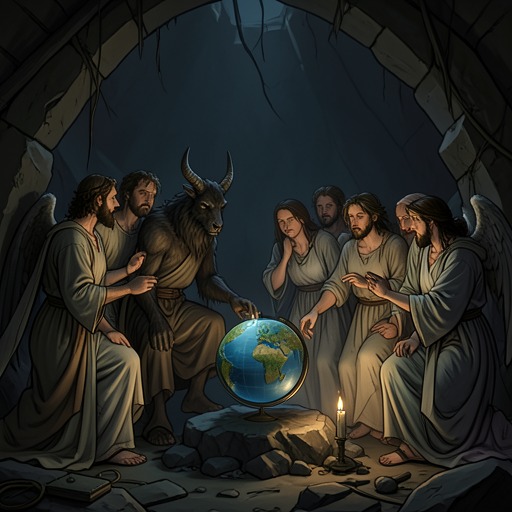
The journey begins as the practical answer to the infernal council's search for a means of striking at God through His creation. Beelzebub proposes that the devils might waste the new world with Hell fire, seize it, expel its inhabitants, or seduce them into rebellion so that their God might become their foe and destroy His own works. The plan is therefore more than ordinary military revenge: it aims to mingle Earth with Hell, injure God's joy, and make the newly created race the instrument of the fallen angels' resentment.
The council hesitates because the route is almost unimaginable. The messenger must wander through the “dark unbottom'd infinite Abyss,” find a path through palpable obscurity, survive unknown dangers, and evade the Angels stationed around the borders of Heaven. None of the leading spirits volunteers. Their silence and visible dismay turn the proposed expedition into a test of rank as well as courage: the public danger exposes the distance between infernal rhetoric and actual willingness to suffer.
Satan then claims the mission for himself. He argues that a ruler must accept hazard in proportion to honor and that his imperial position would be empty if danger could deter him from a matter affecting all. His offer is also carefully controlled. He refuses assistance, rises before anyone can propose a rival attempt, and thereby prevents another leader from gaining reputation by offering an action Satan would have had to reject. The expedition is presented as self-sacrifice for the common safety, but it also preserves his supremacy and turns danger into political capital.
The Gates and the Abyss
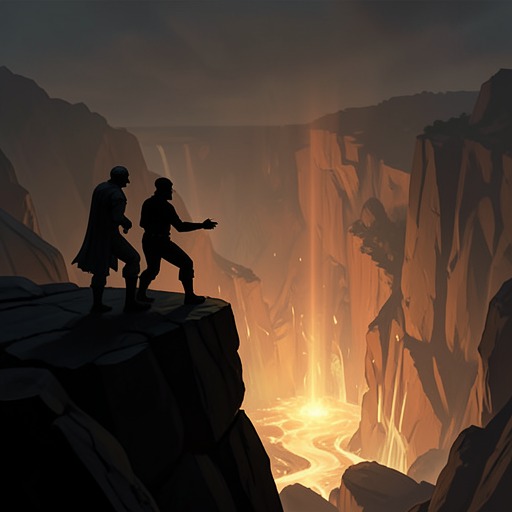
Satan first confronts the structure that imprisons the fallen powers. Hell is enclosed by ninefold fire, with burning adamant gates barring escape; beyond them lies a profound void that threatens the traveler with the loss of being. The journey consequently passes through successive forms of negation: a prison, an empty gulf, an unknown region, and the possibility that every attempted escape may end in annihilation.
The Gates of Hell open only because Sin uses the fatal key entrusted to her. She has been placed in a hateful office by God's command, but she treats Satan as her father and author and chooses to obey him instead. The key releases intricate wards, bolts, bars, and solid rock, while the gates swing open with a thunder that shakes the lowest bottom of Erebus. Once opened, they stand so widely apart that a bannered host with horses and chariots could pass through. Their opening is therefore not a minor departure but a structural breach in the boundary separating infernal confinement from the wider creation.
Beyond the gates appears the realm of Chaos: an immeasurable ocean in which length, breadth, height, time, and place have lost definition. Night and Chaos, described as the ancestors of Nature, preside over an eternal anarchy in which hot, cold, moist, and dry contend for mastery. Their embryonic atoms gather into factions, while Chaos judges only in a way that produces further disorder; Chance governs beside him. The Abyss is thus neither sea, shore, air, nor fire, but a confused mixture of all these materials in their potential causes, a womb of nature and perhaps its grave.
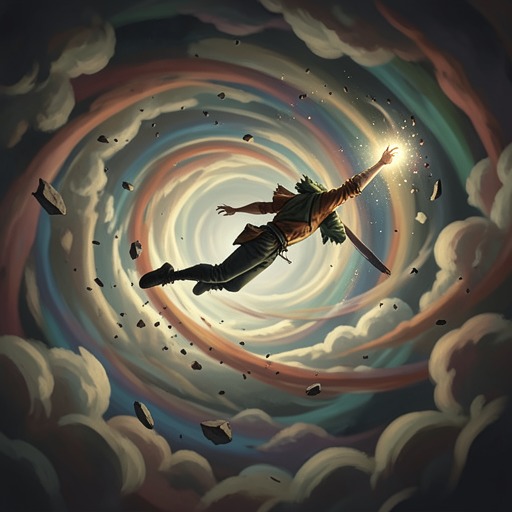
The physical setting actively frustrates Satan's ambition. He spreads his broad wings and rises in the smoke, but the apparent support beneath him fails and he plunges ten thousand fathoms. A turbulent cloud charged with fire and nitre violently throws him upward, after which he lands near the boggy Syrtis, where no firm sea or dry land supports him. He must combine oar and sail, alternately walking, flying, swimming, sinking, wading, and crawling through a crude, unstable substance. The movement makes the voyage a contest not simply against distance but against the failure of the elements to remain separate or dependable.
Encounter with Chaos
Satan eventually follows a tumult of confused voices and discovers the throne and dark pavilion of Chaos. Ancient Night sits beside him, while Orcus, Ades, Demogorgon, Rumor, Chance, Tumult, Confusion, and Discord occupy the surrounding disorder. Satan approaches boldly but presents himself as a traveler under constraint rather than a spy. He asks for the quickest route to the borders of light, or to any region newly possessed by the Ethereal King.
His request is also a bargain. Satan promises that, if he reaches the lost region, he will expel God's usurpation, restore it to Ancient Night, and erect Night's standard there once more. The offer reveals the political logic of his journey: revenge against God is made to resemble a restoration of the old powers, while Chaos is invited to regard Satan's destructive purpose as an enlargement of its own dominion.
Chaos recognizes him as the mighty leading Angel who made war against Heaven's King and was overthrown. He also identifies the changing geography of his realm. Hell already stretches beneath him; now Heaven and Earth hang over the borders of Chaos as another world linked by a golden chain to the side of Heaven from which the rebel legions fell. Chaos therefore directs Satan toward the new world, warning that the route is near but dangerous. Havoc, spoil, and ruin are declared to be the gains of Chaos, so the direction offered is compatible with Satan's revenge even though Chaos does not become his companion.
Passage, Discovery, and Consequences
After receiving the direction, Satan does not linger. Renewed by the prospect of finding a shore, he surges upward like a pyramid of fire through the fighting elements. The passage is compared with the perilous movement of the Argo between the Symplegades and of Ulysses between Charybdis and the other whirlpool: even under guidance, progress remains laborious, narrow, and exposed to forces that could destroy him. The repetition of difficulty emphasizes that his success is achieved through persistence and audacity rather than through mastery of the realm.
The voyage also produces a route that outlives the immediate expedition. After mankind falls, Sin and Death follow Satan's track and, by the will of Heaven, pave a broad road across the Abyss. This Bridge of Sin and Death extends from Hell to the outer orbit of the frail world, allowing perverse spirits to pass back and forth in order to tempt or punish mortals, except those protected by God and good Angels through special grace. Satan's individual act thus becomes an infrastructure of recurring evil: what begins as a difficult solitary crossing is transformed into an accessible connection between Hell and human history.
At the far edge of Chaos, the influence of light begins to appear. A glimmering dawn reaches into dim Night, Nature begins at its furthest verge, and Chaos retreats with diminished tumult. Satan can then move more easily, like a weather-beaten vessel reaching port with torn shrouds and tackle. The change from violent elemental struggle to navigable calm marks the journey's central reversal: the greatest physical danger ends precisely when the moral danger of his mission comes into view.
Arrival at the World
Satan finally beholds Empyrean Heaven, with opal towers and battlements of living sapphire, once his native seat. Near it hangs the newly created world, suspended by a golden chain and appearing in size like a star of the smallest magnitude beside the Moon. The image makes Earth seem both minute and immensely consequential: physically small beside Heaven, yet the chosen target through which Satan intends to wound God's creation and corrupt mankind.
He approaches the world carrying revenge rather than discovery. The journey's apparent heroic pattern is therefore inverted. Satan receives a call, crosses a threshold, survives an ordeal, and reaches a new realm, but the return with a healing gift is replaced by an advance toward temptation and ruin. His courage is real, and the expedition demands extraordinary endurance, yet its purpose converts heroic energy into destructive service. The voyage ends not in restoration but at the opening of the next stage of the plot, with Satan poised to enter the world and turn its innocence against its Creator.