Satan's Journey to Eden
Paradise LostSatan's Journey to Eden is the expedition by which Satan turns the defeat of the Rebel Angels into a new strategy of revenge. The Infernal Council has considered open war, despair, and the possibility of disturbing God's purposes, but Beelzebub proposes seeking the new world and its human inhabitants. The mission is perilous because it requires a solitary passage through Hell, the Gates of Hell, Chaos, and the uncharted distance separating darkness from light. Satan accepts the voyage when no other leader will undertake it, making the journey both a military reconnaissance and the first deliberate movement toward the Temptation and Fall of Man.
Causes and Strategic Purpose
The expedition grows out of Satan's refusal to accept defeat. After the loss of Heaven, he declares that the rebels retain an unconquerable will, revenge, immortal hate, and the courage never to submit. His language converts military failure into a continuing program: if direct force cannot overthrow God, guile may disturb the divine design. Belial warns that an assault on Heaven would meet impregnable defenses and might end in the annihilation of the rebels; the debate consequently shifts from recovering Heaven by force to finding a vulnerable point beyond its immediate fortifications.
Beelzebub identifies that point as the new world and the race of Man. The fallen powers might waste God's creation with Hell fire, seize it, drive out its inhabitants, or seduce them into rebellion so that God might appear to become the enemy of his own works. The proposal is attractive precisely because it turns the rebels' defeat into an indirect attack. Satan's voyage is thus not an aimless flight from punishment. It is a calculated extension of the war, designed to mingle Earth with Hell through the corruption of human beings.
The council's enthusiasm contrasts with its silence when a messenger is requested. The proposed traveler must cross the dark, bottomless Abyss, evade the Angels stationed along the route, and discover the happy island where Man lives. The assembled champions ponder the danger and cannot volunteer. Satan then steps forward with monarchal pride, arguing that a ruler must accept as much hazard as honor. His authority is therefore tested through action: the leader who claims sovereignty over Hell must personally bear the risk that sovereignty entails.
Passage Through Hell and Chaos
Satan first travels toward the Gates of Hell, flying alone through the various regions of the infernal landscape. The gates rise toward the roof of Hell and are formed from three layers each of brass, iron, and adamantine rock, surrounded by circling fire. Before them stand two formidable figures, one serpent-bodied and associated with barking Hell Hounds, the other an indistinct black shape crowned like a king and carrying a dart. Satan confronts these threshold guardians, but the journey's decisive obstacle is overcome through Sin's power to open the gates rather than through Satan's strength alone.
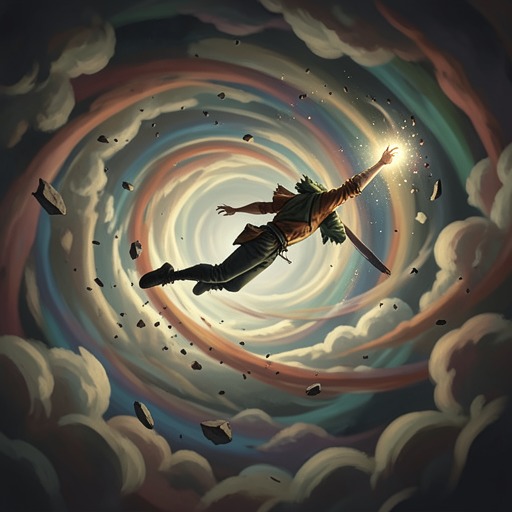
Beyond the gates lies Chaos, an immeasurable waste in which time and place lose their ordinary definitions. Night and Chaos preside over an unstable realm where hot, cold, moist, and dry contend for mastery, while Chance governs amid confusion. The region is neither sea nor shore, air nor fire, but a mixture of elemental possibilities, a womb of nature and perhaps its grave. The voyage therefore passes through a space that resists ordered creation itself, placing Satan between the infernal prison he has left and the structured world he seeks.
The physical hazards make the expedition a repeated struggle between ascent and collapse. Satan spreads his broad wings and rises through smoke, only to meet a vast emptiness and fall ten thousand fathoms. A fire-filled cloud violently lifts him again, after which he becomes stranded in a boggy Syrtis, moving by foot, wing, and effort across an unstable substance. His progress is compared to the difficult passage of a ship through the Bosporus and to the dangers faced by Ulysses near Charybdis. These reversals prevent the journey from appearing effortless: Satan's will is formidable, but the cosmos through which he moves repeatedly denies him a stable route.
At the throne of Chaos, Satan asks for the quickest path toward the borders of Heaven. He presents himself as a traveler constrained by circumstance, not as a spy seeking to disturb the realm, and offers a bargain: if he reaches the lost region, he may restore it to its original darkness and return it to the dominion of Ancient Night. Chaos confirms Satan's identity as the leading Angel who recently made war against Heaven and points toward the region where Heaven and Earth hang over his diminished realm. Satan does not pause to debate. Renewed by the discovery of a navigable direction, he forces his way through the contending elements and continues upward.
Arrival at the New World
As Satan advances, light begins to appear at the furthest boundary of Chaos. The violence of the elements diminishes, and he travels more easily through a calmer region, like a weather-beaten vessel entering port. He then sees Empyreal Heaven, the place of his former glory, and the created world hanging nearby in a golden chain. The image establishes a sharp contrast between origin and destination: Satan approaches a world governed by divine order while looking back toward the radiance from which he fell.
He lands on the dark globe of the Earth, which initially appears as a boundless, waste, and storm-threatened continent. He walks alone because no other creature yet inhabits the place. The solitude is strategically important. Satan is not entering an established society or confronting an army; he is approaching the first human pair before human history, institutions, and collective defenses have developed. The new world is therefore both vulnerable and symbolically charged, a fresh creation that Satan hopes to turn into the first theater of his counterattack.
His destination is Paradise, the abode of Adam. The journey's route is not merely geographical, since the Earth is described as the site from which a future human history will unfold. The expedition reaches toward the beginning of the story's central catastrophe: Satan's arrival precedes the temptation, and the passage through cosmic darkness culminates at the garden where human obedience will be tested.
Disguise and Deception Before Uriel
To avoid danger or delay, Satan changes his proper shape. He assumes the appearance of a young Cherub, wearing multicolored, gold-sprinkled wings, a close-fitting habit suited to speed, and carrying a silver wand. The disguise is not a decorative transformation but an instrument of access. Satan cannot safely approach the guardians of the new creation as the openly declared enemy of God, so he adopts the outward signs of a legitimate heavenly messenger.
The disguised Satan encounters Uriel, one of the seven Spirits nearest God's throne and a swift interpreter of divine will. Uriel's sight is described as the sharpest in Heaven, yet he is deceived because Satan presents his curiosity as reverent admiration. He claims to have left the choirs of the Cherubim in order to see God's works, especially Man, whom God has favored and for whom the surrounding worlds were made. He also speaks of God's justice in driving the rebels into Hell, using apparent praise of divine order to conceal his purpose.
The episode makes hypocrisy the instrument by which evil crosses a boundary that force might not penetrate. Uriel, whose office is associated with vision and divine errands, nevertheless fails to recognize the false messenger. The deception exposes a tension between sight and moral knowledge: physical perception can identify a face and a celestial form, but it cannot by itself detect an inward intention. Satan's false humility and elaborate praise are therefore as important to the journey as his wings.
Uriel answers without suspicion and explains the arrangement of Creation. He describes the ordering of the elements, the division of light from darkness, the firmament, and the Earth's place beneath the neighboring Moon. At last he points to Paradise and identifies it as Adam's abode, marked by its lofty shades. Satan has obtained exactly what the expedition required: a precise direction to the human sanctuary, supplied by the guardian whose trust he has exploited.
Consequences and Narrative Significance
Satan takes leave with the outward reverence expected among heavenly Spirits, then descends from the Ecliptic and lands on the summit of Niphates. The movement completes the journey's major sequence: departure from the defeated host, passage through infernal and chaotic thresholds, arrival in the created world, and acquisition of access to Paradise. The event ends not with Satan's defeat but with apparent success. His voyage has delivered him to the threshold of his intended prey.
The success is nevertheless morally and structurally unstable. Satan's route depends on deception, and his apparent gain is folded into a providential history that will not finally serve his purpose. The divine plan already includes the possibility that Man, though fallen, may be restored through grace and through the Son of God, who offers life for life and accepts death on humanity's behalf. Later revelation makes clear that the Son's obedience and resurrection will defeat Sin and Death and bruise Satan's power. The journey therefore produces a real catastrophe for Adam and Eve while also inaugurating the larger movement from Fall and Restoration.
The event's dominant plot forms are quest, pursuit, revenge, temptation, and descent-and-ascent, but they are inverted. Satan undertakes a heroic-looking passage through danger, yet the object of his quest is not wisdom, healing, or communal deliverance; it is a means of corrupting the innocent. His threshold crossings resemble an initiatory voyage, but the knowledge he gains is used against the order he pretends to honor. The expedition's grandeur consequently intensifies its irony: the rebel who cannot storm Heaven discovers that the road to human ruin runs through a garden, and that the first victory of his renewed campaign will also become the setting for the eventual defeat of his works.