Satan, Sin, and Death
Paradise LostSatan, Sin, and Death constitute the poem’s central infernal relation: a distorted family and political alliance through which rebellion becomes moral corruption, corruption becomes mortality, and mortality becomes an instrument of further destruction. The relation is established through Satan’s revolt against God, embodied in Sin’s emergence from Satan, and completed by Death’s violent birth from Sin. It then expands materially when Sin and Death follow Satan through Chaos, construct the Bridge of Sin and Death, and enter the new world to infect and consume it. Their apparent empire is therefore both genealogical and strategic: Satan supplies the originating will, Sin opens the way, and Death enforces the consequences. Yet the alliance is also marked for reversal, since the Son of God will defeat their power through obedience, sacrificial death, resurrection, and final judgment.
Genealogy of Rebellion and Its Offspring
Sin first appears as the bodily manifestation of Satan’s rebellion. Before the war in Heaven, Satan suffers a strange transformation: pain seizes him, his eyes darken, and flames issue from his head. From the left side of that head, a figure resembling him in bright, goddess-like form springs forth, astonishing the Heavenly Host. The angels name her Sin and regard her birth as portentous. Her origin makes the relation more than an ordinary family connection. Sin is literally produced from Satan’s divided consciousness and rebellious power, so that the revolt against God acquires an embodied form.
Sin recalls that Satan became enamored of her because he saw his own image perfected in her. Their secret union follows, and her womb conceives. While war continues in Heaven, the unborn Death grows within her. After the defeat of the Rebel Angels and their expulsion into Hell, Death violently breaks through Sin’s entrails, emerging as her son and Satan’s offspring. The birth is figured as an act of rupture rather than generation: Death tears through the body that produced him, and his appearance transforms Sin’s lower shape. The family is thus founded on violence, desire, and self-reproduction, with each member carrying forward the deformity of the original revolt.
Death immediately becomes Sin’s inbred enemy as well as her child. He brandishes a fatal dart, pursues her, and repeatedly forces himself upon her. From that assault come the yelling monsters that surround Sin, conceived and born without cessation. These offspring return into her womb, gnaw her bowels, and burst forth again, making her motherhood an endless cycle of internal punishment. Sin describes Death as a son who would devour his parent if he did not know that his own end is bound up with hers. Their mutual destruction is therefore built into their relation: Death depends upon Sin as his source, while Sin’s survival is threatened by the force she has generated.
The Bargain at the Gates of Hell
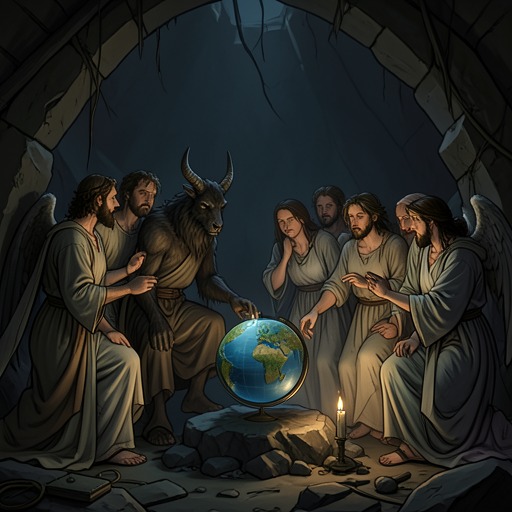
When Satan reaches the Gates of Hell, Sin and Death stand ready to oppose him. Death confronts him as a monstrous king, armed with a dart and crowned in a form suggesting sovereignty. Satan does not fear the creature, but the encounter reveals a conflict within the infernal household: Satan sees only an execrable shape, while Death identifies him as the traitor who broke the peace of Heaven and led a third of Heaven’s Sons into rebellion. Each raises a weapon and prepares for a single decisive stroke. Hell itself darkens beneath their mutual hostility.
Sin interrupts before the combat begins. She calls Satan her father and Death his son, forcing Satan to recognize a relationship he does not remember or does not acknowledge. Her intervention prevents the immediate destruction of the family, but it also exposes the structure of their alliance. Sin is not merely a guardian of the Gates; she is the necessary mediator between Satan’s originating rebellion and Death’s destructive force. She explains her birth from Satan’s head, her seduction by him, and Death’s emergence from her body, turning what looked like an isolated confrontation into a family history of rebellion made flesh.
Satan responds by changing his manner. Once he understands that Sin claims him as father and Death as the child born of their dalliance in Heaven, he presents himself not as an enemy but as a liberator. He says that he has come to free Sin, Death, and the fallen spirits from their prison and to seek a new world created in the outskirts of Heaven. His promise is materially specific: in that world, Sin and Death will be able to move unseen through the air, feed without limit, and make all things their prey. The proposed future binds affection, appetite, and political expansion together. Satan offers freedom from confinement, but the freedom is defined as unrestricted predation.
Sin accepts the offer because she regards Satan as her author and believes that obedience to him will restore her to a world of light and bliss. She possesses the Key of Hell, which God has entrusted to her with orders to keep the Gates shut, but she resents the hateful office imposed upon her and prefers to follow the father who gave her being. Her decision converts private grievance into practical conspiracy. By taking the fatal key and turning its intricate wards, she releases bolts and bars of iron and rock. The Gates open with thunder, smoke, and ruddy flame, revealing the boundless darkness of Chaos.
The Bridge and the Expansion of the Alliance
Sin and Death do not merely pass through the opened Gates; they build the route by which Hell can reach the created world. Sin feels a new strength and an attraction drawing her toward Satan across the distance. She proposes that she and Death construct a path over the impassable gulf from Hell to the new world, both as a monument to their merit and as a means of passage for the infernal host. Death agrees, guided by his instinct for carnage and by the scent of prey among living things.
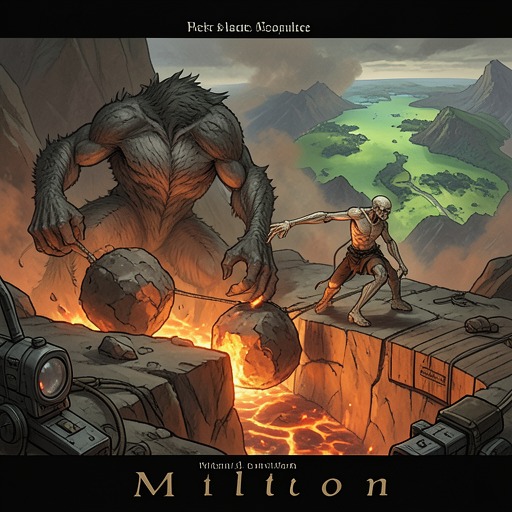
Together they drive the floating matter of Chaos toward the mouth of Hell. Death strikes the gathered substance with his petrifying mace, fixes it with Gorgonian rigor and asphaltic slime, and helps form a vast arched mole of rock. The result is the Bridge of Sin and Death, a durable causeway following Satan’s track from Hell to the outside of the round world. Its construction joins three formerly separated realms: Heaven, Earth, and Hell become visible as connected destinations, while the new world becomes accessible to the powers that had been confined below. The bridge is therefore both an architectural object and a diagram of moral transmission. It gives physical form to the passage from rebellion into human history.
Satan returns after witnessing the Fall of Adam and Eve and meets Sin and Death at the edge of Chaos, near the bridge. Sin recognizes the success of his enterprise through a secret sympathy that links the three across worlds. She declares that Hell could no longer hold them and that the gulf could no longer prevent them from following his track. Satan celebrates them as his daughter, son, and grandchild, praising the work that has made Hell and the world a single realm with an easy thoroughfare. He assigns them dominion over Earth and the air, orders them to make Man their thrall, and ultimately commands them to kill him. The relation has thus moved from biological origin to imperial administration: Satan’s family becomes the governing apparatus of the new kingdom he claims.
Sin and Death in the World
Sin and Death arrive in Paradise before their father’s final return, with Sin already exercising power in a new form. She is no longer only an occasional act or inward impulse; she has become an embodied and habitual inhabitant. Death follows her closely, not yet mounted on his pale horse, and asks what she thinks of their empire. Sin answers by directing him toward the abundance of the created world. He is to feed first on herbs, fruits, flowers, beasts, fish, and birds, and then on everything that Time’s scythe cuts down. His appetite treats the distinctions among living things as provisional stages in consumption.
Sin reserves the most important conquest for herself. She says that she will reside in Man across the human race and infect his thoughts, looks, words, and actions, preparing him as Death’s final and sweetest prey. This division of labor explains the alliance’s operation. Sin works inwardly and universally, entering human consciousness and conduct; Death follows as the consummation of that corruption. The pair seek not merely to destroy individual creatures but to make destruction systemic, ensuring that human existence continually reproduces the conditions of its own mortality.
Their relation also produces a bitter irony in the infernal response to the Fall. Satan’s triumph is publicly celebrated, but the spectacle soon turns against the victors. The fallen spirits are transformed into serpents and are drawn to a grove of deceptive fruit resembling the forbidden fruit of Paradise. Driven by hunger and thirst, they repeatedly climb the trees and consume fruit that becomes bitter ashes in their mouths. The punishment echoes the temptation through which Man was deceived: the agents who used apparent abundance to corrupt another are themselves trapped in recurring appetite and frustrated consumption. Sin and Death’s world-making power therefore carries a pattern of repetition, in which predation returns as humiliation.
Limits, Reversal, and Final Defeat
The alliance appears strongest when Sin and Death enter the world together, but the poem places their success within a larger providential design. God sees them advancing to waste the world and explains that human folly allowed the destructive powers to enter what had been pure. Their apparent freedom is not the abandonment of creation to infernal rule. They have been drawn into the world as agents who will gather and consume the pollution produced by human Sin, until the Son of God casts Sin, Death, and the Grave through Chaos and obstructs the mouth of Hell forever.
The Son of God’s role clarifies the opposing structure of the two relations in the poem. Satan, Sin, and Death operate through generation, infection, appetite, and unending punishment; the Son of God answers them through voluntary mediation, obedience, and sacrificial exchange. When mankind’s disobedience creates a debt that can be satisfied only by death for death, the Son offers life for life. He assumes human nature, endures the penalty of transgression, dies on the Cross, and rises before the third dawn. His death defeats the powers that Death seemed to command, while his resurrection denies Death permanent possession of its prey.
The promised victory is not merely Satan’s destruction in combat. The Son of God defeats Satan by defeating his works in humanity, crushing Sin and Death as his two principal arms. Through redemption, death becomes a passage toward immortal life for those who receive the benefit by faith, rather than the endless dominion once claimed by the infernal triad. The final contrast is therefore structural: Satan’s family turns freedom into bondage and life into prey, while the Son’s self-offering turns bondage into restoration.
Satan, Sin, and Death remain one of the poem’s most consequential relations because they make evil simultaneously personal, hereditary, political, and cosmic. Their genealogy explains how rebellion becomes embodied; their opening of the Gates and construction of the bridge explain how Hell reaches Earth; their occupation of human thought and appetite explains how corruption becomes historical. Yet their very interdependence contains their defeat. Sin cannot escape the source from which she sprang, Death cannot escape the parent and condition that sustain him, and Satan’s apparent conquest becomes the route by which the forces of redemption enter the story. The alliance gives evil a family likeness, but its promised permanence is undone by the Son of God’s death, resurrection, and final victory over Sin, Death, and the Grave.