Serpents
Paradise LostSerpents occupy a pivotal place in the poem’s account of creation and temptation. They first appear among the innumerable forms brought forth from the Earth, but one serpent later becomes the bodily instrument through which Satan approaches Eve. The creature’s natural subtlety, visual beauty, and altered posture allow Satan to conceal infernal intelligence within an apparently admirable animal form, making Serpents the point at which the nonhuman world is drawn into the central conflict over human obedience and ruin.
Identity and Place in Creation
Serpents belong to the multitude of creatures produced on the sixth day, when the Earth opens its fertile womb and brings forth living beings in their appointed kinds. They are grouped with insects, worms, beasts, cattle, and other creeping things, yet the poem gives them an exceptional scale and variety. Some are small and ordinary, while others are described as astonishing in length and corpulence, winding their folds together and even bearing wings. Their bodies therefore extend across the boundary between familiar terrestrial animals and more prodigious forms of nature.
The created serpent is not inherently evil. It is described as the most subtle beast of the field, sometimes enormous, with brazen eyes and a hairy mane, terrifying in appearance but not harmful to God and obedient to the divine command. This distinction is essential: the creature’s native qualities belong to creation, whereas the later malice belongs to Satan, who enters and uses it. The serpent’s dangerous narrative function is thus not presented as an original defect in the animal itself.
Satan’s Choice of the Serpent
After returning secretly to Eden, Satan searches widely for a suitable creature through which to conduct his deception. He surveys land and sea, ranges across distant regions, and studies the creatures closely before deciding that the serpent is the fittest vessel for his purpose. Its subtlety offers a natural disguise. Any cleverness displayed through it might be attributed to animal instinct rather than to a diabolical power operating behind the animal’s senses, so the serpent can carry Satan’s suggestions without immediately arousing suspicion.
The choice converts a created capacity into a weapon. Satan does not select the most powerful beast, but the one whose recognized cunning can make fraud appear native and harmless. The serpent’s value lies in the ambiguity between animal behavior and supernatural agency: its intelligence can seem merely bestial even while Satan speaks through it. In this sense, the creature becomes a narrative instrument of concealment, allowing the tempter’s intention to pass beneath the threshold of Eve’s judgment.
Appearance and Approach to Eve
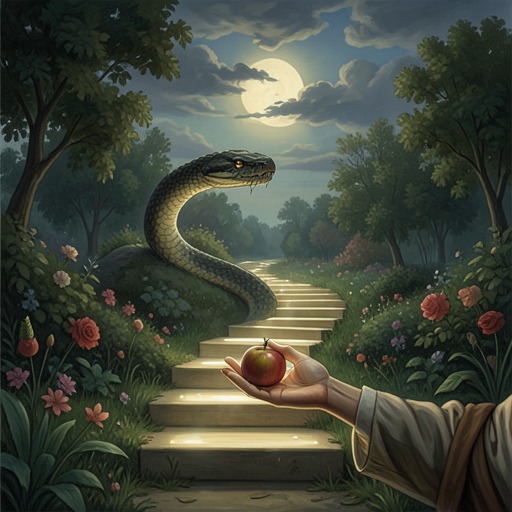
The serpent that Satan inhabits is not yet the crawling creature associated with its later condition. It approaches Eve upright, balanced on a circular base of rising folds, with its head lifted high. Its crest, jewel-like eyes, burnished green-gold neck, and graceful coils make it pleasing rather than repulsive. The poem emphasizes that it is lovelier than other celebrated serpent forms associated with mythic transformations, giving the animal an appearance suited to attraction and admiration.
Its movement reinforces the deception. At first it approaches obliquely and cautiously, changing direction like a ship whose pilot adjusts sail near a river mouth where the wind repeatedly shifts. It curls its tail into playful wreaths within Eve’s sight, bows its crested head, smooths its neck, and fawns by licking the ground where she has walked. These gestures create a mute language of submission and wonder before the creature begins to speak. Eve is accustomed to the animals’ approach and obedience, so the serpent’s behavior initially belongs to the familiar order of Eden rather than signaling an immediate threat.
The Serpent as Speaking Tempter
When the serpent has secured Eve’s attention, Satan uses its tongue and voice to begin the fraudulent temptation. The opening speech flatters her as the sovereign marvel of creation, praises her resemblance to her Maker, and implies that the other creatures can only imperfectly recognize her beauty. It also suggests that she deserves a wider sphere of admiration than the secluded garden provides, preparing the emotional ground for pride and discontent.
The animal’s speech is therefore inseparable from its visual presentation. Beauty makes the approach welcome; submissive gestures make it appear safe; native subtlety makes its intelligence seem plausible; and articulate praise turns those advantages toward manipulation. The serpent does not merely deliver an argument. Through Satan’s inhabitation, it performs a carefully staged transition from creaturely attractiveness to persuasive authority.
Narrative and Thematic Significance
Serpents unite the poem’s celebration of natural abundance with its account of corruption. In the creation scene, the serpent belongs to a world in which every kind is brought forth complete, richly varied, and obedient to God. In the temptation scene, the same order of nature becomes vulnerable to hostile appropriation. The creature itself is not shown choosing rebellion; rather, Satan selects its form because its qualities can be made to serve an alien purpose.
This distinction gives the serpent a double significance. It remains an impressive part of the created world, marked by bodily variety and unusual beauty, yet it also becomes the visible surface of an invisible enemy. Its apparent gentleness conceals malice, and its natural subtlety becomes the means by which falsehood enters human deliberation. The serpent consequently stands at the threshold between the innocent creation and the Fall: neither the ultimate author of evil nor a neutral background creature, but the embodied medium through which Satan’s intelligence reaches Eve and the created world’s harmony begins to break.