Son of God
Paradise LostThe Son of God is the decisive mediator between God and creation in Paradise Lost. He is presented not merely as a heavenly prince but as the Father’s expressive Word, wisdom, and active power, the appointed head of the celestial orders, the voluntary ransom for fallen humanity, and the future judge and universal king. His defining action is a movement from divine glory into chosen humiliation and back into triumphant exaltation: he enters the mortal condition in order to restore what Adam’s disobedience has corrupted.
Identity and Divine Status
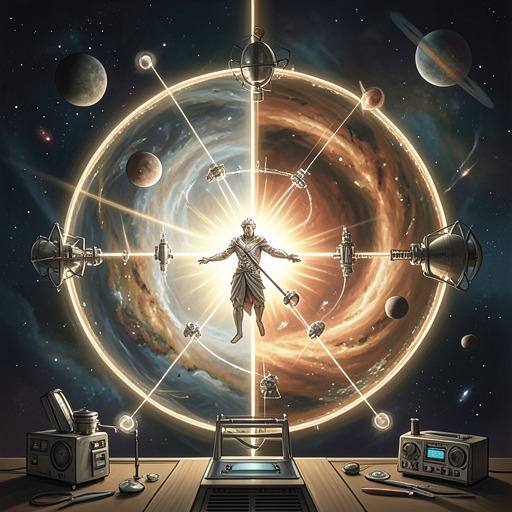
The Son of God appears within the heavenly order as the one in whom the Father is substantially expressed. During the assembly before creation, God declares him the only Son, anoints him on the holy hill, places him at his right hand, and appoints him Head over the angelic powers. Obedience to the Son is therefore obedience to God, while refusal of his authority is treated as rebellion against the divine unity itself. The Son’s kingship is not presented as a private seizure of power but as an office established by the Father’s decree, through which the Thrones, Dominations, Princedoms, Virtues, and Powers are to remain united.
This status becomes the theological target of Satan’s revolt. Satan recasts the Son’s anointing as an illegitimate demand for submission, asking why beings who regard themselves as free and equal should bend the knee. Abdiel answers that the Son is not an alien tyrant but the head of the angelic nature, and that honor given to him returns to the order from which the angels themselves derive. The conflict thus turns on competing accounts of freedom: Satan treats freedom as exemption from a superior head, while the poem presents ordered dependence upon the Son as the condition of a more perfect unity.
The Son’s authority is also creative. In Raphael’s account of the celestial summons before the making of the world, the angels gather beneath their hierarchies before the Father, with the Son seated in divine intimacy at his side. Later, when the created universe is brought into being, the Son proceeds as the Father’s effective agent. His participation joins authority to action: the Father decrees, and the Son gives that decree visible and operative form.
Counsel for Fallen Humanity
After Adam and Eve have fallen, the Father declares that humanity cannot simply be abandoned to the sentence of death. Human beings were created free, and their fall was not forced by divine decree; nevertheless, their disobedience leaves them unable to restore themselves. The Son responds not by disputing justice but by asking how grace can find a means of saving those who are dead in sin and possess no adequate offering of their own.
The Son then offers himself without compulsion. He proposes life for life, asking that the Father’s anger fall upon him and consenting to leave the divine bosom and glory for the sake of mankind. His offer is both substitution and self-emptying: he accepts mortality while retaining the power of indestructible life, so that death may take what can die without holding him permanently. His anticipated resurrection is already contained within the offer. He will enter the grave, rise victorious, strip Death of its claim, and lead the powers of darkness captive.
The exchange is not treated as a simple mechanical payment. The Son’s life becomes the place where justice and mercy meet. Humanity’s debt is real, because disobedience has incurred a sentence that cannot be dismissed as though justice were merely generosity; yet the payment is made by love rather than by an unwilling victim. The Son’s willingness gives the ransom its moral and theological force, transforming punishment into an act of redemptive solidarity.
The Father accepts the proposal and explains its consequence. The Son must join human nature to divine nature, become human among humans, and be born from virgin seed. As Adam is the root through which humanity falls, the Son will become a second root through which those who are restored receive new life. Adam’s crime brings guilt upon his descendants, while the Son’s merit is imputed to those who renounce their own claims to righteousness and live by faith in him. Humanity therefore satisfies for humanity, but only because the Son freely assumes humanity and supplies the obedience that fallen people cannot provide.
Incarnation, Obedience, and Atonement
The Son’s incarnation does not diminish his divine status. The Father explicitly presents his descent as the path by which his goodness becomes more glorious: although equal with God and enthroned in supreme bliss, the Son gives up his position for the salvation of the world. His greatness is measured less by height or inherited privilege than by the abundance of his love. Humiliation therefore becomes the source of exaltation, and the assumed human nature is raised with him rather than discarded as a temporary instrument.
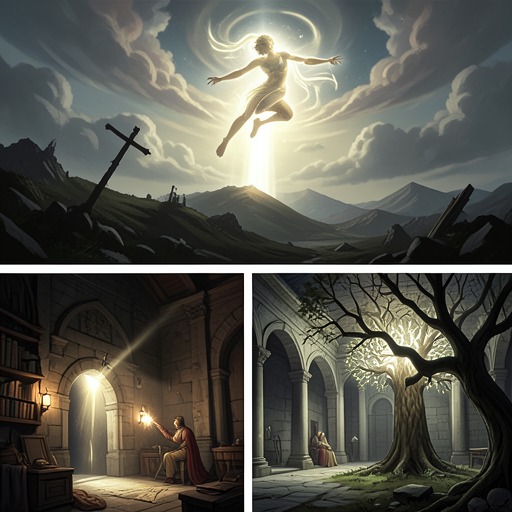
Michael’s later prophecy makes the mechanism of redemption more precise. The Son will fulfill the law through obedience and love, then endure the death owed to Adam and his descendants. He will live under hatred, blasphemy, arrest, judgment, and a shameful execution by crucifixion. Yet the Cross reverses the apparent triumph of his enemies: the law standing against humanity and the sins of mankind are figuratively fastened there with him, so that they no longer destroy those who rightly trust in his satisfaction.
His death is followed by resurrection before the third dawn. The grave cannot retain him, and his rising becomes the payment that releases humanity from the death it should have suffered. The poem distinguishes this redemption from mere automatic acquittal: its benefit belongs to those who accept it by faith, with faith not emptied of works. The Son’s obedience is counted as theirs, while his merit, rather than their legal performance, becomes the ground of salvation.
The Son’s victory is directed against a structure of evil rather than against Satan alone. His death wounds the two principal powers of the adversary, Sin and Death, and destroys the works through which Satan harms Adam’s descendants. Satan is not simply annihilated in a duel; his power is defeated by the Son’s obedience, suffering, and resurrection. The promised bruise to the serpent’s head is therefore a moral and redemptive reversal, while the wound to the victorious heel remains the cost of entering the flesh and accepting death.
Judge, King, and Universal Mediator
The Son’s mediating office continues after resurrection. He remains on Earth only long enough to appear to his disciples, then commissions them to teach all nations what they have learned from him. Their preaching is no longer restricted to the physical descendants of Abraham but extends to all who share Abraham’s faith. Baptism becomes the outward sign of cleansing from guilt and preparation for a life oriented toward salvation, even when that life may culminate in a death resembling the Redeemer’s.
His ascension is portrayed as a victory through the air. He rises above his enemies, captures the serpent prince of the air, drags him in chains through his realm, and resumes his seat at God’s right hand. The movement completes the pattern established by the incarnation: the one who descended into human nature returns in glory, carrying redeemed humanity with him in promise and establishing his authority above every name in Heaven.
The Son is also appointed judge. When the world reaches its dissolution, he will return in glory and power to judge both the living and the dead, condemning the unfaithful while receiving the faithful into bliss. The earlier heavenly decree already anticipates this tribunal: all knees in Heaven, Earth, and Hell will bow, and the Son will judge bad men and angels. His judgment is not detached from his sacrifice. He is able to temper justice with mercy because he has already undertaken the burden that justice imposes and has become mankind’s Friend, Mediator, Ransom, and Redeemer.
His final kingship extends beyond the present order. He will reign as the anointed universal King, with Thrones, Princedoms, Powers, and Dominions reduced beneath his supreme headship. After judgment, the old world will burn and give rise to a new Heaven and Earth in which the just dwell through golden days marked by joy, love, and truth. At the end of that restorative order, the regal scepter will no longer be necessary, because God will be all in all; the Son’s kingship thus culminates not in perpetual political display but in the completed unity of divine creation.
Relationships and Narrative Role
The Son’s primary relationship is with the Father, and the poem renders it through mutual delight, obedience, and shared purpose. The Father calls him the Son of his bosom and sole complacence, while the Son speaks as one whose will is perfectly aligned with the Father’s eternal purpose. This filial obedience is not passive submission. It is an active willingness to undertake the work that no other heavenly being will accept when the celestial choir stands mute before the human sentence.
His relationship with Adam is structured as both contrast and substitution. Adam is created in the image of God, given dominion over the living world, and placed under a single prohibition; the Son becomes the second root of mankind after Adam’s disobedience. Where Adam’s failure transmits corruption and death, the Son’s obedience transmits merit and life. The contrast does not erase Adam’s responsibility, but it opens a path by which the effects of his fall can be overturned.
The Son’s relation to Satan is likewise defined by reversal. Satan seeks equality with God, rejects the Son’s rightful headship, and attempts to make human beings repeat his rebellion through deception. The Son answers this pride not by imitating its logic but by accepting the lowest condition: flesh, suffering, and death. Satan’s strategy converts freedom into self-exaltation; the Son reveals freedom as the capacity to give oneself for others without abandoning justice.
The Son also stands in a special relation to human history. The ancient laws, sacrifices, Tabernacle, and mediating office of Moses are presented as anticipations of his greater work. The prophets identify the promised seed, the royal descendant of David, and the Messiah whose reign will have no end. His birth from a Virgin, announced by an angel to shepherds and recognized by Eastern sages through gifts of incense, myrrh, and gold, brings these strands together: divine sonship, human descent, kingship, and universal blessing converge in one figure.
Thematic Significance
The Son of God embodies the poem’s central logic of fall and restoration. Creation brings light out of darkness; the Son brings life out of death. Human disobedience produces a moral wound that cannot be healed by denial, sacrifice of lesser value, or human effort alone, but the Son’s willing self-offering converts the same history into the occasion for greater mercy and glory. The pattern is not that evil becomes good in itself, but that divine love can answer evil without being overcome by it.
His story also gives the poem’s theology an economy of merit and gift. Adam loses an inheritance through disobedience; fallen humanity has no adequate price with which to recover it; the Son supplies the life, obedience, and suffering required for restoration. Yet the exchange remains gracious because the payment is freely offered and because its benefits are received through faith rather than purchased by human achievement. Redemption therefore exceeds an equivalent transaction: the giver’s love is greater than the loss it repairs.
Finally, the Son provides the poem’s most sustained answer to the political question raised by rebellion. Legitimate authority does not rest on raw force, nor does freedom require absolute independence from every superior order. The Son is rightful king because he is appointed by the Father, because he belongs to the created hierarchy as its head, and because his rule is confirmed by self-sacrificial goodness. His authority reaches its highest expression precisely when he accepts the cost of saving those beneath him. In that paradox, kingship becomes service, judgment is joined to mercy, and divine power is most fully displayed as love.