The world was all before them
Paradise Lost“The world was all before them” is the decisive closing expression of Paradise Lost. It gathers the poem’s final reversal into a single image: Adam and Eve have lost Paradise, but they have not been left without a future. Before them lies a world in which they must choose a place of rest, while Providence guides their uncertain passage. The line therefore holds grief and possibility in the same frame, ending the poem not with restoration to Eden but with companionship, responsibility, and an unfinished human history.
The Scene of Departure
The expression occurs after Adam has learned from Michael that knowledge alone is insufficient and that wisdom must be joined to faith, virtue, patience, temperance, and love. Michael tells him that such inward qualities will enable him to possess “A Paradise within thee,” a transformed understanding of what can survive the loss of the garden. Adam then returns to Eve, who has awakened from a consoling dream and is ready to leave with him. Her willingness gives the departure its emotional center: remaining in Eden without Adam would itself be a form of departure, whereas going with him is, for her, a way of staying together.
Eve also carries a promise into exile. Although she acknowledges that her crime has caused their banishment and that everything has been lost through her, she is comforted by the assurance that through her the Promised Seed will restore what has been ruined. The future represented by the expression is therefore not merely geographical space. It includes the long historical prospect of restoration, a prospect made possible through the descendants of Adam and Eve.
Loss, Choice, and Providence
The world appears before the expelled couple as both burden and possibility. They must choose their place of rest rather than return to the place that once defined their happiness. Their future is no longer sheltered by the conditions of Eden; it is marked by wandering, labor, sorrow, and the consequences of disobedience. Yet the line refuses to reduce the future to punishment alone. Choice remains, and Providence is named as their guide.
This combination changes the meaning of expulsion. Eden is closed behind them, but the entire world opens ahead. The flaming sword at the eastern gate makes the separation final: the garden is guarded by dreadful faces and fiery arms, and the climate itself is scorched by the sword’s heat. The visible violence of the boundary contrasts with the breadth of the world beyond it. Human history begins under judgment, but it begins in a space larger than the lost sanctuary.
Adam and Eve Together
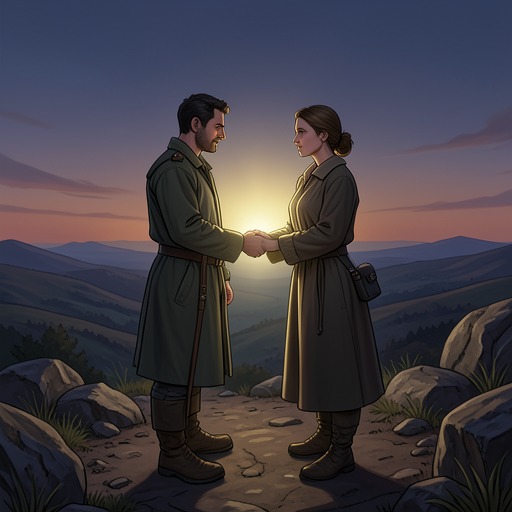
The expression depends on the couple’s physical and emotional movement together. The archangel directs the “lingring Parents” toward the eastern gate, and Adam and Eve descend from Paradise hand in hand, taking “wandring steps and slow” through Eden. Their gestures make the line relational rather than merely individual. They do not face the world as isolated figures; they face it as a pair whose shared future has been made possible, paradoxically, through the catastrophe that expelled them.
Eve’s speech establishes the depth of this attachment. She tells Adam that he is all things to her under Heaven and that every place is defined by his presence. Her response transforms the apparent choice between staying and going: without Adam, staying would be unwilling departure; with Adam, going becomes a form of continued union. The final image thus gives personal fidelity a place beside Providence. The couple cannot recover their former home, but they can carry their bond into the world that awaits them.
The Final Image and Its Significance
Before looking forward, Adam and Eve look back. They see the eastern side of Paradise overwhelmed by the flaming sword, and they shed natural tears before quickly wiping them away. The tears acknowledge the irreparable loss of the State of Innocence, while the act of wiping them suggests that sorrow will not wholly determine what follows. Their movement is slow and solitary, but it is not static: they continue through Eden toward an unknown place of rest.
The expression’s force comes from its refusal of a simple ending. Paradise is closed, yet the poem ends with a world rather than a void; the pair is banished, yet not abandoned; they are sorrowful, yet guided. The phrase also converts spatial openness into moral and historical possibility. Adam and Eve must now live under mortality and the consequences of the Fall, but they also carry the promise of deliverance through the Seed. The last image therefore joins Fall and Restoration: the old home disappears behind them, while a difficult future opens ahead, and the poem closes on the threshold of human history rather than at the end of hope.