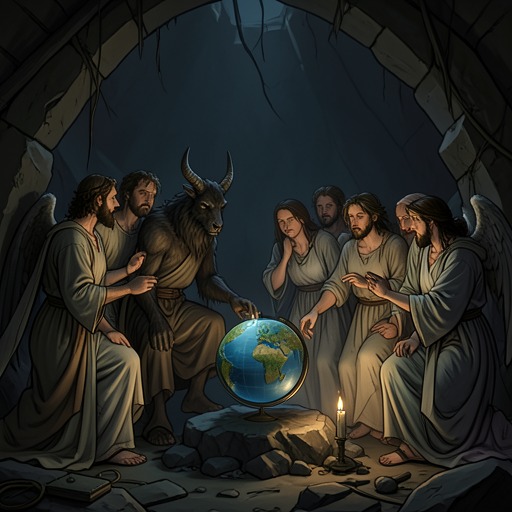
Who overcomes by force hath overcome but half his foe
Paradise Lost“Who overcomes by force hath overcome but half his foe” is a strategic maxim spoken by Satan in the aftermath of the Rebel Angels’ defeat. It converts military failure into a doctrine of continued resistance: force may secure submission or inflict damage, but it cannot by itself conquer the adversary’s inward purpose. The line therefore becomes the governing principle of Satan’s next response to defeat, shifting the conflict from open battle toward secrecy, deception, and design.
Immediate Context
The maxim appears while Satan addresses the fallen host in Hell. His listeners are not a small remnant but vast legions: millions of spirits who have been expelled from Heaven and condemned to pain because of the revolt. Their ruined condition is visible in the scene around them, yet Satan still presents them as a power capable of collective action. The speech thus answers a crisis of morale as much as a military loss.
Satan acknowledges that the battle has revealed the superior might of the ruler of Heaven and has also clarified the limits of the rebels’ own strength. He does not pretend that the previous contest ended in anything other than defeat. Instead, he argues that the loss has supplied knowledge: the rebels now understand the power they challenged, and they can avoid repeating the same kind of direct confrontation. The maxim marks that intellectual adjustment.
Meaning and Strategy
The sentence distinguishes bodily conquest from total victory. Force has overcome only half of the foe because an enemy is more than an army that can be routed; an enemy also possesses counsel, memory, desire, and the ability to devise another form of action. In Satan’s reasoning, the defeated host retains precisely this unmastered half. Their weapons have failed, but their minds have not been captured.
This distinction authorizes a change in method. Satan proposes that what force could not achieve may be attempted through “fraud or guile.” The contrast is deliberate: open violence belongs to the failed past, while covert planning becomes the instrument of the future. The maxim is therefore not a detached aphorism. It is the compact formulation of a practical program, explaining why the rebels should preserve resistance rather than accept submission.
Relation to the Rebellion
The maxim also protects the meaning of the original revolt. If defeat by force automatically amounted to complete defeat, the rebellion would end with the fall from Heaven. Satan refuses that conclusion. He interprets the surviving capacity for thought and choice as a remainder that military power cannot erase, and he uses that remainder to keep the defeated community politically and psychologically intact.
His argument depends on a sharp contrast between external condition and internal stance. The Rebel Angels are exiles in Hell, deprived of their former place and glory, but their deprivation has not made them obedient. Their continued ability to deliberate gives the defeat a second phase. The battlefield has been lost; the conflict itself has not been dissolved.
Consequences in the Narrative
The speech immediately produces collective action. After Satan declares that open or concealed war must be resolved upon, millions of flaming swords are drawn from the thighs of the mighty Cherubim. The blaze illuminates Hell, and the fallen host clashes weapons against shields while directing defiance toward Heaven. Their military display confirms the emotional and political effect of the maxim: it turns defeat into renewed mobilization.
The next movement develops the shift from force to organized resource. A brigade travels to a hill whose glossy surface conceals metallic ore, and Mammon leads the labor. The fallen spirits cut into the hill and excavate gold, preparing the material basis for their infernal enterprise. The sequence makes Satan’s principle concrete: resistance survives not only as rhetoric but as planning, labor, technology, and the conversion of Hell into a place capable of sustaining opposition.
Literary and Thematic Significance
As an expression, the line condenses a paradox at the center of Satan’s position. He admits the supremacy of the power that defeated him while denying that supremacy the ability to determine the whole future. The concession gives his defiance strategic credibility, but it also reveals its limitation: the rebels’ freedom is being redirected into an endless opposition whose methods increasingly depend on deceit.
The maxim’s force lies in its portability. It can describe a military defeat, a political struggle, or any conflict in which coercion suppresses conduct without changing conviction. Within the poem, however, its first function is precise: it supplies the intellectual bridge between the failed war in Heaven and the covert designs that follow. Physical defeat becomes the condition for a more secretive form of antagonism, and Satan’s refusal to equate defeat with surrender becomes one of the defining principles of the continuing conflict.