Clare Kendry’s exposure and death
Passing (Nella Larsen Edition)Clare Kendry’s exposure and death is the novel’s climactic event: John Bellew discovers Clare’s concealed Black ancestry at a gathering, and moments later she has fallen from the window. The sequence makes a private racial secret publicly legible, but leaves the circumstances of Clare’s death unsettled. Through Irene Redfield’s narrowed, interrupted perception, the scene joins the danger of racial classification to an equally consequential uncertainty about what Irene saw, remembers, and is willing to say.
Background and Stakes
Clare’s life depends on John Bellew accepting her as white. His arrival at the gathering turns that concealed identity into an immediate confrontation. Before entering the room, he argues with Dave Freeland, insisting that Clare is with the Redfields and that he knows this because he has visited them. His assertion connects his discovery to Irene and Brian Redfield’s household, where he has encountered people whose racial identity he did not recognize. At the door, Brian challenges him, but John pushes past those present and advances toward Clare.
The confrontation carries stakes beyond a marital disclosure. The novel’s historical and critical context describes Racial passing as a response to a society in which racial identity was tied to legal status and the material privileges of whiteness. Under the One-drop rule, supposed Black ancestry could override visible appearance; the passing figure therefore exposed how unstable the distinction was even as custom and law enforced it. John’s discovery makes that contradiction intimate and immediate: a racial boundary he treated as certain becomes a crisis inside his own marriage.
Exposure at the Gathering
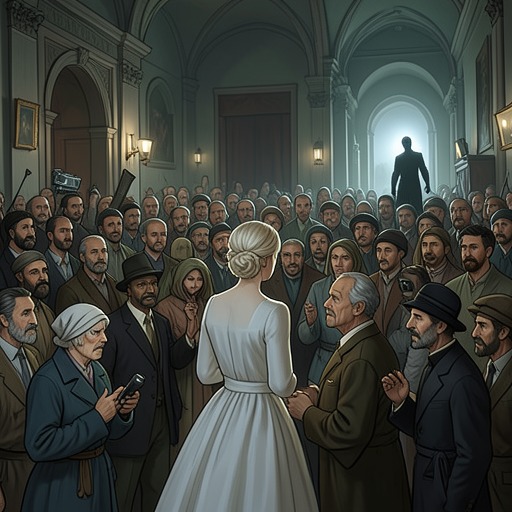
John names Clare’s Black identity in an outburst of rage and pain. The room shifts at once: people move toward him, while Felise Freeland places herself between John and the others and warns him that he is the only white man present. Her response makes the gathering’s racial composition explicit and checks the authority John assumes on entering. Brian is also among those confronting the disturbance, but John’s attention remains fixed on Clare.
Clare stands at the window, composed while the people around her stare. The scene presents her life as having collapsed in the eyes of those assembled, yet she shows a faint smile. That expression unsettles Irene more than John’s accusation alone. Irene runs to Clare and touches her bare arm; her response is governed by the thought that she cannot bear to have Clare rejected by John, but cannot bear to have her free either. The two impulses expose the possessive and conflicted character of Irene’s attachment at the precise moment when Clare’s marriage and racial passing are being publicly undone.
The Fall and Its Immediate Aftermath
The narration breaks at the decisive instant. Irene never afterward permits herself a clear recollection of what happens next: Clare is present, then gone. The interval between those two facts is not explained. John is left speechless among the people in the room, and the gathering’s attention turns from the exposure to the sudden loss. The event confirms Clare’s fall, but does not provide an unobstructed account of its cause.
Felise later answers that they think Clare died instantly. Irene struggles against a sob of thankfulness, then begins to cry convulsively; Brian wraps his coat around her and makes a limited attempt to comfort her. His own face is altered, his lips tremble, and his voice breaks as he speaks of Clare. Dave Freeland insists that Irene, who was beside Clare, should be heard. The emotional aftermath is therefore also a demand for testimony: Irene is not merely a shaken witness but the person whose account may shape how the death is understood.
An official asks Irene whether Clare fell or whether her husband pushed her, noting that Dr. Redfield appears to suspect a shove. Irene says that John did not push Clare, that she was close by, and that Clare fell before anyone could stop her. She then collapses. The official later says that death by misadventure is the likely finding and proposes another examination of the window. The provisional wording does not resolve the gap in Irene’s recollection; it records an administrative conclusion while leaving the reader with the scene’s missing moment.
Legal Context and Narrative Significance
The reference to the Rhinelander case sharpens the event’s connection to law and racial classification. In that highly publicized case, Leonard Kip Rhinelander sought an annulment of his marriage to Alice B. Jones by alleging that she had misrepresented her ancestry. Jones countered that he knew her racial status before their marriage, and Rhinelander eventually acknowledged prior knowledge. During the trial, the jury was made to inspect her skin, and the verdict exonerated her from fraud. The case dramatized the clash between visible appearance, intimate knowledge, and legal claims about race that the scene around Clare also brings into view.
The broader account of Whiteness as property and the legal enforcement of racial hierarchy makes John’s exposure of Clare more than a discovery about one person. The novel links private marriage to a public order that protects the color line, while the passing body reveals the limits of any supposedly reliable visual test of race. At the same time, the ending refuses the certainty that such a system seeks: Clare’s identity has been exposed, but the cause of her fall remains indistinct, and Irene’s account is inseparable from her fear, attachment, and incomplete memory. The death closes the immediate confrontation without making its final instant fully knowable.