Clare Kendry’s fatal fall
Passing (Nella Larsen Edition)Clare Kendry’s fatal fall is the unresolved climax of Clare Kendry’s decision to pass as white: at a Christmas party, John Bellew exposes her Black identity, and she falls from a sixth-story window. The novel refuses to determine whether her death is accidental, suicidal, or caused by another person. Instead, the fall gathers force from a series of earlier warnings and from the conflicting actions of Bellew and Irene Redfield, leaving both the racial boundary Bellew asserts and Irene’s role in the events morally unsettled.
Background and Stakes
Clare’s death recalls the conventional ending of the nineteenth-century passing narrative, in which a passer discovered between Black and white worlds dies and the racial order is restored. Yet the resemblance is uneasy. Clare has successfully performed whiteness, a success that exposes the instability of the essentialist assumptions supporting that order. Her death may remove her from a society that offers her no secure place, but it does not make the racial categories that govern her life appear natural or coherent. The apparent restoration of order comes at the cost of revealing its violence and contradictions.
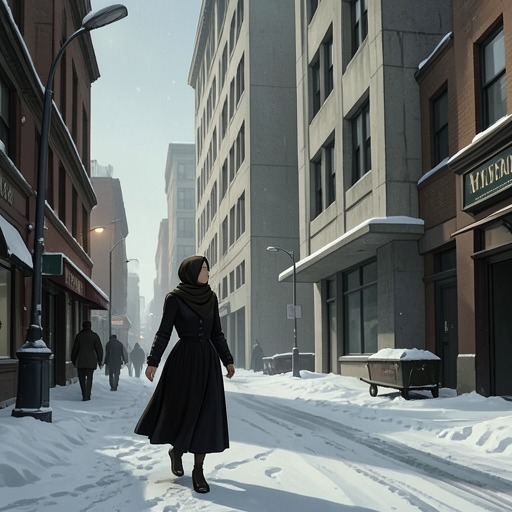
The fall also completes a sequence of forewarnings. Irene tears Clare’s offending letter into tiny ragged squares and scatters them from a train railing. Later, Irene’s boiling rage accompanies a slight crash and a shattered cup; dark stains dot the bright rug. These images do not explain what happens at the party, but they give the ending a pattern of broken objects, dispersed fragments, and damage that cannot simply be undone. As Irene and Clare climb to the Freelands’ sixth-story apartment, Brian Redfield jokingly warns Clare not to fall by the wayside. Shortly afterward, Irene opens the long casement windows, finishes her cigarette, and watches its tiny spark descend toward the white ground. The height, the open window, and the falling spark anticipate the fatal drop without settling its cause.
Exposure and Fall
At the party, Bellew’s verbal accusation identifies Clare as Black and redraws the color line he had believed she could not cross. His words do more than disclose her identity: they make the boundary audible at the instant Clare’s position in the white world collapses. The narrative links accusation and fall so closely that Bellew’s speech can be read as a symbolic push, though it does not establish that he physically pushed her. Clare stumbles across the line that his words enforce, and falls through the blackness of night toward the whiteness of the snow below.
The physical circumstances remain deliberately unsettled. Clare may have fallen accidentally, jumped, or been pushed from the sixth-story window; the narrative supplies no tangible proof that privileges one explanation. Afterward, Irene hears a strange man attribute the death to misadventure. That description offers an outwardly accidental account, but it cannot close the question. The uncertain cause is central to the event: the reader is left to weigh an accident against suicide or homicide without being given evidence sufficient to convert suspicion into certainty.
Irene’s Role and the Unresolved Cause
Irene is implicated not as a confirmed physical cause of the fall, but through what she withholds. After inadvertently encountering Bellew, she considers telling Clare that Bellew might have discovered her racial identity. Irene fears Clare would not avert the consequences of exposure and suppresses the words she is on the verge of speaking. Her silence thus becomes an indirect link in the chain leading to the party: the warning that might have changed Clare’s choices is never delivered.
That omission is shadowed by Irene’s earlier wish that Clare would die. Irene has imagined Clare’s death as a way to be rid of the menace Clare represents to her desired permanence; even while trying to drive the thought away, Irene feels faint and sick. This desire does not prove that Irene causes the fall, just as her silence does not establish that she intends the outcome. It does, however, make her relation to the death more troubling than that of a detached witness. Bellew’s accusation and Irene’s failure to speak implicate them in different ways, without resolving whether the fatal act itself was an accident, suicide, or homicide.
Aftermath and Narrative Significance
The event ends without a reliable account of its cause or a clear resolution for Irene. The novel returns the reader to Irene’s memories, a narrative assembled through scenes of reading and recollection rather than a secure explanation of what happened. At the conclusion, Irene cannot reliably read or remedy her own situation. Her knees give way; she moans and sinks down, and the heaviness around her deepens until everything is dark. The ending withholds the certainty that might turn the fall into a settled verdict, leaving Irene’s consciousness—and the reader’s account of responsibility—unresolved.
Clare’s death therefore invokes the tragic conclusion of earlier passing narratives while disrupting the reassurance those conventions could provide. The ending restores neither a stable racial order nor a definitive moral account of individual guilt. Bellew’s accusation enforces the color line; Irene’s silence contributes to Clare’s exposure; and the exact cause of the fall remains unknowable. The final darkness is not an answer to the competing interpretations but the point at which the narrative ceases to make them legible.