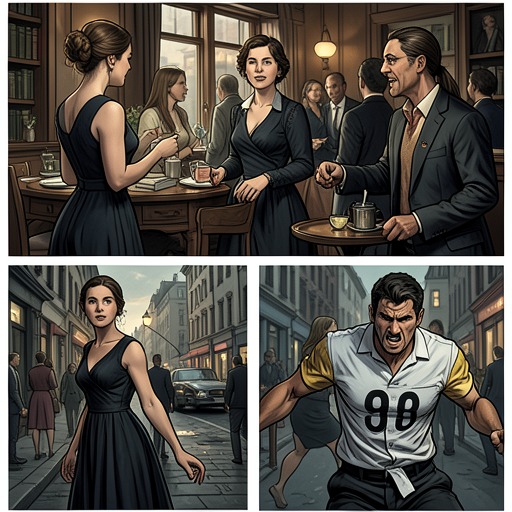
Clare falls from the window and dies
Passing (Nella Larsen Edition)Clare falls from a window and is presumed dead in a scene whose central fact is also its central uncertainty: Irene Redfield is close enough to touch Clare, yet cannot or will not remember what happened at the decisive moment. The event turns on a sudden disappearance, Irene’s insistence that it was an accident, and an official inquiry that leaves the circumstances unsettled. It closes Clare’s immediate presence in the story while making Irene’s account, and her relation to what happened, newly difficult to read.
The Scene and Its Stakes
The scene finds Clare Kendry at a window, composed while the people around her stare in curiosity and wonder. The life that had appeared intact is now, in Irene’s perception, in fragments; Clare nevertheless appears either unaware of the danger or unconcerned by it. A faint smile remains on her face. That composure is not a simple sign of safety: Irene experiences it as maddening, and her response is charged by fear and urgency.
Clare’s husband, John Bellew, is part of the immediate crisis. Irene thinks she cannot allow Clare to be cast aside by him, but also cannot allow her to be free. The two impulses stand side by side without being reconciled. They make Irene’s intervention significant beyond its physical circumstance: she acts at the instant Clare’s future appears to be changing, yet her thought does not resolve into a clear wish to protect, release, or retain her. The text records Irene laying a hand on Clare’s bare arm. It does not provide a clear account of what follows that contact.
The Missing Moment
The narration breaks at the point where a definitive account might be expected. Irene never afterward allows herself to remember what happened next, and cannot remember it clearly. The story gives two sharply contrasting images instead: Clare is present as a vivid, glowing figure, and then she is gone. This gap is not filled by an eyewitness explanation. The event’s immediate result is visible, but its physical cause remains withheld.
That formal interruption makes the fall more than a reported accident. Readers receive Irene’s perceptions and later statements, but not an unambiguous description of the crucial action. The uncertainty does not establish that Irene caused Clare’s fall, nor does it settle that she had no part in it. It places the reader in the same evidentiary difficulty Irene faces, while keeping her own failure or refusal to remember at the center of the scene.
Irene After Clare Disappears
Irene stays behind and sits very still, staring at a Japanese print on the wall across the room. The fixed image provides a precise counterpoint to the scene’s missing instant: while the account of Clare’s disappearance is broken, Irene’s attention settles on an ordinary object. Her stillness does not answer what happened. It marks the interval in which she tries to understand what the others may conclude.
She considers two possibilities others might believe: that Clare fell, or that she deliberately leaned backward. Irene then rejects a further possibility without completing it. She mutters that it was an accident and repeats the assertion with fierce insistence. The repetition is evidence of what she wants to establish, not independent proof of the event’s mechanics. Her words hold the scene’s immediate explanation in place even as the narration has denied the reader a clear view of the fall.
Later, the possibility that Clare may not be dead becomes terrifying to Irene. She grips the banister to steady herself and experiences intense physical distress. That question complicates the apparent finality of Clare’s disappearance: Irene is not simply responding to a settled report, but confronting the uncertainty of what has happened and what may still be true. The account does not disclose what she would have done had Clare survived, so the significance lies in the fear itself rather than in an imagined consequence.
Testimony and Official Assessment
An authoritative, official-sounding man asks Irene whether she is sure Clare fell and whether her husband pushed her, noting that Dr. Brian Redfield seems to think he may have. Irene denies that John pushed Clare. She says she was present and as close to Clare as he was, and maintains that Clare simply fell before anyone could stop her. Her statement offers a direct account of her position at the scene, but it does not repair the missing moment she has already said she cannot remember clearly.
The official’s initial assessment is death by misadventure, expressed as a belief rather than an account supported by a fully narrated sequence. He proposes going back to examine the window. The investigation therefore remains open at the point where the excerpt ends: Irene has given a firm denial, Brian’s suspicion has been reported, and the official has offered a provisional conclusion while seeking another look at the physical setting. No definitive explanation of the fall is supplied here.
Narrative Consequence
The event shifts the story from the danger surrounding Clare to the problem of how her disappearance will be understood. Irene’s proximity makes her both a witness and a person whose own incomplete memory is implicated in the account. Her insistence on accident, Brian’s apparent suspicion, and the official’s questions create competing interpretations without confirming any one of them. The distinction between what Irene remembers, what she says, and what the reader can know becomes part of the event’s consequence.
Clare’s fall also gives concrete force to the conflict Irene’s thought registers: she cannot bear Clare being cast aside by John, yet cannot bear Clare being free. The scene does not explain that contradiction away. Instead, it leaves Irene with the missing moment, the Japanese print, and the need to answer questions about what she witnessed. Clare’s absence becomes final in the room, while the meaning and cause of her death remain suspended between accident, suspicion, and Irene’s broken recollection.