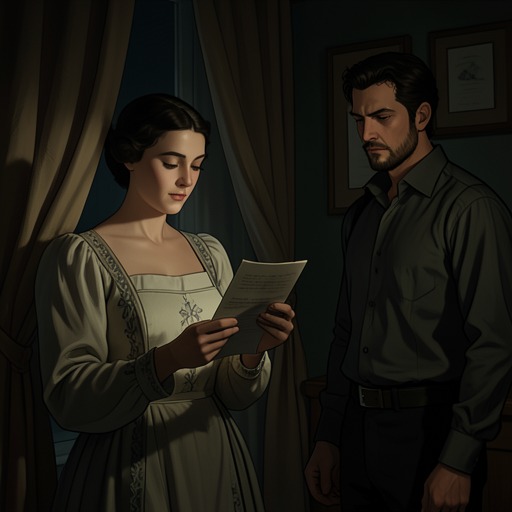
Irene conceals her encounter with Bellew
Passing (Nella Larsen Edition)Irene’s concealment of her encounter with John Bellew turns a chance meeting into a deliberate silence with consequences for Clare Kendry and Irene’s marriage. She recognizes that John may have understood who she is and what her presence with Felise Freeland implies, yet she withholds the encounter from both Clare and Brian Redfield. Her hesitation is not simply fear or loyalty: it exposes the conflict between racial solidarity and her determination to keep her life intact.
The wish and the encounter
Before the meeting, Irene had wished that John would discover Clare was spending his absences in Harlem, because that knowledge might end Clare’s hold on her life. But Irene did not want him to discover Clare’s Black ancestry. The distinction matters: Irene imagines a way to be rid of Clare without exposing her to the danger of being identified as Black by her white husband.
The very next day, Irene goes downtown shopping with Felise. On a bitterly cold, windy day, the two women cling to each other as they turn onto Fifty-seventh Street and collide with a man. Irene looks up and recognizes Clare’s husband. John greets her as Mrs. Redfield, removes his hat, and extends his hand. His genial smile quickly fades; surprise and disbelief cross his face, followed by what Irene reads as understanding.
Recognition and refusal
John’s attention shifts to Felise, whose golden complexion and curly black hair make her Black identity apparent. Her arm is still linked with Irene’s. Irene becomes sure that John has grasped the significance of seeing her in Felise’s company, and she also notices his displeasure. Although he does not immediately withdraw his offered hand, Irene does not take it.
Instead, she masks her recognition and looks at him as if she does not understand who he is. When he continues to stand with his hand outstretched, she gives him the cool, appraising stare she reserves for unwanted male attention and draws Felise onward. The encounter is thus marked by two opposed gestures: John offers a public acknowledgment, while Irene refuses to confirm their connection. She does not tell Felise who he is, either.
The warning she considers
Afterward, Irene regrets not introducing John to Felise with the explanation that he is Clare’s husband. She understands that her instinctive loyalty to Black people has shaped her response, despite her resentment toward Clare and her sense that Clare has shown little consideration for her. Irene cannot separate Clare from the larger community or herself from Clare; her frustration lies partly in recognizing that this solidarity persists even when it conflicts with her personal wishes.
Irene then considers warning Clare. She has not seen her for days, and neither writing nor a telephone call seems safe. Even if she could reach Clare, Irene doubts a warning would avert what was coming: if John was certain of Clare’s identity, the encounter had already set events in motion. Alongside this reasoning, Irene feels relieved at the possibility that she may be rid of Clare without having acted or spoken. The impulse to warn and the relief at not having to do so coexist.
Silence as a choice
Irene means to tell Brian about meeting John. At dinner with their sons, however, she cannot bring herself to say that she encountered Clare’s husband downtown and believes he recognized her while Felise was present. She senses that the simple report would sound like the warning she wants to give. The evening passes without her speaking; after going upstairs, she still intends to tell Brian when he comes up.
Her reluctance becomes clearer when she considers what might follow if Clare were free of her marriage. Irene fears that Clare might then want Brian. In Irene’s assessment, Clare has obtained what she desires through conquest and sacrifice, and money or social position might not restrain her if circumstances changed. Irene is already prepared to preserve the outer form of her own marriage even while questioning whether she has ever truly loved Brian; she would rather share him than lose him altogether. In this context, telling Brian about John could weaken Irene’s ability to hold on to him.
Consequences and significance
Irene finally resolves that neither Clare nor Brian will hear about the meeting from her. She also intends not to tell either of them that John appears to be nearing the truth about Clare’s identity. Her earlier failure to acknowledge John now becomes a decision to protect her own position through continued silence. What began as an instinctive response on a windy street has hardened into a policy of concealment.
The episode makes Irene’s motives deliberately difficult to reduce to either loyalty or self-interest. Her awareness of racial solidarity prevents her from treating Clare as wholly separate from herself, yet her fear of losing Brian shapes what she chooses to hide. The encounter gives Irene information that could have served as a warning, but she withholds it from the person most directly endangered by John’s suspicions. Her silence preserves uncertainty while placing her own security ahead of disclosure.