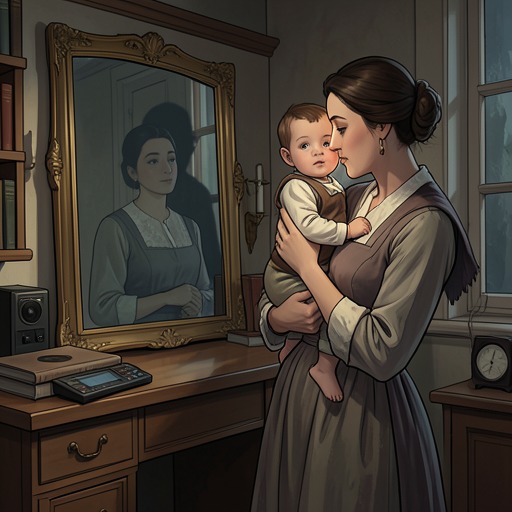
Margery Bellew
Passing (Nella Larsen Edition)Margery Bellew, the daughter of Clare Kendry and John Bellew, is a child whose importance in the story exceeds her brief, offstage presence. Her mother’s fear that Margery might be born dark, and later her anxiety that John Bellew might discover her own Black ancestry, make Margery both a loved daughter and a vulnerable point in the family’s precarious arrangement. Irene Redfield invokes that vulnerability to argue that Clare’s choices could endanger the child; Clare, in turn, identifies Margery as the one remaining restraint on her wish to live freely in Harlem.
Identity and Background
Margery is ten years old when Clare mentions her during Irene’s visit. Clare invites Irene to tea and says that Margery will be there, along with John Bellew if his business leaves him free. The expected family introduction does not take place: Clare later explains that she and John had gone to visit his relatives near Milwaukee, while Margery wanted to stay with the children. Clare presents the decision as an accommodation to her daughter, particularly in the heat of the city. Margery is therefore introduced through family plans and her mother’s account, rather than through her own words or actions.
That absence is significant to the way the story establishes her. Margery is named and described by adults, but the evidence gives no account of how she understands her family, her mother’s racial identity, or the arrangements governing her life. The reader encounters her chiefly as Clare’s daughter and as someone whose future the adults anticipate, fear, and debate. Her characterization remains limited, but the consequences attached to her are repeatedly made concrete.
Birth and the Fear of Racial Discovery
At tea, Clare explains that she has no sons and does not expect to have any. She recalls spending the nine months before Margery’s birth terrified that the baby might be dark. Clare says that Margery was born light enough to reassure her, and that she will never risk another pregnancy. Her account turns the expected joy of childbirth into a period of fear governed by the racial categories surrounding the family. Margery’s birth is presented not simply as a private maternal event, but as a moment when Clare feared that her concealed identity might become visible through her child.
Gertrude Martin responds with complete comprehension, while Irene says nothing. The exchange reveals how the women understand the danger Clare describes, but it does not show what Margery herself knows. Her mother’s relief that she “turned out all right” belongs to Clare’s fearful perspective and to a racial order that treats visible signs of ancestry as consequential. Margery is not responsible for that order, yet her appearance becomes bound up with her mother’s ability to maintain the life she has made with John Bellew.
Schooling and Separation
Later, Margery has been left at school in Switzerland while Clare and John Bellew prepare to return there in early spring, possibly in March. Clare complains about the approaching departure and says she would be happiest if she could remain in New York City alone for a couple more months. Irene answers by reminding her that Margery is there and that Clare may be glad to see her after the separation. Clare rejects the idea that children are everything, adding that there are other things in the world. Her response does not establish that she lacks affection for Margery; it shows instead that motherhood does not erase her longing for a life beyond family obligations.
The projected return to Switzerland places Margery within a family schedule largely determined by her parents. She is already away at school, and Clare speaks of the coming reunion as an obligation mixed with anticipation and resistance. Irene reads the separation as a reason Clare might welcome going back, but Clare’s answer exposes the limits of that reassurance: the prospect of seeing her daughter cannot, by itself, satisfy her desire to remain in New York City. The tension is not resolved by any action from Margery, who remains absent from the conversation.
The Stakes of Clare’s Choices
When Clare argues that one more risk cannot matter because no one is entirely safe, Irene answers by making Margery the central consequence. Irene warns that if John Bellew discovers Clare’s racial identity, Clare could lose her daughter, and that even if Margery remained with her, the child’s life would be changed. Irene also imagines the lasting harm if Margery later learned that her mother had concealed her ancestry. These are Irene’s predictions and arguments, not reported outcomes: the passage does not establish that John has discovered the truth or that Margery knows it.
Irene’s appeal changes the terms of their dispute. Rather than treating Clare’s risk as a private choice, she insists that a mother must consider her child’s security and happiness. Clare is visibly struck by this argument and calls motherhood cruel; Irene agrees, then emphasizes its responsibility. Margery thus becomes the measure by which Irene challenges Clare’s willingness to accept danger. The episode also makes clear that the protection Irene invokes is fragile: it depends on Clare’s identity remaining undiscovered and on assumptions about what John Bellew and Margery would do if the truth came out.
Margery as a Restraint and Narrative Presence
In a later conversation, Irene asks what Clare would do if she acted on what she wanted most. Clare says she would come to live in Harlem, where she could do as she pleased. When Irene asks about Margery, Clare says that her daughter is all that holds her back; if John Bellew discovers the truth and the marriage is broken, Clare reasons, that barrier would be removed. The statement gives Margery a decisive place in Clare’s imagined future, even though the child is not present. Clare’s longing for independence and her acknowledgment of attachment coexist in the same answer: Margery restrains her, but Clare also frames that restraint as contingent on the marriage’s survival.
Margery’s narrative function is therefore not reducible to a symbol of innocence or to a simple reason for Clare to stay. She is a daughter whose welfare is invoked by Irene, whose absence and schooling mark the family’s separation, and whose existence complicates Clare’s desire for freedom. The novel does not supply Margery’s own perspective or settle what she knows. Instead, it shows how adults project danger, duty, and choice onto her future. That silence keeps the stakes unresolved: Margery matters deeply to the decisions around her, while remaining outside the scenes in which those decisions are made.