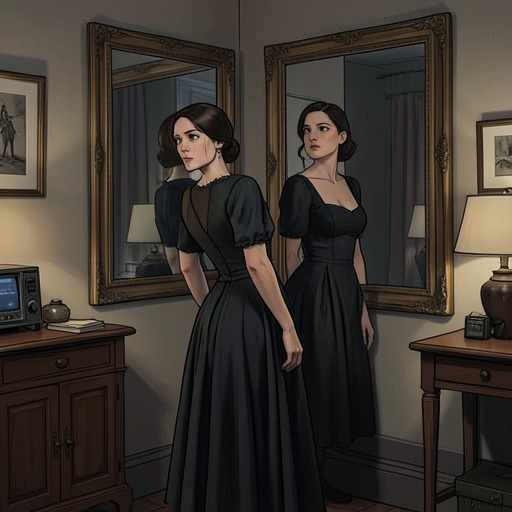
Irene withholds her warning to Clare about Bellew
Passing (Nella Larsen Edition)Irene Redfield withholds a warning to Clare Kendry after an inadvertent encounter with John Bellew, a silence that becomes one possible link in the chain leading to Clare’s exposure and death. Irene’s failure to speak is consequential without being a proven cause: the novel presents her silence alongside Bellew’s later accusation, while leaving the circumstances of Clare’s fatal fall uncertain.
The withheld warning
On the verge of telling Clare about her encounter with Bellew, Irene fears that Clare would not avert the consequences of being exposed. That fear checks the words already gathering in her; she represses what the narrative calls the “flood of speech on her lips.” The warning she withholds is therefore not simply unspoken information. It is information Irene believes may fail to protect Clare, and her anticipation of that failure helps explain why she does not deliver it.
The narrative describes this silence as Irene’s “failure to speak” and, in retrospect, as “keeping back information.” Those formulations make the omission legible as an action with stakes, even though its outcome cannot be known in advance. Irene does not control whether Bellew will discover Clare’s identity, but she does control whether Clare hears of the encounter from her before that discovery.
Fear, safety, and the threat Clare represents
Irene’s hesitation is bound up with her own desire for permanence. Earlier, the thought that Clare might die makes Irene feel “faint and sick”; she tries to drive away the possibility because Clare’s presence represents a “menace” to the security of Irene’s established life. The episode places that desire beside Irene’s concern about warning Clare, exposing a conflict between self-preservation and an opportunity to help her friend prepare for exposure.
The evidence does not establish that Irene withholds the warning in order to cause Clare harm. Rather, it shows her fearing that disclosure would not change what followed, while also revealing how Clare’s return unsettles the permanence Irene wants to preserve. Her silence thus carries a double weight: it may spare Irene an immediate confrontation, yet it leaves Clare without information that could matter when Bellew confronts her.
Consequence and unresolved responsibility
Bellew’s later accusation that Clare is Black redraws the color line through speech. The account describes his words as effectively pushing Clare across that line, where she stumbles into her fatal fall. In this sequence, Irene’s silence can be read as an indirect condition of the tragedy, while Bellew’s accusation is the immediate verbal act that coincides with Clare’s fall. Neither fact alone settles what physically happened: Clare may have fallen, jumped, or been pushed from a sixth-story window, and the novel supplies no tangible proof favoring one explanation.
At the conclusion, Irene hears a stranger attribute Clare’s death to “death by misadventure,” but that label does not resolve the competing possibilities or erase the implication of either Bellew or Irene. The narrative returns the reader to Irene’s memories, yet Irene cannot reliably read or remedy her own situation; she sinks toward unconsciousness rather than reaching a clear judgment. Her withheld warning remains significant precisely because its possible consequence is visible while her responsibility, like the manner of Clare’s death, remains unresolved.