
The City's Birthday Ritual
PeacemakerThe national celebration turns a family birthday into a public ritual that joins political legitimacy, numerical belief, and civic participation.
increasing Bearing strength in each event
 decreasing
Bearing strength in each eventdecreasingFortunate Numbers

Fortunate Numbers
A decision made auspicious
The College of Numerology returns favorable numbers for Cajeiri’s birthday event. Tabini uses the result to confirm a public celebration and ultimately a formal investiture.
Belief and governance
The numbers do not replace political judgment; they give a culturally powerful frame through which a decision can be accepted and understood. The aiji’s choice becomes stronger because it aligns with a recognized public tradition.
The novel treats numerology neither as simple superstition nor as mechanical fate. Its force lies in the way shared belief organizes political expectation, allowing a ruler to present an uncertain future as a moment of collective confidence.
The City Takes Part
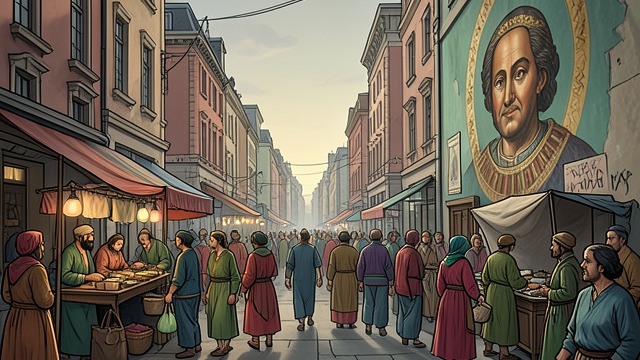
The City Takes Part
Streets prepared for celebration
The Festivity brings vendors, public transport, banners, and crowds into Shejidan. The city’s established routines make it possible to transform a ruler’s decree into a broad civic event on short notice.
A public answer to loss
The celebration also covers the shock of Komaji’s murder and the unrest surrounding the Kadagidi. Its scale declares that the political community remains intact and capable of gathering for a fortunate event.
The public ritual does not make grief or danger disappear. It places them within a larger account of continuity, showing how shared ceremonies can answer political uncertainty without pretending that the underlying conflicts are settled.
The Heir's Public Voice
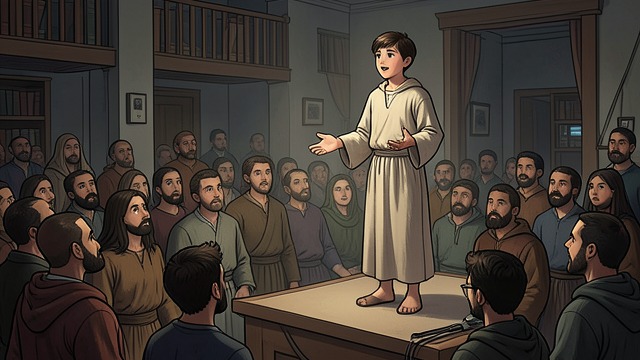
The Heir's Public Voice
Speaking beyond the script
Cajeiri forgets the prepared address and speaks from memory of the people who taught and protected him. He connects learning and art to a wish that the aishidi’tat become a beautiful and peaceful home.
The audience responds
The speech is irregular but sincere, and the crowd answers Ilisidi’s invocation of long life and good fortune. The kabiuteri can interpret the boy’s words through the ritual framework even though he has departed from the planned text.
Cajeiri’s unplanned address joins personal feeling to public responsibility. He does not yet rule, but he begins to show how an heir can make inherited traditions speak to his own hopes rather than merely repeat them.
the day Tabini receives the favorable numbers
the evening before the ninth birthday
during the Audience Hall ceremony
