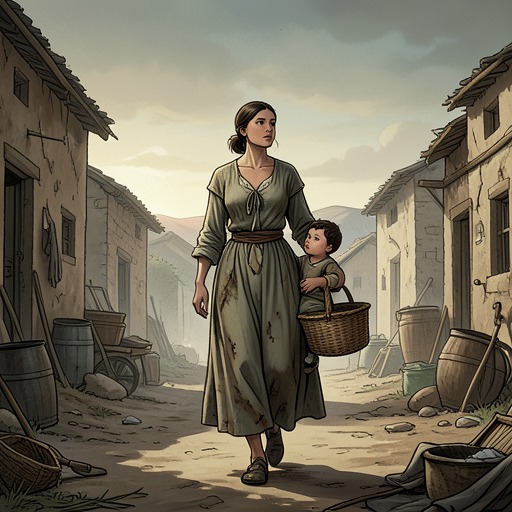
Abundio Stabs Pedro Páramo
Pedro PáramoAbundio Stabs Pedro Páramo grows out of a plea for help with a burial. After Refugio dies, Abundio’s grief, poverty, and drunkenness bring him to Pedro Páramo’s door, where his request for money ends in a fatal attack.
Background and Immediate Cause
Refugio has died the previous night, around eleven. Abundio has kept watch over her body, and says he sold even his donkeys to make her final hours easier. When asked whether there will be visitors for the wake, he says there will be none; he wants alcohol to ease his grief. The exchange makes clear that he is facing both bereavement and the practical cost of burying his wife without support.
Abundio is deaf, so the conversation with the woman he addresses as Mother Villa is marked by misunderstanding: he cannot hear what she says and asks her to repeat herself. The scene leaves his grief plain but gives him no communal consolation. His request for alcohol instead becomes part of the chain of events that carries him away from home and toward Pedro Páramo.
The Approach and the Plea
The drink does not send Abundio home as he intended. Though Refugio is waiting there, he changes direction, climbs the street, and leaves the village wherever the road takes him. Its strength makes him cough and sneeze; he gulps it down, fanning his mouth with his shirt, and soon staggers so badly that he sometimes goes on all fours. The narration renders his intoxication as a struggle with the ground itself: it seems to rear, spin him around, and fling him away, slipping from his grasp whenever he tries to catch it.
Pedro Páramo, seated near a doorway, notices the approaching figure and calls for Damiana Cisneros of Media Luna to see what he wants. Abundio stops before him and asks for charity so he can bury his wife. When Damiana presents a cross and prays for deliverance from the snares of evil, Abundio shudders. He takes her terror as a sign that the demon may have followed him, turns to look for a terrible apparition, and, finding no one, repeats his request for help burying his dead wife. The appeal is plain, but the encounter has already become distorted by drink and fear: the plea for burial is met not with assistance in the scene, but with a gesture of spiritual alarm.
The Attack and Its Aftermath
Damiana Cisneros of Media Luna’s cries that Pedro Páramo is being killed carry across the fields. His face disappears beneath the blankets, as though he is trying to shield himself from the light. Abundio Martínez hears the shouting but cannot work out how to stop it; the cries hurt his ears, and his thoughts are hard to grasp. In the middle of the violence, his mind turns to Refugio, alone in the courtyard where he had placed her to keep her cool. He remembers her as she was the day before, alive and close to him, and recalls their child, who died shortly after birth. The attack thus unfolds alongside the loss that brought him to Pedro’s door: his plea for burial money and his memories of his wife occupy the same fractured moment.
When other men reach Pedro, they disarm Abundio, who is still holding the bloodied knife, and take him away. He says he is drunk; as the men drag him back toward the village, his toes furrow the earth. Pedro’s face reappears, and he only moves his head. From his chair, he watches the procession recede. His left hand, which he tries to raise, falls inert onto his knees, but he does not concern himself with it. He has grown accustomed to feeling a part of himself die each day. The holy tree on the Media Luna path shakes and sheds its leaves as he sees the others departing, a last image of departure that folds the immediate aftermath into his longer sense of loss.
Pedro turns from the procession to memories of Susana San Juan. He recalls asking her to return and dwells on a moonlit image of her, while the present slips away. When he tries to lift a hand to clarify the vision, his legs hold him as if made of stone; his other hand falls to the ground and braces his failing shoulder. He recognizes this as his death. In the sun, the devastated land lies empty, and the movement of his eyes passes from one memory to another until the present is erased; his heart stops, and with it, it seems, time and the breath of life.
Even then, Pedro answers that he will come and tries to walk, leaning on Damiana Cisneros of Media Luna. After a few steps he falls without speaking, his unvoiced supplication ending in a hard impact with the earth. His body collapses like a heap of stones. Abundio’s attack has brought the landowner’s death, but Pedro’s final consciousness remains fixed on Susana, so that the fatal encounter closes not with reconciliation or a response to Abundio’s appeal, but with Pedro returning inward to the loss that had already emptied his world.
Narrative Significance
The encounter’s final irony lies in the gap between what Abundio asks for and what the scene becomes: a request for help burying his wife is absorbed into a spectacle of terror, violence, and departure. His deafness and intoxication fracture communication at the very moment when a practical appeal might have connected him to another person; Damiana’s cross is read through his fear, while her alarm turns the encounter into a public cry. The scene’s images then widen beyond the confrontation. The holy tree sheds leaves as the procession recedes, and Pedro’s failing body gives physical form to the same departure. Abundio’s act ends Pedro’s life, but the closing movement belongs to Pedro’s inward return to Susana, leaving the request that began the encounter unanswered.