Ana
Pedro PáramoAna is Father Rentería’s niece and a central witness to the violence Miguel Páramo committed against her family. She says Miguel killed her father and sexually assaulted her in the night, then encounters the consequences of his death through a burial whose identity she cannot confirm by sight. Her story links intimate harm to Comala’s religious life: the man she asks the saints to condemn is also the dead man for whom her uncle, under pressure and with Pedro Páramo’s gold before him, performs a blessing.
Identity and Place in Comala
Ana lives within the religious and domestic world of Comala as Father Rentería’s niece. Her uncle’s position gives her access to him as both family and priest: she can speak with him about what Miguel did, and she knows the moral teaching he has given her. He has taught her that one should not hate anyone, a lesson she recalls at the moment when she is confronted by the person she understands to have killed her father. Her account makes that teaching neither abstract nor easy; it becomes a principle she tries to act upon under extreme coercion.
The narrative also places Ana among the parish’s ordinary religious routines. On a morning when Father Rentería returns home late, she asks where he has been and tells him that several women have come seeking confession before the first Friday of the month. He says they will have to return that evening. The detail situates her in a household connected to the church’s pastoral work, without making her herself a confessor or suggesting that she speaks for the women. Her presence marks the everyday obligations surrounding her uncle’s priesthood, in contrast with the grave moral compromises that attend Miguel’s funeral.
Assault and the Limits of Recognition
Ana recounts that Miguel claimed he had come to apologize and ask forgiveness. She was in bed and did not move; she told him the window was open, and he entered. His explanation presented the visit as an attempt at reconciliation, but what followed was another violation: he came to kiss her and then climbed on top of her and did what she understood to be wrong. The gap between his professed apology and his conduct is decisive. In her account, asking forgiveness does not repair the harm or prevent him from repeating it.
The darkness governs what Ana can know. She says she could not see Miguel’s face, neither during the assault nor afterward; she identifies him because he announced who he was. She describes smiling because she remembered her uncle’s instruction not to hate anyone, hoping Miguel would understand the gesture. Yet she also realizes that he could not see her smile, since she could not see him. That small, failed communication exposes the distance between her attempt to respond with kindness and the physical reality of the encounter, in which Miguel controls what happens to her.
Ana thinks Miguel may kill her. She says she stopped thinking and tried to die before he had finished, then understood that she was still alive when morning light entered through the open window. For a time, she had felt as though she had ceased living. Her account gives the aftermath no easy resolution: waking establishes survival, but it does not make the assault an apology or restore the sense of safety the night destroyed. She also tells her uncle that she knew Miguel had killed her father, though she had never seen him. Her knowledge of him is thus bound to violence and to what he says about himself, rather than to a face she could recognize.
Miguel’s Burial and Ana’s Uncertainty
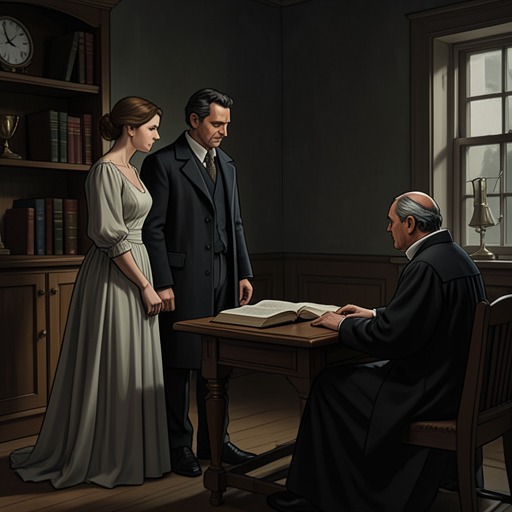
At the funeral, the corpse lies on a catafalque in the church among new candles and flowers; Pedro Páramo, Miguel’s father, waits alone behind it. Father Rentería initially refuses to bless Miguel, declaring that he was a wicked man who would not enter Heaven. He then turns away from his refusal: despite his trembling hands, he sprinkles holy water over the body and kneels. The priest’s action makes the funeral a struggle between judgment and intercession, not a straightforward confirmation that Miguel has been forgiven.
Pedro kneels beside Father Rentería and names the grievances against his son: the killing of the priest’s brother, the assault on his niece Ana, and other offenses and disrespect. He urges the priest to forget them and forgive Miguel, then places a handful of gold coins on the kneeler as an offering for the church. The material gift accompanies the appeal for mercy. Ana is not present in the scene as a participant, but her assault is explicitly invoked in the negotiation over the dead man’s standing before God. The priest’s blessing follows even after he has publicly resisted it.
Later, Father Rentería asks Ana whether she remembers Miguel and whether she is sure it was he who was buried. She lowers her head and says she cannot be sure: she never saw his face, because he surprised her at night in the darkness. She explains that she knew the assailant was Miguel because he told her his name. This leaves a striking distinction between the name she heard and the body the community buries. Ana does not retract her account of the assault, but she cannot verify the corpse visually; the funeral’s apparent certainty exceeds what her own senses can establish.
Kinship, Prayer, and the Question of Forgiveness
Ana’s response to Miguel’s death is shaped by both her knowledge of his violence and her belief in prayer. She says she asked all the saints with fervor to send him to the depths of Hell. Father Rentería cautions her against being certain of that fate: Miguel may have many people praying for him, he says, while Ana is alone, and some prayers may be more ardent than hers. He thinks of telling her that he has granted Miguel forgiveness, but chooses not to wound her already half-broken spirit by saying so. His silence protects her from an immediate disclosure, while also keeping from her the fact that the priest has yielded to Pedro’s appeal.
The funeral scene makes that withheld fact especially consequential. Ana’s uncle is at once the priest who performs the rite and her relative, whose brother Miguel killed and whose niece Miguel assaulted. Pedro’s money and request for forgiveness enter that family grief through the church’s ritual authority. Ana’s account, by contrast, insists on the particular experience that the rite risks smoothing over: the darkness, her inability to see, the name Miguel gave, and the morning when she woke after believing she had died. The conflict is not simply whether Miguel’s soul can be saved; it is also whether a public act of absolution can do justice to the living person who bears the harm.
Narrative Significance
Ana’s testimony complicates the certainty surrounding Miguel’s identity and death. She knows the assailant by his spoken self-identification, but cannot recognize his face, and so cannot say with confidence that the buried body is his. That limit does not erase what she experienced; instead, it separates the certainty of violence from the uncertainty of bodily recognition. The distinction gives her account force without making her an all-knowing witness.
Her encounter also tests the religious language of apology, hatred, and forgiveness against conduct and consequence. Miguel presents his visit as a request for pardon, while Ana’s remembered teaching leads her to smile; neither gesture prevents the assault. Later, Father Rentería performs a blessing after first refusing, and Ana remains unaware that he has privately decided to pardon Miguel. Through her, the novel places the language of mercy beside a harm that cannot be undone, and shows how family power and church ritual can shape the dead man’s fate while the injured woman is left with uncertainty.