Armed upheaval during the Mexican Revolution
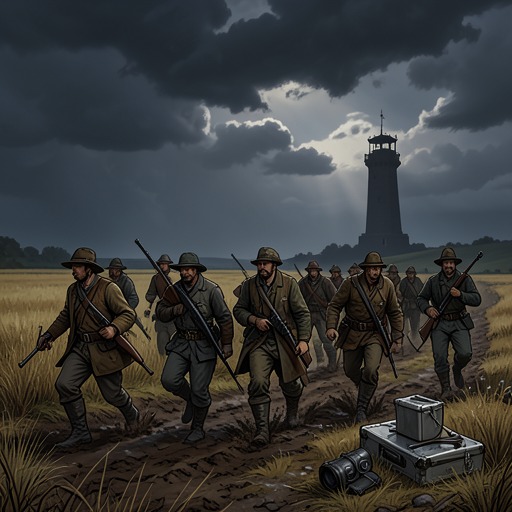
Pedro PáramoArmed upheaval during the Mexican Revolution unsettles the order don Pedro has built around Media Luna, but it does not simply displace that order: he seeks to bargain with the insurgents, supply them, and turn their violence toward his own purposes. The sequence runs from disputed boundaries and a steward’s death to alliances made over dinner, the redirection of Damasio’s troops, and, finally, don Pedro’s decision to let Comala go hungry. Revolution appears both as a challenge to local domination and as another instrument that a powerful landowner tries to manage.
Land, debt, and the local law
The unrest takes shape against a background of property claims and financial pressure. At Media Luna, Fulgor Sedano reports that the estate has sold its last cattle and still owes money. Don Pedro responds by directing him to pursue marriage to Dolores Preciado, whose property at Enmedio is an important asset. In the same conversation, Fulgor raises Toribio Aldrete’s boundary claim: Aldrete has measured the land and wants the missing section of fence put in place. Don Pedro rejects that limit, insisting that the estate’s land should have no enclaves and ordering Fulgor to make the boundaries conform to his claim.
Fulgor’s formal complaint against Aldrete invokes usufruct, but Aldrete treats the paper as a pretext rather than an effective legal instrument. He mocks its usefulness and recognizes that Fulgor has acted at the direction of his patron. The exchange gives legal language a double role: it supplies a documentary appearance of procedure, while the underlying contest is decided by the estate’s power to impose its version of ownership. Don Pedro makes the principle explicit when Fulgor asks about the law: he says that they will make the law themselves. He instructs Fulgor to dismantle Aldrete’s fences and to accuse him under whatever legal heading comes to mind.
This coercive order also depends on people and resources. Fulgor’s plans are not confined to paperwork: don Pedro tells him to send men to visit Aldrete, while directing him to settle other claims and obligations in ways that strengthen the estate. Later, during heavy rain, the great gate of Media Luna opens and a procession of horsemen—continuing to roughly two hundred—rides out to move cattle from Enmedio beyond the former Estagua and drive Estagua’s herd toward the heights of Vilmayo. Fulgor gives instructions as the riders leave. The scene makes the estate’s reach visible in the movement of livestock and armed labor across the countryside.
The killing of Fulgor Sedano
The revolutionary challenge becomes immediate when an armed band meets Fulgor and an unnamed companion near the water outlets, where they have gone to investigate falling water levels. The men identify Fulgor as Media Luna’s steward and declare themselves revolutionaries who have come for don Pedro’s lands. They order Fulgor to go back and tell his patron that they will meet him there. He flees on horseback, but the attackers kill him while he is running. His companion remains still, waits until night, and then carries the news to Media Luna.
The killing turns a contest over estate power into a direct threat to don Pedro. Fulgor had been the agent who converted instructions into boundary disputes, legal accusations, and the management of the ranch. His death therefore removes not only a trusted steward but also a practical intermediary between the landowner and the local order he has enforced. Don Pedro’s response is not to retreat: he tells the messenger that the revolutionaries may come to him, and sends him to find the Boa, whom he wants summoned.
Bargaining with the revolutionaries
A group of about twenty armed men later arrives at Media Luna carrying rifles and ammunition belts. Don Pedro invites them to dinner. They sit without removing their hats and wait in silence, eating chocolate and then black beans with tortillas. The meal is a negotiation staged on the estate’s ground: the men arrive as opponents, but don Pedro receives them as potential partners and asks what service he can provide once they have eaten.
The group does not speak with one voice. One man says they have rebelled against the government and against don Pedro because they are tired of enduring his rule, calling him a bandit and a thief. Another suggests waiting for instructions before deciding what comes next. Don Pedro asks what the revolution will cost and offers support. When the men begin by discussing a sum of money, he offers one hundred thousand pesos. Asked how many fighters they have, they say three hundred; he offers a further three hundred men to increase their contingent. He distinguishes the gift of money from the loan of troops, who are to be returned when no longer needed. The arrangement turns rebellion into an exchange: armed men gain funds and reinforcements, while don Pedro retains a claim on the force he supplies.
Damasio and the widening conflict
The military situation continues to change. Damasio arrives with seven hundred men and some additional recruits, denying that he has been beaten. He explains that his men clashed with a much larger force from the north, associated with the Villistas, whose fighters plunder whatever they find. Don Pedro advises him to side with the stronger force. Damasio replies that he is already with them, but also speaks of what his men need.
Don Pedro redirects that need into an attack on Contla. Instead of asking him to seek more support from his patron, he tells Damasio to raid a wealthy town and take from its rich inhabitants. The advice is not an appeal to a shared revolutionary program: it treats the campaign as a way to obtain money and prove military strength. Damasio acknowledges that don Pedro’s counsel is useful. In this episode, don Pedro does not command the entire revolutionary movement, but he can shape the choices of an armed leader who depends on his resources and judgment.
From armed disorder to retaliation
The episodes reveal an unstable relation between local domination and revolutionary force. The insurgents denounce don Pedro’s conduct, yet he responds by financing one group and advising another how to extract wealth elsewhere. Meanwhile, his earlier assertion that the estate’s law is whatever he makes it is mirrored by a conflict in which armed groups can seize land, kill a steward, or impose their own authority. Neither formal legal procedure nor revolutionary allegiance guarantees a settled order.
After Susana San Juan is buried, the contrast between Media Luna and Comala becomes stark. The estate is silent and subdued, while the village continues celebrating despite the funeral bells; few in Comala appear to notice the burial. Don Pedro stays in his room and vows revenge on the town. He then makes his retaliation concrete by withdrawing his support and allowing Comala to starve. The armed upheaval has shown how power over land and troops can be exercised beyond ordinary law; this final act turns control of food into another weapon. The state of conflict thus reaches beyond battles between armed groups: don Pedro’s private command over the estate and its resources carries violence into the lives of the town’s inhabitants.