Catholic Church
Pedro PáramoThe Catholic Church in Comala is the principal institution that can administer confession, absolution, blessing, and funeral rites, yet its authority is repeatedly undermined by dependence on wealthy patrons and by the limits of its clergy. Its rituals remain visible and consequential, but they do not reliably secure forgiveness or even preserve the meaning of mourning: the Church’s prayers and bells can be crowded by money, fear, and public festivity.
Identity and sacramental authority
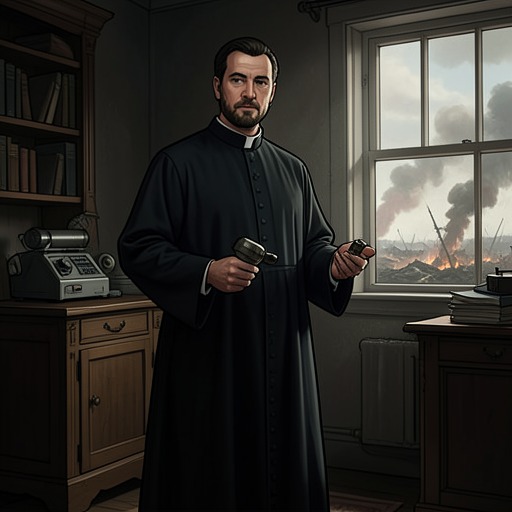
The Church’s local presence is represented chiefly through Padre Rentería and the rites he is expected to perform. His ministry gives him authority over absolution and the sacraments, while the visiting bishop represents a higher ecclesiastical judgment. The distinction matters: people seek the priest for immediate help, but his own conduct and capacity to grant that help are subject to scrutiny beyond Comala.
The Church’s power is most concrete at the boundary between sin and forgiveness. Miguel Páramo dies without absolution, and Padre Rentería initially treats that fact as decisive: he turns away from the body and leaves the church without blessing the congregation. The funeral is attended by people gathered around Miguel’s catafalque, its new candles and flowers, while his father, Pedro Páramo, waits alone behind it. The priest’s refusal does not hold. After Pedro kneels beside him and asks him to consider the wrongs Miguel committed—including the killing of the priest’s brother, the assault on Ana, and other offenses—Pedro places a handful of gold coins on the kneeler as an alms for the church. Padre Rentería then blesses the body with holy water and kneels in prayer. The scene makes the sacrament both a formal religious act and an encounter shaped by the patron’s wealth.
Clerical dependence and conscience
Padre Rentería’s private reckoning exposes the material pressure beneath his public role. He recognizes that those who sustain him are the people he fears offending, while the poor cannot support him and their prayers do not fill his stomach. He understands himself to have betrayed parishioners who trust him to intercede for them, and he questions what their faith has gained them when their souls still seem to need purification.
His recollection of María Dyada’s plea for her sister, Eduviges Dyada, brings that conflict into focus. María describes Eduviges as a woman who helped others, gave what she had, and sheltered men who later denied their children. Padre Rentería had refused to absolve Eduviges because she died by suicide, which he regarded as acting against God’s will and as a failure at the final hour. María answers by recalling the severity of her sister’s death and the suffering the priest himself had once acknowledged. Even the possibility of arranging further masses becomes entangled with expense: Padre Rentería says that elaborate services would require additional clergy and money. The episode presents religious judgment, pastoral compassion, and the cost of ritual as pressures that do not resolve into one easy answer.
Discipline, exclusion, and a priest under judgment
A woman in Comala recounts seeking the bishop when he visits to administer confirmation. She confesses that she and her brother live together and asks him to marry them. The bishop rejects the request, insists that shame does not absolve, and tells them to separate. In her account, this refusal leaves them without a path to an approved union; she connects the village’s many wandering, unpardoned souls with the scarcity of prayer and the sins of those still living. This is her explanation of Comala’s spiritual condition, and it shows how church teaching can be experienced as a judgment with consequences that outlast the encounter.
Padre Rentería is himself denied absolution when he goes to Contla for a general confession. The priest there condemns his failure to resist Pedro Páramo’s contempt for the Church and argues that the parishioners’ faith cannot be credited to him if it rests on superstition and fear. He also recognizes the difficulty of serving poor villages, but says that difficulty does not make Padre Rentería’s hands clean enough to absolve him. Padre Rentería asks whether his ministry will be suspended and then appeals for temporary permission to administer the last rites and the Eucharist, explaining that people in his village die constantly. The priest at Contla leaves judgment of the dead to God rather than granting the requested interim authority. The exchange makes the sacramental system a source of aid and a point of institutional discipline, while leaving the dying in Comala dependent on a priest whose own standing has been challenged.
Ritual in public life
The Church’s presence also takes collective form in its bells. On the morning of December 8, the ringing begins with the great bell and spreads to other churches. It continues through noon and into the night, growing into a single, prolonged lament. After three days, people are deafened and ordinary conversation is impossible. The tolling draws visitors from Contla and farther away; musicians, a circus, and fairground amusements arrive, and the gathering gradually becomes a celebration.
The shift exposes the distance between a rite’s intended meaning and its public reception. The bells are sounding for mourning, but those drawn to them cannot be made to understand that the days are days of grief or persuaded to leave. Meanwhile, Susana San Juan is buried at the silent Media Luna, where people walk barefoot and speak softly, while Comala fills with music, cockfights, shouting, and vendors. The bells communicate an event across the region, but their ritual signal does not command a shared response. The Church can mark death publicly; it cannot ensure that the community mourns together.