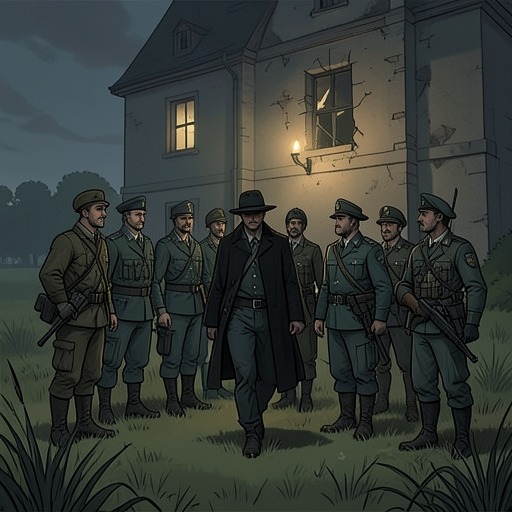
Damasio
Pedro PáramoDamasio, known as the Boa, is don Pedro’s armed agent during the revolutionary upheaval around Comala. His role shifts from carrying men and promises into the rebellion on his patron’s instructions to returning with a much larger force already aligned with the Villistas. The change makes him both an instrument of don Pedro’s local power and a participant in an armed movement whose strength makes that power answer to new demands.
Identity and Position
Damasio appears in conversation with don Pedro as the man don Pedro calls on to organize armed followers. His identification with the nickname the Boa is established when don Pedro asks the Boa who he thinks commands the insurgents, then addresses the same man as Damasio. The exchange places him close enough to his employer to discuss military command, money, and property directly, but the evidence gives no account of his earlier life or how he first entered don Pedro’s service.
Damasio presents fighting as an attraction in itself. When don Pedro asks whether he wants to take part in the revolt, he eagerly agrees and says he is already impatient for a fight. Later, he insists he would have joined for the pleasure of it even without the reward being offered. His enthusiasm is personal, while his position gives that appetite an organized form: don Pedro can direct it toward a political and military purpose.
Recruitment for the Insurgents
After observing a group of men, don Pedro asks Damasio who commands them. Damasio guesses that leadership belongs to a large man in the middle who kept his eyes lowered. Don Pedro corrects him: Damasio himself is to be the commander, unless he would rather stay out of the revolt. The order assigns Damasio authority rather than merely placing him among the followers, and turns don Pedro’s reading of the situation into a new responsibility for his agent.
Don Pedro directs him to gather three hundred trusted men and join the insurgents, telling them that he is bringing the men don Pedro promised. He leaves Damasio to handle the rest as he sees fit. The arrangement combines a precise initial task and troop number with broad discretion over how to carry it out; Damasio is made the intermediary between don Pedro’s resources and the rebel force.
The offer is not limited to military instructions. Don Pedro promises ten pesos for each man, enough for the insurgents’ most urgent expenses, and says the remaining money will be kept safely at Media Luna and made available to them. He also offers Damasio the small farm at Puerta de Piedra, to be put in his name through a document carried to Gerardo Trujillo, the lawyer in Comala. Don Pedro adds that Damasio should take some cattle because the farm lacks animation. In response, Damasio says the property will give his wife something to occupy herself with while he enjoys the fighting. The exchange binds enlistment to both immediate cash and a lasting material reward.
Return with a Larger Force
Later, don Pedro asks Damasio whether he has been beaten and why he allowed it to happen. Damasio denies the report, says that his troop is intact, and announces that he has brought seven hundred men, along with others who joined along the way. The number is more than twice the three hundred men in the original order. The account signals the scale of the force now at his disposal, though the available scene does not explain every step by which it grew.
Damasio describes a clash that began when some of his allies, tired of doing nothing, fired on what they mistook for a platoon of poorly dressed men but which turned out to be an entire army. He identifies that larger force as the Villistas, coming from the north and plundering whatever they find. His description stresses their power and reach: they seem to be moving across the land, testing every terrain, and no one can deny their strength. The incident supplies a practical reason that don Pedro’s earlier, smaller recruitment has become entangled with a much larger military presence.
When don Pedro asks why Damasio does not join the stronger side, recalling his own rule that one should always side with the powerful, Damasio replies that he is already with them. This answer marks a change in the relationship between patron and agent. Damasio has followed the force that don Pedro identifies as dominant, but his allegiance does not remove his dependence on don Pedro’s estate and resources.
Supplies, Dependence, and Significance
Asked why he has come to see don Pedro if he is already with the Villistas, Damasio asks for money. His men are tired of eating meat, he explains, and no one will extend them credit. They want provisions so they will not be forced to steal from nearby people. Damasio distinguishes their position from that of a force operating far away: distant neighbors might be robbed without the same personal cost, but the men have relatives in the surrounding area, and stealing from them would bring remorse. He reduces the immediate need to a vivid measure of ordinary food: they want enough money to buy a large, spicy corn cake.
The request exposes the limits of command by itself. Damasio can bring hundreds of armed men into the region and claim an alliance with the stronger force, yet their continued movement depends on food and cash. Their stated reluctance to rob local relatives contrasts with the Villistas’ indiscriminate plunder, while their dependence on don Pedro keeps the local patron in the position of supplier. Damasio’s scenes therefore trace a reciprocal but unequal connection: don Pedro recruits and rewards a fighter to extend his influence, while the fighter’s growing force returns to demand the means to sustain itself.