Dorotea's illusion about her son and posthumous plight
Pedro PáramoDorotea's illusion about her son and posthumous plight is a story of motherhood experienced as bodily certainty, then overturned by an afterlife revelation. For years she carries the conviction that she had a child; only after death does she accept that the child belonged to a dream. Her account to Juan Preciado joins this belated recognition to a life shaped by hunger, exclusion from salvation, and the charity she depended on. Even in the grave, her voice does not simply fall silent: it describes a soul released from the body while continuing to speak from the place where she has been buried.
Identity and the imagined child
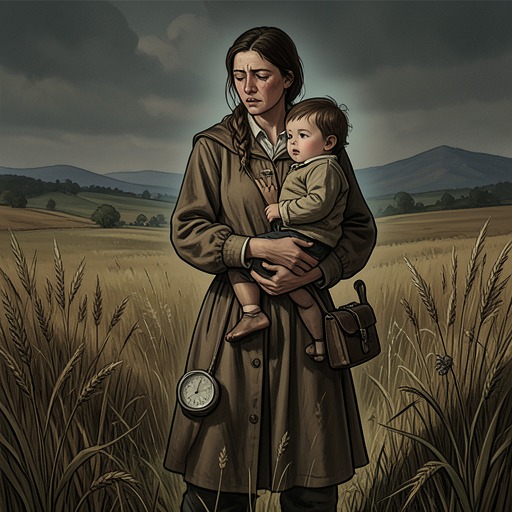
During her life, Dorotea was known in Comala as a poor woman who survived on alms. Damiana Cisneros of Media Luna says Dorotea came early to seek food, carrying a bundle in her shawl and rocking it as though it were a baby. Damiana suspects that some misfortune had befallen her, but Dorotea never discussed it, leaving the villagers without an explanation. The bundle and the rocking gesture make her imagined motherhood visible to others, even though its origin and history remain unknown to them.
Miguel Páramo asks Damiana about Dorotea and whether she is nearby. Damiana points out that she may be outside, following her usual routine. Miguel then reflects that Dorotea might be useful to him and calls her from the back door. The scene places her at the edge of other people’s purposes: she is recognized through the bundle she cradles and through her need for food, while the villagers do not know the private story that gives those actions their meaning.
A dream made bodily
In the grave, Dorotea explains to Juan Preciado that she had two dreams, which she later understood as blessed and cursed. The first convinced her she had borne a son. Her belief was not merely an idea she could set aside: she remembers feeling the infant in her arms, soft and full of mouth, eyes, and hands. For a long time, her fingers retained the impression of his lowered eyelids and the beat of his heart. She carried him everywhere, wrapped in her shawl, until she suddenly lost him. The physical vividness of this memory helps explain why the dream remained more persuasive to her than any absence of proof.
The second dream reversed the first. In Heaven, Dorotea searched among the angels for a face she could recognize as her son’s, but all the faces seemed made from the same mold. A saint put a hand into her belly as though reaching into wax and brought out something like a nutshell, presented as proof that she had never had a child. Dorotea tries to interpret the object as her stomach, shrunken by hunger and meager food. The vision allows no such correction: another saint ushers her out and tells her to rest longer on earth and try to be good, so that her stay in Purgatory will be shorter. She takes this encounter as the belated explanation of the dream that had sustained her maternal certainty.
Hunger, hope, and religious exclusion
The revelation comes only after Dorotea’s body has deteriorated. By the time she concludes that she never had a son, she says her body has shrunk, her back has bent until it rises above her head, and she can no longer walk. Her physical decline and the nutshell-like object in the vision converge around deprivation, but the vision gives that deprivation a religious meaning rather than accepting her explanation about hunger. The certainty of motherhood that once guided her is replaced by a judgment delivered in Heaven and a further sentence of earthly suffering.
Dorotea also recalls that Father Rentería told her she would never know Heaven, not even see it from afar, because of her sins. She regards the announcement as cruelly destructive because hope of being carried somewhere after death is what helps a person keep going through life. Once Heaven is closed and Hell seems the only remaining destination, she sees little reason to have been born. Her answer is not a recovery of religious hope: she identifies her present place, in the grave with Juan, as her Heaven. The line makes the grave both a resting place and the only consolation left to someone excluded from the promised afterlife.
Death, the soul, and the shared grave
Dorotea describes the departure of her soul as a deliberate ending. While alive, she says, remorse made the little food she had taste bitter and filled her nights with anxious thoughts and images of the damned. As she sat down to die, her soul urged her to get up and continue bearing the burden of life, still seeming to wait for a miracle that would cleanse her faults. Dorotea refused to continue. She opened her mouth to let the soul leave and felt a small thread of blood connecting it to her heart fall into her hands. In her account, death ends the soul’s claim on her through an intimate, bodily severing.
She imagines that the soul may now wander the earth like other souls, pursuing the living so they will pray for it; it may also hate her for the mistreatment it endured. Dorotea says she has healed herself of its excesses of remorse and is no longer concerned with its fate. Yet her own posthumous speech complicates any simple distinction between release and lingering. She is dead, buried in Juan Preciado’s grave, and recounts her experiences to him from there. She says she was buried in his grave and has settled between his arms, then turns the image around, thinking that she ought to be the one embracing him. Her account makes companionship in the grave tangible without suggesting that burial has restored the life she lost.
Abandonment and the voice of the dead
Dorotea’s last years were shaped by the abandonment of Comala. The villagers left to follow other paths, and the charity on which she lived departed with them. Bent and unable to walk, she sat waiting for death, telling herself that nobody would notice her because she troubled no one. She believed she had taken up no space even in the earth. Her burial in Juan’s grave gives that imagined insignificance a literal form, while her long account gives her the attention she feared she would never receive.
The conversation ends not with a declaration of peace but with sounds that unsettle the shared resting place. Dorotea asks whether Juan can hear the rain beating outside; he answers that it feels as though someone is walking over them. The rain and the footsteps return the conversation from dreams of Heaven and the fate of the soul to the physical fact of their burial. Dorotea has found rest for her bones and calls the grave her Heaven, yet the scene remains open to disturbance. Her voice preserves both the comfort of being held and the unresolved condition of the dead in Comala.