Father Rentería Absolves Miguel and Blesses His Body
Pedro PáramoFather Rentería’s blessing of Miguel Páramo’s body is a compromised funeral rite: the priest first declares that Miguel died without absolution and rejects the family’s plea, then blesses him after Pedro Páramo places gold before him. The reversal makes the ceremony a test of whether religious authority can withstand the power of the man who has come to bury his son.
The Refusal and the Ritual
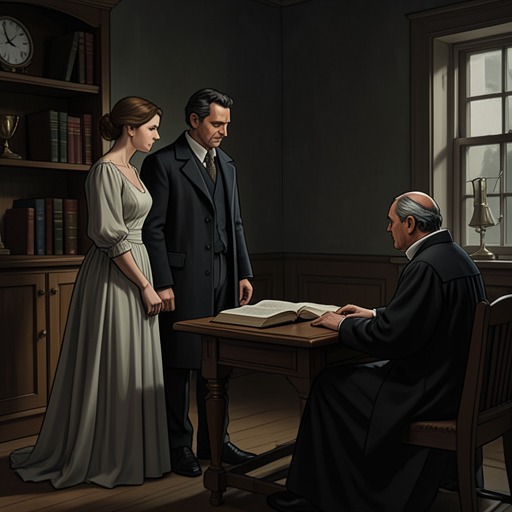
The funeral takes place in a crowded church. Miguel’s body rests on a catafalque among new candles and flowers, while Pedro stands alone behind it, waiting for the final prayers. Father Rentería turns away from the corpse and hurries to end the Mass without blessing the congregation. When those present insist that he bless Miguel, he refuses, calling Miguel a wicked man who cannot enter heaven and arguing that God would disapprove of his intercession. The priest’s spoken verdict is emphatic, but his hands tremble as he gives it.
Pedro approaches and kneels beside Father Rentería. He recalls the grievances against Miguel, including the murder of the priest’s brother and the rape of his niece Ana, and asks him to put those injuries aside and forgive Miguel as God may have done. He then lays a handful of gold coins on the prie-dieu as an offering for the church. Father Rentería has named the spiritual limit of Miguel’s case; Pedro’s money immediately brings that judgment into contact with the economic dependence that shapes the priest’s choices.
The Offering and Its Aftermath
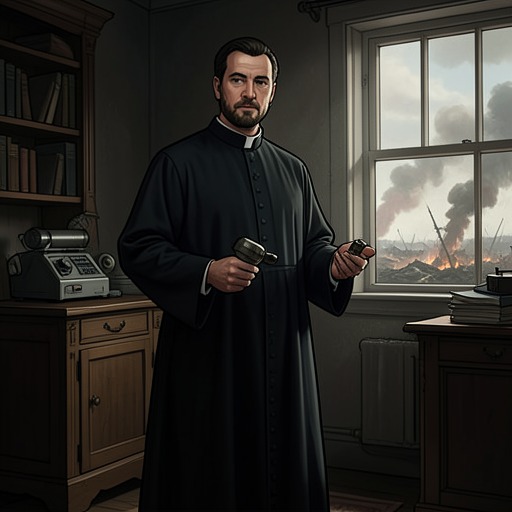
After Pedro leaves the gold on the prie-dieu, Father Rentería takes the coins one by one and carries them to the altar. His private prayer refuses to settle the moral question: he asks God for justice or injustice, then asks that Miguel be condemned. The gesture keeps the ceremony divided. The priest has blessed the corpse, but he does not claim to know whether the money can buy Miguel’s salvation; that judgment, he leaves to God.
Father Rentería closes the tabernacle, withdraws to a corner of the sacristy, and weeps with grief. Yet the scene ends not with a public repudiation of Pedro’s offering but with the priest saying that God has won. At dinner he drinks his customary chocolate and feels pacified. The ordinary meal follows the extraordinary conflict, suggesting that the rite has quieted him without resolving the contradiction between his condemnation of Miguel and his compliance with Pedro.
The priest’s later sleepless self-reproach gives the funeral a wider institutional context. He blames himself for fearing the people who sustain him, reasoning that the rich maintain him while the poor cannot fill his stomach with prayers. He recalls María Dyada pleading for her sister Eduviges, whose generosity had been abused and who died by suicide. Rentería had treated her final act as a forfeiture of salvation; María answered that Eduviges had suffered terribly and had seen no other way out. Their exchange exposes the same pressure visible at Miguel’s funeral: spiritual judgment is exercised amid material dependence, while those most in need of mercy are left to bear the cost.
The Funeral as Public Ritual
A later funeral in Comala gives the ceremony for Miguel a revealing contrast. On the gray morning of December 8, the bells began with the bourdon, and other church bells joined; residents first took the prolonged ringing for the customary call to Mass, but it continued through noon, through the night, and for three days, until people could no longer hear one another and some bells sounded cracked. The mourning drew visitors from Contla and farther away, along with a circus, musicians, serenades, and crowds who turned the occasion into a village festival. Susana San Juan was buried while Comala celebrated, and few in town seemed to notice. At Media Luna, by contrast, people walked barefoot and spoke quietly; Pedro Páramo stayed in his room and swore revenge on Comala. The two funerals expose different failures of communal mourning: Miguel’s burial is concentrated in a church rite shaped by Pedro’s wealth, while Susana’s death is overwhelmed by a public celebration that cannot be made to recognize itself as grief.
The Limits of the Blessing
The scene’s decisive tension lies in the gap between a rite’s public form and the priest’s private conviction. Father Rentería can complete the blessing, but he cannot make its spiritual meaning certain: he leaves judgment to God even as he asks for Miguel’s condemnation. His later distress does not undo the rite; it shows that performing it has deepened rather than settled his conflict. The funeral therefore offers no clean exchange in which wealth purchases salvation or the priest’s refusal remains intact. Instead, it stages religious authority as compromised and unresolved, caught between the demands of conscience and the material power that surrounds it.