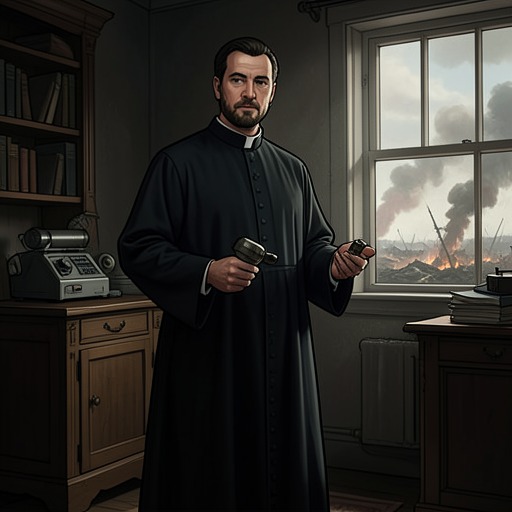
Father Rentería Refuses to Absolve Eduviges
Pedro PáramoFather Rentería Refuses to Absolve Eduviges is an episode recalled through the priest’s sleepless self-reproach: when María Dyada pleaded for her sister Eduviges Dyada, he treated her suicide as a final offense against God rather than as the desperate end of a life marked by generosity and exploitation. The refusal exposes the distance between the priest’s authority to speak of salvation and his fear of the people whose money sustains him; its later echo in his dealings with Miguel Páramo makes that conflict harder to dismiss as a single moment of weakness.
The plea for Eduviges
The episode returns in Father Rentería’s thoughts as he turns restlessly in bed and judges his own conduct. His memory is not a detached account: he frames the encounter as evidence that he has betrayed people who love and trust him, and who depend on him to intercede with God. What he remembers most insistently is María Dyada’s face, which remains before him as he tries to sleep.
María had come asking him to save her sister. She described Eduviges as someone who relieved other people’s needs and gave away everything she possessed. Men had fathered children with her, then refused to acknowledge them when she brought them forward. In María’s account, Eduviges answered their rejection by saying she was their father as well as their mother, though chance had made her the mother. The men had abused her hospitality; she had been unwilling to offend or quarrel with any of them. Her goodness, as María presents it, did not protect her from being used and abandoned.
Eduviges had taken her own life. María did not deny the act, but resisted the priest’s interpretation of it: she argued that her sister had seen no other way out, and that even this final act had arisen from goodness. She recalled Eduviges dying in great pain, writhing as blood suffocated her. The remembered physical suffering stands against a judgment that reduces her last hour to a doctrinal failure.
The refusal and its cost
Father Rentería had told María that Eduviges had failed at the final moment and acted against God’s will. In his recollection, he had insisted that a life of good deeds could be lost through suicide. María answered that her sister’s suffering mattered, reminding him that he himself had spoken about the significance of suffering. The exchange leaves the priest’s ruling under pressure: María does not contest the religious principle so much as challenge his willingness to apply it without regard to the woman’s life and pain.
When María asked whether much prayer might help, Father Rentería raised the possibility of solemn masses, but explained that these would require a deacon and subdeacon and therefore money. María had none, and he knew it. He ended the discussion by proposing that they leave matters as they were and entrust them to God; María accepted his words. The recollection gives that acceptance no air of resolution. It sits alongside the priest’s knowledge that he could have spoken words of forgiveness, and his later question about how little it would have cost him to do so.
The exchange also reveals the material condition shaping his ministry. Father Rentería admits to himself that the wealthy support him and that the poor have nothing to give him; their prayers cannot fill his stomach. He fears offending those who keep him alive. His dependence does not erase his responsibility, but it helps explain why a spiritual judgment becomes entangled with money and social power. The high mass is presented as a possible remedy, yet its price places that remedy beyond María’s reach.
Memory, guilt, and the later echo
The refusal returns not as a settled decision but as an accusation Father Rentería makes against himself. He wonders what the faith of those who trust him has gained them, and whether he has betrayed their hope of his intercession. He remembers María’s face as the face of a poor, burdened woman, and asks himself what forgiveness would have cost. His reflection shifts from the doctrine he once invoked to the ease with which he might have offered comfort: one word, or many, could have mattered to a soul whose fate he claimed to weigh.
The later treatment of Miguel Páramo provides a sharp, but not identical, echo. At Miguel’s funeral, Father Rentería says that Miguel died without absolution and that no grace can reach him. He refuses the crowd’s demand to bless the body, then blesses it after all. Pedro Páramo kneels beside the priest and places a handful of gold coins on the prie-dieu as an offering for the church. The scene does not establish that Eduviges and Miguel received the same rites: it distinguishes the earlier question of absolution from the later blessing of a corpse. But together the episodes show a priest whose pronouncements and actions do not align securely, and whose church operates amid the pressure of wealth.
Significance
Eduviges’s case is remembered through the person who judged her, while María’s plea supplies the human circumstances that his ruling had set aside: generosity, exploitation, rejection, poverty, and a death in pain. That structure makes the episode more than a statement of church doctrine. It is also an examination of what happens when the authority to intercede is exercised by someone conscious of his dependence on the rich and of the poor people he has failed to help.
The unresolved ending is essential to the memory. María accepts the priest’s suggestion to leave matters to God, but Father Rentería cannot leave the encounter behind. He lies awake returning to the face, the poverty that barred costly masses, and the forgiveness he could have offered. The refusal thus persists as a burden on the priest’s conscience: the question is not only whether Eduviges could be saved, but whether he met her sister’s appeal with compassion when it was within his power to do so.