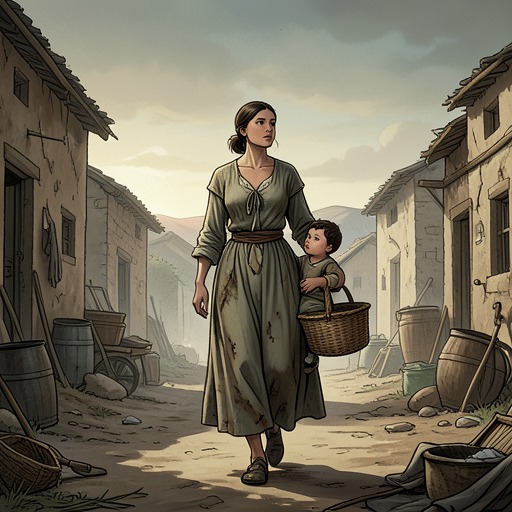
Juan Preciado and Damiana Cisneros: Caregiver and Guide
Pedro PáramoJuan Preciado and Damiana Cisneros of Media Luna are joined by a bond that reaches from his birth into his final passage through Comala: she once watched over him as a newborn, then finds him in the village and offers him shelter. As his guide, she gives him both a personal connection to his mother’s past and a way to hear Comala’s persistent echoes; her abrupt disappearance leaves that guidance unresolved.
Identity and Background
Damiana Cisneros of Media Luna lives at the estate, and explains that this is why she took so long to come for Juan. Her connection to him, however, predates his arrival in Comala. Juan recalls that Dolores Preciado had told him about a Damiana who watched over him when he was born. Damiana confirms that she was that caretaker and says she has known him since he first opened his eyes. The exchange turns an unfamiliar woman into a figure from his earliest history: Juan has arrived in the village as a stranger, but she has known him since before he could remember her.
Her care is practical as well as remembered. Finding Juan in a place where cries have kept him from sleeping, she invites him to stay at her home, where he will have somewhere to rest. He accepts and accompanies her. The invitation supplies an immediate refuge, while her recognition of him gives their meeting the familiarity of a relationship resumed rather than one newly begun.
Meeting and Guidance in Comala
Juan initially mistakes Damiana for Eduviges Dyada, asking whether Eduviges has come and what has happened. Damiana corrects him: she is Damiana, and she has come because she heard he was there. The confusion places her arrival amid the unsettling encounters of his journey, but she does not leave him alone with the cries. She offers a place to sleep and leads him away from the room where he has been frightened.
As they travel through the village, Damiana explains that its sounds seem lodged inside walls or beneath stones. They follow people as they walk: creaking, laughter, and voices worn down by use. She imagines a day when those sounds will die away. Her account gives Juan a companion’s interpretation of what he is hearing, without making the village’s strange presence disappear. The echoes remain both part of the surroundings and a continuing disturbance that the two of them encounter together.
When Juan hears another cry and asks whether Damiana heard it, she suggests it may be an echo trapped in the room. She identifies that room as the place where Toribio Aldrete was hanged long ago. The door was then sealed until his body had dried out, so that it could not find rest; Damiana says there is no key that opens the door and wonders how Juan managed to enter. Her explanation links his frightening present experience to a specific violent past. As his guide, she does not simply lead him through space: she supplies the history attached to places where the dead remain audible.
Shared Knowledge of the Dead
Damiana’s account of the echoes is grounded in her own long experience of them. For many nights, she heard what sounded like a celebration at Media Luna. Once she went closer to watch the dancing, only to see what the travelers see in the present: nobody and empty streets. Eventually she stopped hearing the festivities. She takes their end without surprise, observing that joy grows weary. The contrast between the sound of a crowded celebration and the emptiness she finds gives her story a particular weight: in Comala, noise does not guarantee that anyone is there.
She also tells Juan about her sister Sixtina, who died when Damiana was twelve. Sixtina was the eldest of sixteen siblings, and Damiana says that, although she has long been dead, she still wanders in the world. She urges Juan not to fear more recent echoes. Her reassurance comes not from denying that the dead persist, but from treating their presence as something familiar. In that sense, Damiana serves as a mediator between Juan’s alarm and a village where the past continues to make itself heard.
Juan asks whether Dolores Preciado also warned Damiana that he would come. Damiana says she did not, then asks how Juan’s mother is. The exchange places their reunion beside the absent mother whose memories first connected them. Damiana’s knowledge of Juan began in infancy, but she does not claim foreknowledge of his arrival; her question turns the conversation back toward Dolores and the relationship that linked the two women through his childhood.
Care, Uncertainty, and Disappearance
The relationship is marked by an imbalance of knowledge. Damiana recognizes Juan immediately and remembers caring for him as a newborn, while he must identify her through what his mother once told him. Yet her familiarity does not make her fully able to explain the present. She can offer shelter, describe the echoes, and recount what happened to Toribio Aldrete, but when Juan asks how she found him, she gives no answer. Her guidance has limits even before it ends.
After that unanswered question, Juan asks Damiana whether she is alive and calls for her. Suddenly he finds himself alone in the empty streets. Open windows face the sky, climbing plants pass through them, and the adobe walls show crumbling bricks beneath thorn-bristled tops. He calls Damiana Cisneros of Media Luna’s name, but she is no longer beside him. The disappearance unsettles the security her invitation had seemed to offer: the woman who knew him from birth and had led him through Comala cannot be held in place as an ordinary, dependable guide.
Damiana’s role therefore joins intimate care to the novel’s uncertainty about presence and absence. She offers Juan a bed and the recognition of a lifelong acquaintance, but her knowledge also confirms that the dead and their echoes remain woven into the village. Her sudden vanishing does not erase the bond; it leaves Juan with the memory of a caretaker who could lead him through Comala’s history, but not protect him from its instability.