Justina Díaz
Pedro PáramoJustina Díaz is the lifelong caregiver of Susana San Juan, bound to her by a closeness formed in infancy and sustained through grief, isolation, and Susana’s increasingly strange experiences. Her care is practical and intimate: she prepares a dead woman for burial, brings rosemary through the rain, and stays beside the person she has looked after since birth.
Identity and Lifelong Care
Justina’s attachment to Susana reaches back to Susana’s earliest years. She held her as a baby, taught her to walk, and remembered her first steps as unforgettable. Her recollection lingers on Susana’s growing mouth and eyes, comparing their changing colors to blue, yellow, and green mint candy. The memory is affectionate but also physical: Justina recalls biting Susana’s legs playfully and letting the child suckle at her breasts, which she describes as toys. Her language makes caregiving a bodily history, not simply a duty assigned to her in adulthood.
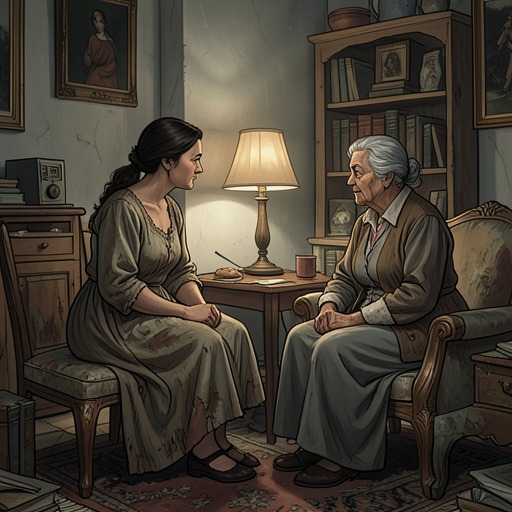
That history shapes Justina’s response when Susana’s mother dies. She arranges chairs along the corridor for people waiting to pay their respects, but they remain empty. The dead woman lies alone among the candles. Justina presses her black dress, starches its collar and cuffs, and arranges her hands across her chest. She and Susana pray beside her, though the wind’s tumult swallows their prayers. The carefully prepared chairs and clothing cannot summon mourners or restore the dead; they show instead how Justina gives grief a form through the work still within her reach.
Years later, Justina’s care continues amid another death in Susana’s family. She tells Susana that her father died two nights earlier, has already been buried, and could not be brought back because the road is too long. Susana answers as though the news confirms a visitation: her father, she says, has come to bid her farewell. Justina is the one who delivers the news, but she cannot make its finality ordinary or easy for Susana to receive.
Care Under Strain
On a rainy day, Justina Díaz walks from Media Luna into town beneath an umbrella, skirting water that has flooded the sidewalks. The Indians waiting at the market watch her pass; she feels their attention following her as she stops at the first stall and buys rosemary for ten centavos. On her way back, she mutters that the branch is hardly fragrant enough to justify its price. The small purchase becomes an errand of care: she carries it to Susana San Juan’s room and sets it on the console.
With the curtains shut, the room is dim. Justina takes Susana to be asleep, as she prefers to find her, until a sigh comes from somewhere in the darkness. A voice calls her name. She sees no one, but feels a hand on her shoulder and breath near her ear, followed by a quiet command that she take her things and leave because she is no longer needed there. The unseen address turns the room where Justina serves as caretaker into a place that seems to reject her.
The strain also surfaces in her quarrel with Susana over the cat, whose nighttime movements have frightened Justina. She tells Susana that she has visions and threatens to leave the next day, taking the animal with her. Susana answers that Justina will not leave: nowhere else, she insists, will anyone love her as much. Justina’s reply makes her choice plain. She will stay and watch over Susana, even when the work exhausts her and Susana’s fears unsettle her. Her devotion is neither a cure for Susana’s isolation nor a guarantee that she can understand what happens in the room; it is the steady care she continues to offer despite both.
Witness at the Threshold
Justina’s place beside Susana San Juan is tested by a divide she cannot resolve: the person she has cared for since infancy is still physically near, yet Susana’s perceptions open onto presences Justina cannot see. In the darkened room, the command to leave reaches Justina through a felt hand and breath, not a visible speaker. The scene gives her no explanation to act on; it makes care an encounter with what remains unseen, as well as with the familiar person she continues to serve.
That uncertainty sharpens the difference between Justina’s practical knowledge and Susana’s private world. Justina calls Susana’s fears visions, yet she does not answer strangeness by withdrawing from her. Susana, in turn, frames Justina’s staying as proof of an affection unavailable elsewhere. Their bond therefore rests not on shared understanding but on continued presence: Justina may doubt what Susana experiences, and may be unsettled by it, while still accepting responsibility for her.
Mourning and the Living World
In the recollection Susana San Juan addresses to Justina, her mother’s death belongs to a season when life around her remains insistently active. The morning is bright; wind enters through the open door and breaks the cobaea stems, sparrows play, and grain sways on the hillsides. Susana grieves that her mother will never again see the wind in the jasmine or open her eyes to daylight, yet remembers at the same time the first down on her legs and her embarrassed hands brushing her breasts. Her question about why she should have wept does not erase her sorrow: it sets bereavement beside the vivid continuation of the world and her own changing body. Justina is the person Susana calls upon to remember this contradiction, a witness to a grief that does not take the expected outward form.