Land Monopoly and Local Power
Pedro PáramoLand Monopoly and Local Power describes the order Pedro Páramo builds around ownership of Media Luna and the surrounding land. His power is not merely a claim of title: it reaches into debt repayment, marriage, boundaries, labor, food, and the practical meaning of law. Comala’s landscape makes this concentration visible, while the lives shaped by it show how property becomes political authority—and how that authority can make a whole community vulnerable to one man’s decisions.
The Estate as Territory and Social Order
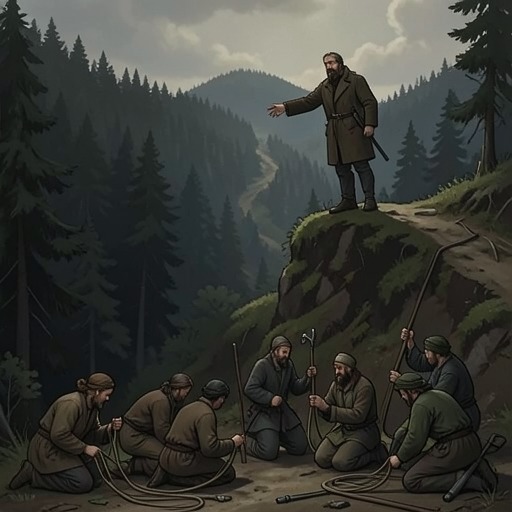
From the road into Comala, Media Luna appears as land stretching from one distant height to another, almost too extensive to take in at a glance. The muleteer tells Juan Preciado that it all belongs to Pedro Páramo. He describes the sons Pedro has fathered outside acknowledged family life: their mothers gave birth to them in haste on straw mattresses, though Pedro also stood as their godfather. The detail joins the estate’s immense reach to the intimate, uneven consequences of its owner’s power. Even family ties bear the mark of a hierarchy organized around his property.
The journey itself frames land as something experienced differently according to one’s relation to it: the road rises for those leaving and falls for those arriving. The terrain is not an abstract backdrop. It is measured, possessed, crossed, and seen from the standpoint of who controls it. In the heat, the country shimmers like a clear pool dissolving into vapor; that wavering view contrasts with the muleteer’s blunt account of ownership. What seems open and expansive is, in material terms, gathered under a single proprietor.
The estate’s control is also apparent in its management. During the rains, the great gate of Media Luna opens and a column of horsemen rides out, reaching two hundred men. Fulgor Sedano directs them to move cattle from Enmedio beyond the former lands of Estagua and to drive Estagua’s cattle toward the heights of Vilmayo. This is property maintained through the organized movement of animals and armed manpower across a large territory. The estate does not simply occupy land; it schedules and redirects activity across it.
Debt, Marriage, and the Capture of Boundaries
Debt gives Pedro a route from financial weakness to expanded control. When Fulgor reports that business is bad and the last cattle have been sold, Pedro does not begin by asking how much is owed. He wants the names of the creditors. Fulgor reads them out and explains that there is no money with which to repay them. Pedro’s response is to identify the order in which the debts will be settled: the Preciados first, because they are owed the most and have received the least. The distinction between the amount owed and the creditor’s power to collect it is already stark.
Dolores Preciado, called Lola in this exchange, holds the Enmedio property and is the creditor Pedro intends to approach. He orders Fulgor to ask for her hand in marriage. He instructs him to tell her that he loves her, then makes clear to Fulgor that her money is the reason. Marriage thus becomes an economic maneuver: Pedro addresses a debt and the property associated with it not through repayment, but by making the creditor’s land part of a marital arrangement. His declaration of affection and his explanation of its financial purpose stand together, exposing the transaction beneath the courtship.
The dispute with Toribio Aldrete shows how Pedro treats a boundary as a challenge to his authority. Aldrete has measured the land and begun putting up fences, asking that the missing stretch of fence be completed to mark the division. Pedro says there will be no fences and that the land has no enclaves; he tells Fulgor to deny Aldrete’s measurements and, if necessary, demolish the barriers. When Fulgor raises the law, Pedro rejects it as an independent limit. He directs Fulgor to bring a charge against Aldrete under the name of usufruct, or whatever accusation comes to mind, and reminds him that with Lucas Páramo dead, new arrangements must be made. Fulgor’s formal legal capacity and the language of a legal complaint become tools for a result decided in advance: the boundary will not stand.
Force, Impunity, and the Work of Rule
Fulgor is not only the estate’s administrator but also an intermediary between ownership, legal paperwork, and coercion. His recorded declaration against Aldrete presents him as a fifty-four-year-old professional administrator authorized to bring suit. Yet the document’s formal language does not restrain Pedro’s power. It sits alongside the instruction to invent or adapt an accusation and the threat to send violent men to visit Aldrete. Legal procedure supplies a usable form; Pedro’s command determines what it will serve.
The pattern extends beyond land disputes. When Fulgor tells Pedro that a woman has accused Miguel Páramo of killing her husband, he describes her grief and says she refused both fifty hectoliters of corn and a promise of other compensation. Pedro asks who the victims are. On learning that Fulgor does not know them, he dismisses them as people who do not exist. The exchange links authority over property and resources to impunity: the estate can offer grain as a substitute for justice, while Pedro can make an injured family socially invisible when it refuses the offer.
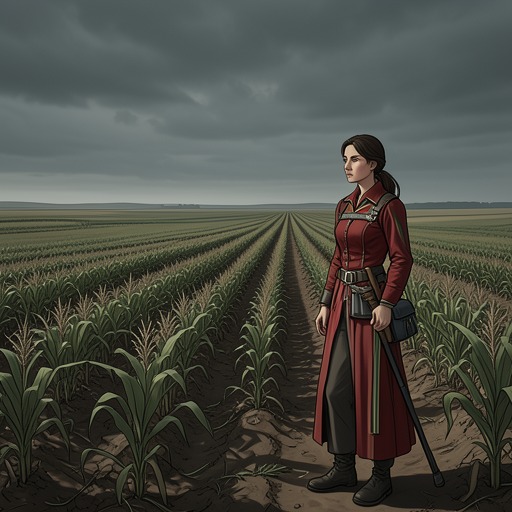
The same concentration appears in a priest’s observation that Comala’s land is good but lies in the hands of one man. His remark identifies the imbalance beneath the region’s agricultural potential. Land may produce well, but its abundance does not amount to shared security when access and decisions rest with a single owner. Pedro’s power therefore operates not only by taking particular parcels, but by narrowing the community’s ability to act independently of the estate.
Political Bargaining and Control of Resources
When armed rebels arrive and condemn both the government and local landowners, Pedro asks how much their revolution will cost and offers to help. The fighters respond by discussing how a rich man might be brought into their support, turning his wealth into a possible resource for their campaign. The encounter makes clear that Pedro’s land-based power has political value beyond Comala: control of wealth can be converted into influence amid armed conflict. The passage does not make him an opponent of the rebels on principle; it presents him bargaining over the price and terms of assistance.
Control over food becomes most explicit after Susana San Juan’s funeral. While the bells have stopped, the celebration in Comala continues, and the contrast between the village’s noisy revelry and Media Luna’s silence deepens Pedro’s isolation. He vows revenge against Comala, then resolves to fold his arms and let the village starve—and carries out that policy. The threat is effective precisely because dependence has been made structural: when the estate’s owner withdraws support, the community bears the consequence. Grain and land are not merely wealth in this order; they are means of life that can be withheld as punishment.
Abandonment and the Estate’s Afterlife
Pedro’s dependence on land as an instrument of power does not prevent the estate from becoming ruinous. After Susana’s death, he withdraws from his properties, orders their contents burned, and remains seated, facing the road by which she was carried to the cemetery. The land is left unattended and becomes overrun; its population dwindles as people leave in search of other sources of water and livelihood. Some depart intending to return, entrusting family and possessions to those who stay, but many gradually forget Comala. Others remain because they have nowhere else to go or hope Pedro will die and leave them his property.
That hope lasts for years while Pedro remains alive like a scarecrow before Media Luna. Later, during the Cristero wars, the army takes the few men still left in the region. The result is not simply a change of owners but a community emptied through successive forms of dependence, departure, and violence. Comala’s emptiness and Media Luna’s decline are the long consequence of an order in which land, work, and food were concentrated without durable protection for the people who lived among them. Pedro’s power can make the estate command a vast territory; it cannot make that territory flourish once he chooses withdrawal and punishment over its continued life.