Media Luna's decline
Pedro PáramoMedia Luna’s decline is the reversal of a system Pedro Páramo had built around land, debt, and command. The estate once sent riders across the countryside to move cattle and extended its influence through dealings with indebted neighbors; after Susana San Juan’s death, Pedro withdraws from that active rule. The land falls into ruin, people leave Comala, and his grief becomes a policy of withholding the food and resources on which the village depends.
Land, debt, and command
The estate’s power is visible before its abandonment. When Fulgor Sedano reports that the last cattle have been sold and nothing remains, Pedro does not first ask how much debt is owed. He asks whom they owe. He then directs Fulgor to settle accounts, beginning with the Preciado women, to whom the family owes the most and has repaid the least. Dolores Preciado still controls the Enmedio property, making her land central to the proposed settlement.
Pedro’s response turns debt into an opportunity for acquisition. He orders Fulgor to ask for Dolores’s hand in marriage, while admitting that his declaration of love is a cover for wanting her money. He also says the land has no enclaves and tells Fulgor not to speak of it. The episode shows how a personal arrangement can serve the estate’s expansion: marriage, repayment, and property are treated as connected instruments of control.
The estate’s command also reaches across the countryside through its livestock and workers. In heavy rain, its gate opens and mounted men ride out in successive pairs until the procession reaches two hundred riders. Fulgor directs them to drive the Enmedio cattle beyond the former Estagua and move the Estagua herd to the heights of Vilmayo. The order is practical and hurried, timed to the approaching rains, but its scale makes the estate’s reach unmistakable. Media Luna is not merely a residence; it organizes land and labor across a broad territory.
From managed estate to abandoned land
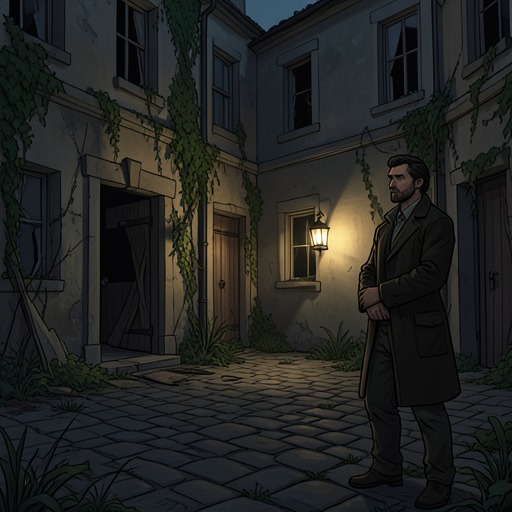
The later account of Media Luna describes a sharp break with that earlier activity. Pedro spends the remainder of his life slumped in a chair, looking toward the road by which Susana was taken to the cemetery. He loses interest in everything else, abandons his properties, and orders their contents burned. Whether observers attribute this to exhaustion or disillusionment, the consequential change is the same: the man who once directed the estate no longer maintains it.
The land left behind becomes ruinous. It is described as afflicted and overrun by pests once it has been left alone. Within a short time, the population dwindles as men depart to seek better prospects elsewhere. The movement is gradual and cumulative: people leave intending to return, entrust their belongings and families to those who stay, and then, in some cases, come back for their families but not their possessions. Eventually, some seem to forget the village altogether.
Those who remain do so for different reasons. Damiana Cisneros says she had nowhere else to go; others stay because they hope Pedro will soon die and leave them his property. That hope persists while Pedro remains alive, still standing over the estate’s lands like a scarecrow. His physical survival does not restore the estate or the community. Instead, it prolongs the uncertainty on which the remaining inhabitants depend.
Grief becomes a policy
The decline is linked directly to Susana’s death, but the account distinguishes Pedro’s private grief from its public consequences. He loved her more than any other woman, according to Damiana, yet she was brought to him sick and perhaps already mad. After her death, he fixes his attention on the cemetery road and withdraws from the properties. The estate’s abandonment is therefore not presented as an ordinary economic downturn: it follows a personal loss and takes the form of deliberate disengagement.
Pedro’s response reaches beyond Media Luna. The estate grows solitary and quiet, while Comala’s people disperse and the town’s population fades. Damiana recalls the years of departures as a time when saying goodbye became almost a source of cheer, although those leaving initially expected to return. The irony is stark: Pedro’s love for Susana is remembered as immense, but the effect of his grief falls on people who have little power over his choices.
The account places the Cristero Wars late in this deterioration. Pedro is already not far from death when the wars break out, and the army takes the few men who remain. Damiana says she then begins to starve and has not been with anyone since. Her testimony locates hunger within a longer sequence of abandonment, depopulation, and armed disruption rather than treating it as an isolated hardship.
The estate and Comala’s linked fates
Media Luna and Comala are joined by more than proximity. The estate’s earlier management of cattle and land shows the material system through which Pedro’s authority operated; its later neglect coincides with the dispersal of the people who had lived under that system. The novel’s account of decline makes the consequences legible in both places: quiet and solitude at the estate, departures and hunger in the village.
The change also alters how the landscape is experienced. On the road into Comala, the path descends for those arriving and climbs for those leaving; the countryside shimmers like a clear pool dissolving into vapor. Later, the village is silent enough for footsteps to echo off its rounded stones, while its doors stand broken and vegetation enters the empty houses. These images place movement and abandonment in the same landscape: arrival leads into a place already losing its inhabitants, while departure leads back up and away.
The emptiness has its own acoustic afterlife. Damiana describes Comala as full of echoes, as though sounds were shut into walls or beneath stones and followed those walking through the streets. She remembers once hearing the noise of a celebration from Media Luna, going to see the dances, and finding only deserted streets; later the sounds ceased. The estate’s decline thus belongs to a wider pattern in which apparent life persists as echo after the people and activity that produced it have gone.
Famine and the final reversal of power
After Susana’s funeral, Comala’s bells continue ringing, but the mourning is overtaken by a village celebration. At Media Luna, by contrast, the house is silent: people walk barefoot, speak softly, and Pedro remains in his room. He vows to take revenge on Comala by folding his arms and letting it starve, and he carries out that threat. The contrast clarifies the final form of his authority. He no longer uses the estate to organize expansive activity; he uses his capacity to withhold support against the community.
Pedro’s later offer to help a band of rebels shows that he can still respond to armed power when it approaches him. When the men explain their revolt against the government and against him, calling him a robber and thief, he asks how much money they need and offers assistance. This does not undo the estate’s decline or the village’s hunger. It underscores the persistence of his political reach even as the world he once governed has been abandoned.
Media Luna’s decline is therefore not simply the disappearance of a powerful household. It is the conversion of concentrated control into neglect and, finally, deprivation. The same authority that once moved cattle, settled debts, and directed riders can cease to maintain the land and deny sustenance to Comala. In the end, the estate’s silence and the village’s hunger are connected outcomes of Pedro’s withdrawal: his private grief becomes a public force, and the people left behind bear its cost.