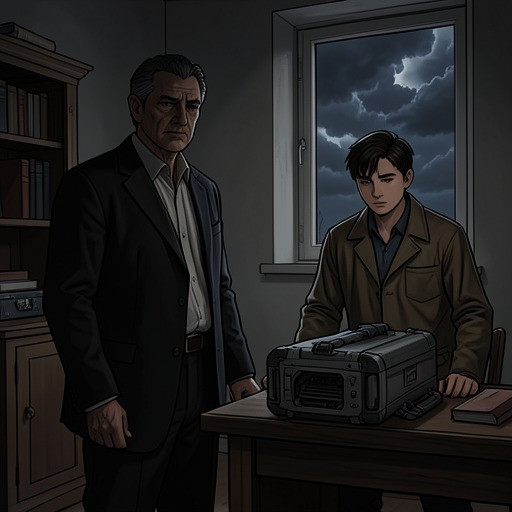
Miguel Páramo's ghostly wandering
Pedro PáramoMiguel Páramo’s ghostly wandering unsettles the boundary between death and ordinary life through a sequence of apparitions, unexplained sounds, and village reports. Eduviges Dyada recounts that Miguel came to her window on the night he died, unable to find the road to Contla; his horse continued to race back toward Media Luna, and later talk placed Miguel’s soul at another woman’s window. None of these traces restores him to life. Instead, they make his death persist as an unfinished journey, carried by the horse, by Eduviges’s memory, and by what people say they have seen.
The Horse and the Unheard Return
The first sign is not Miguel himself but his horse, running along the road toward Media Luna. When Juan asks whether anyone is still alive at the estate, Eduviges answers that no one is; only the horse goes back and forth. The animal and Miguel had been inseparable, she says, and the horse returns around the same hour, apparently searching everywhere for its rider. Eduviges interprets its agitation as remorse, as though an animal could know when it had committed a crime. Her explanation is a belief, not a settled account of what the horse knows, but it gives the repeated galloping an intimate and troubling meaning.
Juan says he hears no horse. Eduviges first attributes the difference to her sixth sense, which she calls both a gift from God and a possible curse. She then recalls that the horse’s return was the beginning of what she alone knew about Miguel’s death. The usual pattern was for him to leave early to visit his beloved in Contla and return late, well after daybreak. On this night, the horse came back at an unusual hour. Eduviges heard what seemed to be a knock at her window and went to see who was there.
The episode is framed by uncertainty even as Eduviges tells it with specific detail. She wonders whether the sound of the horse and the knock might have been products of her imagination; Juan continues to hear nothing. Yet her account insists on the repeated return, and on the difference between Miguel’s customary late arrival and the hour at which the horse came back. The haunting is therefore not presented as a simple shared spectacle. It is something Eduviges perceives and recounts, while her listener remains unable to confirm it.
Miguel at Eduviges’s Window
Eduviges says that Miguel stood at the window. She was not surprised to find him there: before he became absorbed in his beloved, he had spent nights at her home and slept in her bed. In her recollection, he had come to tell her that he could not reach Contla. He believed he had passed the town, but the route had disappeared into fog or smoke, leaving him with no sign of it. He expected Eduviges to understand, fearing that other people in Comala would call him mad as they always had.
Her reply turns his bewilderment into a recognition of death. She reminds him that people had warned him that his horse would kill him, and asks whether he has died or simply done something reckless again. Miguel describes jumping Colorado over a stone wall his father had recently had built, to avoid the longer detour to the road. He remembers continuing at speed, but beyond the wall he encountered only smoke. The wall, built to redirect the route, marks the practical cause of his shortcut; the blankness beyond it gives his failed journey its spectral form. He can describe how he rode, but cannot account for the road or reach the place he intended to go.
Eduviges tells him that his father will be in pain and urges him to go and rest in peace. She says she feels pity for don Pedro, then closes the window. Her account makes the visit both a farewell and a belated disclosure: Miguel has already died, although he speaks as if reporting an inexplicable failure to arrive. Eduviges understands what his confused journey means before the household’s official news reaches her.
Confirmation, Burial, and the Restless Horse
Before daybreak, a servant from Media Luna comes to summon Eduviges because don Pedro wants her to hear that Miguel is dead. She answers that she already knows. The servant explains that Fulgor Sedano instructed him to deliver the message in tears. Miguel had been brought back less than half an hour earlier, but the doctor who examined him said that his body had been cold for a long time. The household had learned something was wrong because Colorado returned alone and was so agitated that nobody could sleep.
The servant emphasizes the bond between horse and rider and says the animal has neither eaten nor slept, yet cannot keep still. His comparison—that the horse may suffer more than don Pedro—makes the animal’s distress a physical aftermath of Miguel’s death. It also resonates with Eduviges’s earlier account: the horse’s return is not a single passing sound but an ongoing disturbance, one that the living household can observe even when Juan cannot hear it.
After Miguel’s burial, another report follows the horse. A woman waiting near the village sees it gallop past the junction of the main road and the road to Contla. She recognizes Miguel’s chestnut horse and thinks it may break its neck when it folds its legs as if about to tumble. The horse straightens and continues without slowing, its head turned backward as if frightened by something it has left behind. The sight gives the animal’s flight a direction and an apparent look of fear, but does not establish what it sees. Its backward glance recalls the failed journey in Eduviges’s story: even as it runs on, the horse seems oriented toward what cannot be reached or left behind.
Rumor and the Persistence of the Dead
After the burial, talk from Contla adds a more explicit account of Miguel’s afterlife. People say his soul wanders there, recognizable in his leather trousers, and that it has been seen knocking at the window of the young woman he visited. The report echoes Eduviges’s experience of a knock at her own window, but transfers the apparition to the beloved Miguel had been trying to reach. The sequence does not confirm the rumor independently; it shows how the story of his failed ride, his return to Eduviges, and his attachment to the young woman becomes communal knowledge in fragments.
In the conversation about the report, one speaker imagines that don Pedro would order his dead son to remain quietly in his grave and stop pursuing women. The remark treats Miguel’s haunting as a continuation of his conduct in life, while also suggesting that even death may not protect him from his father’s authority. The imagined command cannot settle the matter: Miguel is already buried, yet the reports place him outside the grave, still moving from window to window.
The wandering is thus sustained by distinct and imperfect forms of evidence. Eduviges remembers a visit and an impossible account of the road; the servant reports a dead body and a sleepless, agitated horse; a woman sees Colorado running with its head turned back; and people in Contla repeat a story about Miguel’s soul. Their accounts do not combine into a fully verifiable explanation. Together, however, they make his death an event that continues to intrude on the living, and make the horse’s repeated return the most tangible sign of a bond that burial has not ended.