Pedro Páramo's land-dominance order
Pedro PáramoPedro Páramo’s land-dominance order is the system by which he turns the Media Luna’s extensive lands into the material basis of authority over Comala. It does not rely on ownership alone: debt determines whose claims receive attention, legal language disguises coercion, labor and cattle move at his command, and food can be withheld when obedience fails. The result is a local order in which formal rules and ordinary obligations matter only when they serve the man who controls the land.
Land, Debt, and Marriage
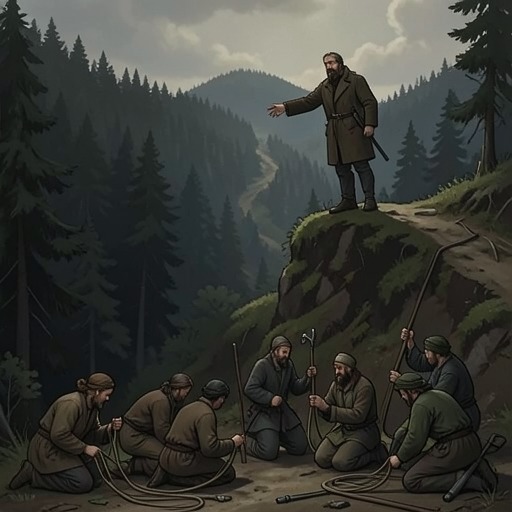
The scale of the estate is made visible to Juan Preciado on the road to Comala. A muleteer points out successive peaks and slopes, explaining that all the land one can take in at a glance belongs to Pedro Páramo. The boundary is therefore conveyed not as a surveyed line but as a landscape-wide claim: the eye can travel across the ground, but the ground belongs to one owner. The same explanation links that property concentration to a family history of unrecognized sons. They were born secretly on pallets despite being Pedro’s children, and Pedro himself carried them to baptism. Paternity and land ownership coexist with an unequal distribution of protection and legitimacy.
An earlier reckoning at the Media Luna shows how debt can become a route to expansion. The estate has sold its last cattle, its family has consumed its resources through repeated borrowing, and creditors are waiting to be paid. Fulgor Sedano identifies the Preciado family as the largest creditors and says that they have received the least in repayment. Their property, including the Enmedio estate, becomes central to the proposed settlement. Pedro orders Fulgor to ask Dolores Preciado for her hand in marriage. He presents the arrangement as love but privately makes clear that he wants her money. Marriage is thus folded into the management of debt and property: a personal bond is deployed as a means of settling accounts and securing land.
Pedro’s conduct also changes the terms of Fulgor’s service. He releases him from his responsibilities as estate manager and tells him to forget the Media Luna, even as he directs him to carry out the marriage arrangement. The estate’s survival and expansion are not treated as matters of neutral administration; they are decisions made by Pedro, who can redirect the people acting on his behalf as readily as he can redirect property.
Boundaries and the Uses of Law
The dispute with Toribio Aldrete shows how the appearance of legal procedure can support a claim backed by force. Fulgor prepares a formal accusation invoking usufruct after Aldrete has challenged the boundary and demanded that the missing section of fence be installed. Aldrete recognizes the maneuver as empty: he dismisses the document as worthless and understands that Fulgor has acted because his employer required it. The legal wording gives the dispute a procedural surface, but it does not settle the underlying question of whose measurements or rights will prevail.
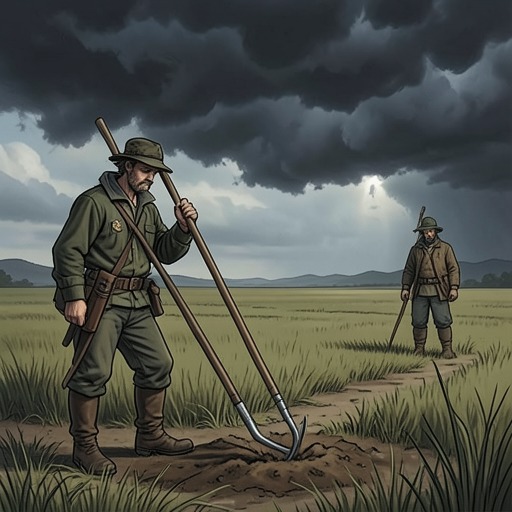
Pedro’s instructions make that imbalance explicit. He rejects Aldrete’s measurements, orders Fulgor to tell him that he has miscalculated, and directs him to tear down the fences if necessary. When Fulgor asks about the law, Pedro answers that they will make the law themselves. He then proposes accusing Aldrete of usufruct or whatever charge comes to mind, sending men to visit him, and reminding him that Lucas Páramo’s death means new arrangements must be made. The fence is therefore more than a boundary marker: it is a test of whether an independent claim can stand against the estate’s power. Pedro’s answer is to make the claim itself vulnerable—to contest the measurement, invent a legal countercharge, and threaten enforcement.
The episode also clarifies the difference between possession and formal evidence in Pedro’s order. Later, Gerardo Trujillo warns that certain irregularities and testimony known only to Pedro could become dangerous in other hands. Pedro tells him to leave the papers behind so that he can burn them, adding that no one can challenge his ownership with or without documents. The papers matter as potential exposure, not as the ultimate foundation of his authority. His confidence rests on the assumption that control of the land and the means of enforcing claims will outlast whatever evidence might contradict him.
Labor, Estate Resources, and Impunity
The Media Luna’s resources are managed through commands that extend across a broad territory. As the rains approach, its great gate opens and two hundred mounted men ride out in succession. Fulgor directs them to move the cattle from Enmedio beyond the former Estagua and to drive Estagua’s cattle up to the heights of Vilmayo. His repeated orders become a compressed instruction to move stock from one place to another and farther still. The scene gives physical form to the estate’s reach: workers, animals, and pasture can be rearranged across named lands according to the needs of the owner.
Control over resources also shapes which human losses count. Fulgor reports that a woman has accused Miguel Páramo of killing her husband. He offers her fifty hectoliters of maize and promises further compensation, but she refuses both. Pedro asks who she is; when Fulgor says he does not know the family, Pedro concludes that they do not exist. The refusal of maize does not lead to recognition or justice. In Pedro’s order, people outside the relations he acknowledges can be erased in speech even when their grief and their claim have been brought directly to his attention. Miguel’s violence is protected not by a hearing, but by his father’s ability to deny the victims’ standing.
The local priest gives the concentration of land a direct political meaning. He remarks that the land around Comala is good but that it is a pity it belongs to one man. Pedro’s representative answers that this is God’s will; the priest doubts that God has much to do with the arrangement. Their exchange sets religious language against the visible structure of ownership. A fertile landscape does not guarantee shared prosperity when its productive ground is concentrated in Pedro’s hands.
Political Bargaining and the Power to Withhold
When armed rebels arrive, Pedro does not first meet their challenge with a defense of the government or a surrender of his position. He asks how much money their revolution requires and offers to help. The rebels recognize the practical value of securing a rich patron. The exchange shows how his wealth can absorb opposition into negotiation: those who condemn landlords and the government still have to consider whether the landowner’s resources can support their cause. Pedro’s property gives him leverage even amid political upheaval.
That leverage becomes most devastating when he chooses not to use it. After Susana San Juan is buried, Comala continues celebrating as if the bells announce a festival rather than mourning. The Media Luna, by contrast, is silent; Pedro stays in his room and vows revenge on the town. He then folds his arms and lets Comala go hungry. The episode turns estate control into a collective punishment: the man who has directed cattle, grain, labor, and settlements now makes deprivation his answer to a town that failed to mourn as he wished.
The Order’s Reach and Meaning
Across these episodes, Pedro’s power operates through connected material mechanisms. Debt draws the Preciados into a marriage designed to secure property; manipulated legal language and threatened force override Aldrete’s boundary claim; estate workers move cattle across distant holdings; maize is offered as compensation for a killing but cannot purchase acknowledgment; and wealth becomes a bargaining resource for armed rebels. Finally, the same command over supplies that sustains the estate is turned against Comala through deliberate hunger.
The order’s defining feature is not simply that Pedro owns an immense estate. It is that his ownership determines what counts as a valid claim, whose suffering registers, how labor and livestock are allocated, and whether the town receives food. The landscape-wide view of the Media Luna and the later silence of a hungry Comala are opposite images of the same authority: one displays how much ground Pedro can command, while the other shows what happens when he withdraws the resources on which the community depends.