Pedro Páramo's hunger blockade of Comala
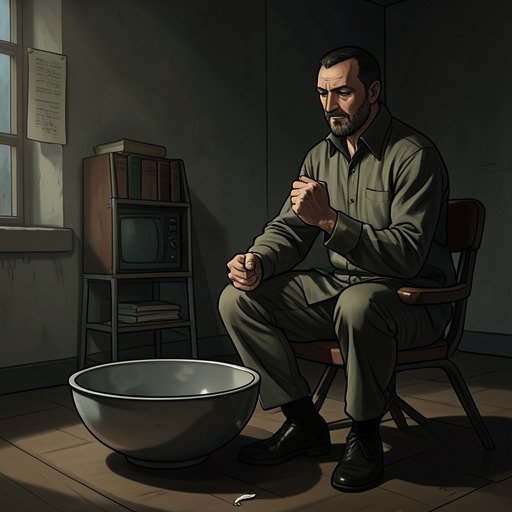
Pedro PáramoPedro Páramo's hunger blockade of Comala is a calculated act of retaliation: after the town turns the days of Susana San Juan's mourning into a celebration, he vows revenge and deliberately withdraws his support. His silence and inaction become instruments of rule, showing how the estate's control of local resources can make an entire town pay for an affront to its owner.
The Funeral and the Grievance
At Media Luna, Susana San Juan is buried in an atmosphere of solitude and restraint. People walk barefoot and speak quietly; Pedro says nothing and does not leave his room. Comala, by contrast, barely registers the burial. The bells draw visitors from Contla and farther away, and the gathering grows into a crowded festival of music, drinking, lottery sellers, and cockfights. Even after the bells stop, the revelry continues, and mourners cannot persuade the crowd to leave.
The contrast gives Pedro's retaliation its immediate context. From Media Luna, the village lights appear like a halo against a grey sky, but the estate itself remains silent and grief-stricken. Pedro swears to take revenge on Comala. His response follows not a public confrontation but a perceived insult made sharper by the difference between the town's festivity and his private mourning.
From Withdrawal to Hunger
Pedro announces that he will fold his arms and let Comala starve; the narrative confirms that he carries out the threat. The policy works through deliberate non-intervention: rather than describe a new attack, the account presents his refusal to act as the means by which hunger is imposed. The brevity of the declaration and confirmation makes the consequence stark. A personal vow becomes a collective punishment.
Pedro's withdrawal is also visible in his conduct at Media Luna. He remains in his room, does not speak, and allows the estate's grief to stand apart from the village's noise. This silence is not reconciliation or retreat from power. By choosing not to sustain Comala, he makes the town's dependence on the estate felt as deprivation.
The Material Power Behind the Threat
The blockade's force rests on an economic order established elsewhere in the narrative. In an earlier account of the estate's affairs, the last cattle have been sold and debts remain. Pedro asks not first how much is owed but to whom; he directs attention to the Preciado women, to whom the family owes the most, and orders Fulgor Sedano to seek Lola's hand. He privately identifies her money as the reason for the marriage arrangement. Debt, property, and marriage are thus treated as connected instruments in the management of the estate.
Other episodes show the scale of the resources and labor available to Pedro's household. During heavy rain, the great gate of Media Luna opens and horsemen emerge in successive groups until two hundred have ridden out. Fulgor Sedano directs them to move the cattle from Enmedio beyond former Estagua and to drive Estagua's cattle to the heights of Vilmayo. This earlier redistribution does not itself describe the later blockade, but it makes visible the estate's reach across land and herds—and the organized workforce capable of carrying out its orders.
Pedro's authority also extends into armed politics. When a group of rebels denounces the government and Pedro as thieves, he offers to help finance their revolution. The exchange presents wealth as a resource he can use even amid resistance to his rule. Against this background, his decision to withhold support from Comala is more than private sulking: it is the use of concentrated local power against people who have little control over the resources on which they depend.
Consequences and Significance
The immediate consequence is a division between the estate and the town. Susana is buried while Comala celebrates; Pedro remains inside Media Luna, then turns his grief into a decision that reaches beyond his household. The feast does not reconcile the village with the estate. Instead, it precedes a punishment imposed on Comala as a whole.
The blockade exposes how Pedro's power operates through both action and refusal. The horsemen and cattle show the capacity to move resources; the starvation policy shows that he can also choose not to make them available. His grievance is personal, but its consequence is collective. In this way, the episode links mourning and landholding to the material vulnerability of the town, and makes Pedro's withdrawal itself a form of coercive control.