Sexual Violence and Impunity
Pedro PáramoSexual Violence and Impunity is a recurring pattern in which men’s access to women and girls is treated as an expression of power, while those harmed must speak from positions of vulnerability and limited authority. The episodes surrounding Miguel Páramo and Pedro Páramo expose different parts of that pattern: Miguel’s assault of Ana and his father’s protection of him; Dorotea la Malfichada’s role in arranging encounters for Miguel; and Pedro’s conduct toward servants at Media Luna. Together, these accounts show that impunity is not simply the absence of punishment. It is maintained through denial, unequal power, and the assumption that the women affected can be treated as incidental.
Miguel Páramo and Ana
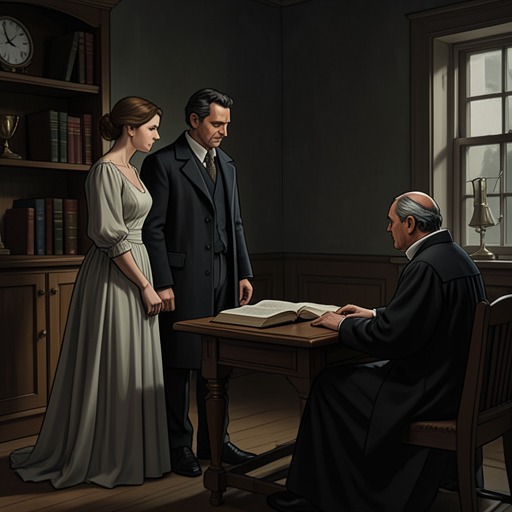
Ana tells Father Rentería that she did not see the man’s face: he surprised her at night, in darkness. She identifies Miguel Páramo because he introduced himself by name and told her not to be afraid. Her account therefore distinguishes between what she could not visually confirm and what she knew from his own words. That detail makes the encounter’s concealment plain without making her identification uncertain: she had heard Miguel name himself.
Miguel presented his visit as an apology and a request for forgiveness. Ana understood his approach as an attempt to make amends, and she responded in light of the teaching that no one should be hated. What followed was not reconciliation. She describes being assaulted, believing she might be killed, and ceasing to think in the expectation that she would die before the attack ended. Only when morning light entered through the open window did she understand that she was still alive. Her account gives the assault its consequences in her own terms: fear, the expectation of death, and the sense that life had stopped before she opened her eyes.
The narrative also establishes how Miguel’s violence is protected at Media Luna. Fulgor Sedano tells Pedro that a woman has accused Miguel of killing her husband and that her grief is unmistakable. Fulgor offers fifty hectoliters of maize, then promises that the harm will be remedied in some other way; the woman rejects both approaches. Pedro responds by telling Fulgor to put Miguel’s offenses on his own account, insisting that Miguel is too young and too weak to kill anyone. When Fulgor presses the point, Pedro dismisses the people involved as nonexistent because he does not know them. His denial does more than excuse a son: it erases the victims as people whose claims require an answer.
Arranging Access to Women
Dorotea la Malfichada later admits to Father Rentería that she found girls for the deceased Miguel. Her assistance took several forms. Sometimes she brought them to him; sometimes she arranged a meeting; with others, she supplied information about when they would be alone and could be taken by surprise. The account makes her role concrete while preserving the distinction between arranging access and carrying out Miguel’s acts. It also shows how violence can depend on information and intermediaries as well as on the direct actions of the powerful man.
The confession comes after Miguel is dead, when Dorotea says the disclosure can no longer cause harm. Father Rentería asks how long it had been happening, and his next question about how many girls there were comes out almost by habit. That exchange places the admission inside a conversation shaped by belated knowledge: the pattern is named only after its principal beneficiary can no longer be held to account. Dorotea’s words reveal repeated assistance, not a single encounter, and the priest’s response registers the scale of what he is hearing without undoing its consequences.
Pedro Páramo and the Servants at Media Luna
Pedro’s authority reaches the household servants as well. Damiana Cisneros of Media Luna, awake with curiosity and fear, looks through a window and recognizes Pedro balanced on the sill of Margarita’s small room. She understands his visit as part of his enduring taste for young maids and wonders why he acts secretly when he could simply have asked her to make Margarita available for the night. The episode presents the estate’s hierarchy from the perspective of a servant who knows the household’s practices and imagines that facilitating the patron’s wishes would be an ordinary service.
Damiana also remembers Pedro once telling her to open the door. She had said she was already asleep and heard him walk away, striking the floor with his foot in anger. The following night, hoping not to displease him, she left the door ajar and made herself available; Pedro never returned. Years later, when she was old and in charge of the servants because she had earned their respect, she still remembered that summons and her response to it. The contrast is telling: her position among the servants has changed, but the memory remains organized around the patron’s demand and her effort to anticipate it.
Another episode places Pedro with a young servant shortly before dawn. He thinks of Susana San Juan while also thinking of the frightened maid with whom he has just slept, and tries to make her body stand in for the woman he desires. The scene presents the servant through Pedro’s perception: he measures her against Susana rather than recognizing an independent desire or perspective. His inward comparison connects his sexual conduct to his fixation on Susana, but it does not lessen the imbalance between a landowner and a servant.
Power, Voice, and Impunity
These episodes differ in setting and in how their information reaches the reader. Ana recounts her experience to Father Rentería; Fulgor reports Pedro’s response to an accusation; Dorotea makes a retrospective confession; and Damiana interprets what she sees and remembers within the servant household. Across these accounts, women’s experiences become legible through testimony, observation, and recollection, while Pedro’s authority determines whether their claims receive recognition. The narrative’s shifting viewpoints make the pattern visible without treating every episode as identical.
The contrast between Ana’s rejection of hatred, Fulgor’s unsuccessful attempt to compensate a grieving woman, and Pedro’s dismissal of unknown victims sharpens the meaning of impunity. An offer of maize cannot substitute for the remedy the woman seeks, and Pedro’s willingness to absorb blame for Miguel does not produce accountability; it protects him. At Media Luna, Damiana’s assumption that she could arrange a maid’s availability reveals how the household’s hierarchy can make access seem routine. The concept therefore encompasses both explicit violence and the social practices that make it easier to conceal, excuse, or repeat.