Susana San Juan's madness and mental isolation
Pedro PáramoSusana San Juan's madness and mental isolation shape both her life at Media Luna and the limits of what others can know about her. People around her call her mad, describe her as seeing visions, or treat her speech as sleep-talk; the narrative, however, also gives her an inward world of memory, pain, and attachment that remains inaccessible even to Pedro Páramo, who loves her. Her isolation is therefore not simply a label applied to her behavior: it is the distance between her experience and the explanations others impose on it.
Identity and Return to Media Luna
Susana returns to the world of Pedro Páramo with her father, Bartolomé San Juan. Rumors of armed men rising up prompt Bartolomé to bring her back, not for his own sake but to place her somewhere populated and safer. His letter to Pedro explains the decision. The return brings Susana within Pedro’s reach, but it does not restore a shared past or make her inner life accessible to him.
When Bartolomé tells Susana that she is his daughter, she responds with uncertainty, repeating that it is not certain. He asks whether she is mad, and she answers that of course she is, as though her condition were already known between them. The exchange does not clarify what she believes about her identity; instead, it makes plain how her father’s question and her own response fail to meet. Bartolomé speaks as a father appealing to a bond, while Susana’s words leave that bond unsettled.
Bartolomé also describes the world as oppressive and speaks of suffering, blood, and the charity of God that Susana’s mother had believed remained available. His appeal to faith and kinship cannot draw Susana into agreement. Her estrangement thus appears in a family conversation as well as in later scenes of visions and disturbed sleep: those closest to her can address her, but cannot reliably reach her.
A Household Unable to Read Her
At Media Luna, Justina interprets Susana’s experiences as dreams or visions. Susana insists that she did not dream and says that the previous night she could not sleep. Their disagreement centers on a cat that stayed in Susana’s bed. Susana says she allowed the wet animal to remain between her legs out of pity and that it made no noise; Justina recalls it jumping from her feet to her head and meowing softly as if hungry. Justina insists the cat was fed and did not leave Susana’s legs, then concludes that Susana has again had deceptive dreams.
The scene offers competing accounts of an ordinary night rather than a settled explanation. Susana reports fear at the cat’s movements, while Justina denies the premise of her account and threatens to leave, taking the cat with her. She says Pedro will find other people willing to work for him and complains that Susana is difficult to bear. The household’s response to Susana’s distress is therefore entangled with the labor of caring for her: Justina attends to her, but also voices exhaustion and the prospect of departure. Susana’s perceptions are not simply private; they affect the fragile arrangements by which others live and work around her.
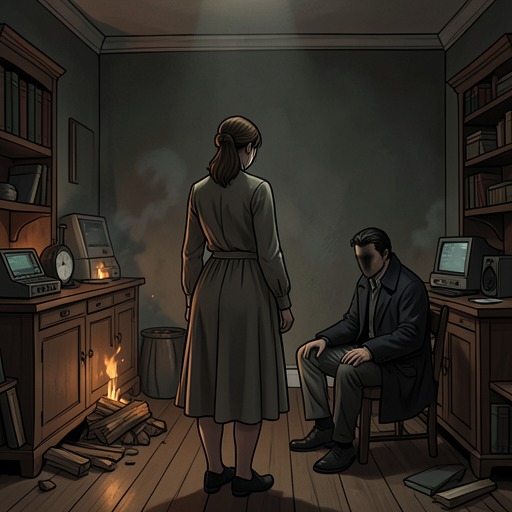
Pedro, too, watches without understanding. He spends nights near Susana’s room, seeing her body move restlessly in the light of the night-lamp: sweat covers her face, her hands pull at the sheets and press the pillow. He wonders what torments her and cannot tell what happens in her mind. His devotion gives him a close view of her physical distress but no key to its meaning. He believes it may be enough that she is the person he loves more than anyone and that her image might accompany him into death, yet the narrative marks the limit of this intimacy: he never discovers Susana’s world.
Memory, Grief, and the Unreachable Inner World
Susana’s interior life is associated with memories of Florencio and with a pain she keeps apart from other people’s grief. When a figure appears to her as a shadow bending over her, with a small, flickering light where the heart should be, she thinks that he has come to tell her Florencio is dead. She already knows, and in her thoughts she tells the grieving figure not to worry about her or let his heart go out: she keeps her pain in a safe place. She then makes her way to Padre Rentería and offers to let her sorrow ease his.
The passage places Susana’s suffering beside another person’s, but does not make it transparent. She recognizes grief and offers comfort, yet describes her own pain as something held in reserve. Her movement toward Padre Rentería is an act of care even as her perception of the scene remains shaped by a vision. The scene resists reducing her to a passive object of concern: within her isolation, she can still respond to someone else’s distress.
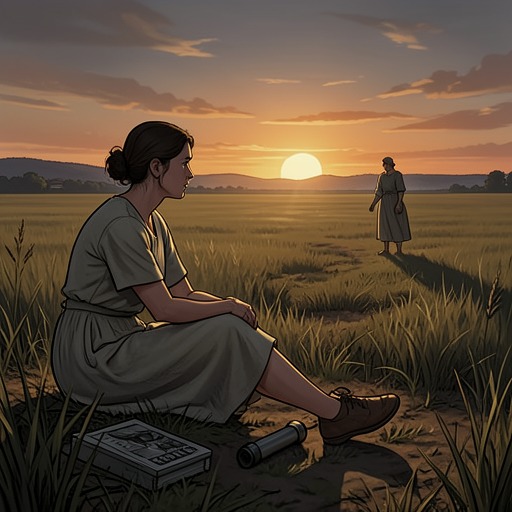
Elsewhere, Susana recalls lying on warm sand with her eyes closed and limbs extended in a sea breeze, while the distant water leaves a little foam at her feet. This remembered seashore belongs to a world Pedro cannot enter. The narration sets it against his anxious vigil at Media Luna: he can observe her body in the room, but cannot follow the memory that occupies her. Her isolation is consequently not mere silence. It contains images and attachments, but they do not become a common reality between her and the people watching her.
Death, Voice, and the Echoes of Comala
As Susana’s illness advances, Pedro opens the door and lets sunlight fall across her. Her eyes are tightly shut, her lips parted, and her hands move over the sheet; convulsions begin to twist her body. Pedro covers her and calls her name. Padre Rentería arrives to give her communion. Pedro raises her against the headboard, and Susana, half asleep, receives the host. She then speaks of having spent a pleasant time with Florencio and sinks back among the sheets. The scene brings the household’s religious care into contact with her private recollection: the sacrament is administered, but her last words turn toward Florencio rather than toward the people at her bedside.
After Susana’s death, her voice remains associated with Comala’s larger field of echoes. Juan Preciado hears a woman speaking and learns from Dorotea that the voice belongs to the woman buried in the great tomb beside them, Susana. Dorotea says that some people considered her mad and others did not, but that Susana had already spoken to herself while alive. The uncertainty of that judgment survives death; no final explanation replaces the competing accounts of her condition.
This posthumous voice belongs to a village where sound repeatedly outlives its apparent source. Damiana Cisneros describes echoes seemingly lodged in walls and stones, old laughter and worn voices, and a funeral procession in which her dead sister calls to her for prayer. Juan, too, recounts hearing the sound of a crowd in an empty square and the faint request that people pray for the dead. These episodes do not establish that every echo is Susana’s. They place her voice within a community in which the dead continue to speak and the living struggle to distinguish presence from memory.
Susana’s death also changes the fate of Media Luna and Comala. Pedro spends his remaining days in a chair facing the road by which she was carried to the cemetery. He loses interest in everything, abandons his properties, and orders their contents burned. The land deteriorates, its population disperses, and Comala becomes a place of repeated farewells. The account explicitly connects this abandonment to the torment of Pedro’s soul after Susana dies. His grief makes her loss consequential for the whole community, but does not undo the distance that defined their relationship: he loved her intensely and still could not know the world she inhabited.