Toribio Aldrete
Pedro PáramoToribio Aldrete appears in the novel through two linked traces: the room where his body was left after he was hanged, and the recollection of his clash with Fulgor Sedano over a legal claim. His story makes a locked room carry the consequences of a property dispute, while his words expose both the reach of Pedro Páramo’s power and the limits of the paper meant to challenge it.
The sealed room and Aldrete’s afterlife
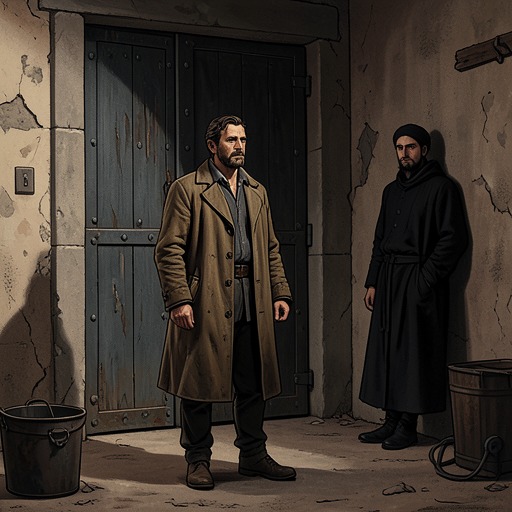
Aldrete enters the narrative as an explanation for cries heard in the house. The room’s occupant says that the sounds may be an echo trapped there, then identifies it as the place where Aldrete was hanged long ago. Afterward, the door was sealed until his body had dried, specifically so that it could not find rest. The account gives the room a history in which confinement continues beyond death: the body was denied the possibility of repose, and the closed door preserves that denial as part of the house’s present.
The room is also difficult to enter. The speaker cannot explain how Juan Preciado got inside, since no key opens its door. Juan answers that Eduviges Dyada had let him in and had described it as her only available room. The casual arrangement of lodging therefore brings him into a place whose past is anything but ordinary. The contrast is stark: what was offered as a spare bed is also the site of Aldrete’s hanging and the enclosure of his body.
When the speaker hears that Eduviges opened it, the response is pity. Eduviges is thought to be still wandering like a suffering soul. Aldrete’s confinement thus sits within a wider landscape of unresolved dead, though the speaker frames the sounds as a possible echo rather than definitively identifying them as Aldrete’s ghost. The uncertainty matters: the room supplies a material cause for the disturbance, but the past remains audible without becoming fully knowable.
The legal claim and the useless document
Aldrete’s conflict with Fulgor Sedano is recalled through a formal declaration. Fulgor identifies himself in it as a fifty-four-year-old bachelor, a professional estate manager, and a man authorized to bring and conduct legal proceedings, including by proxy and in his own name. He concludes by asking that his accusation concerning usufruct be accepted. The careful self-description and legal phrasing present a claim in the language of recognized procedure, rather than as a direct contest of force.
Aldrete’s later response strips that document of its authority. He tells Fulgor that the paper is good for nothing and that the two of them might as well use it to wipe themselves. He mocks the word usufruct and says that Fulgor’s patron ought to be ashamed of his ignorance. The legal instrument, which had seemed to establish a formal dispute, becomes in Aldrete’s telling a prop in a performance whose outcome he believes is already clear. His dismissal does not settle the claim; it reveals how little he trusts the document to protect him.
The meeting had been presented, supposedly, as a drinking occasion to celebrate the record. Aldrete recalls that he and Fulgor drank together, and the convivial setting gives the legal paper an uneasy double use: it is both the object of a proceeding and something around which the men perform fellowship. That fellowship proves fragile. Aldrete can recognize Fulgor’s personal ability while despising the interests he serves, and the social ritual does not erase the conflict between them.
Fulgor, Pedro Páramo, and the reversal in Aldrete’s words
Aldrete distinguishes Fulgor from his employer. He tells Fulgor that nobody could disrespect a man such as him and credits him with being capable through his own merit, not merely through the power of the person behind him. The praise is pointed: it acknowledges Fulgor’s competence while separating it from the authority of Pedro Páramo. Aldrete then turns directly against the patron, saying that Pedro Páramo is the one who is making his life unbearable. The conflict is therefore not simply personal hostility toward Fulgor; Aldrete sees the estate manager as the agent of a larger power that he resents.
The recollection preserves a reversal in Aldrete’s conduct. Fulgor remembers the insult to the patron as Aldrete’s last statement made with full command of himself. After that, Aldrete behaved like a coward and began screaming. The man who had mocked the legal document and spoken boldly about the power behind Fulgor becomes, in the account of his final moments, terrified and reduced to cries. The shift does not cancel his earlier defiance; it places verbal confidence beside the vulnerability of a man facing the consequences of the dispute.
Narrative significance
Aldrete’s character is assembled from testimony rather than from an extended account of his life. The room supplies the physical outcome—hanging, sealing, and a body left to dry—while Fulgor’s memory supplies the language and confrontation that precede it. Because the narrative moves between a present disturbance and a remembered legal encounter, Aldrete’s history arrives in fragments: first as the name attached to a terrible room, then as the opponent whose words reveal the stakes behind it.
The contrast between the legal accusation and the sealed door gives the episode its force. Fulgor’s declaration invokes procedure and authorized action; Aldrete answers that the resulting paper is worthless; the account of the room shows a body deprived of rest. The text does not need to explain the legal outcome to make the imbalance legible. Aldrete’s sharp reading of the power behind the document and the bodily fate associated with his name leave the dispute suspended between a claim on paper and a consequence that cannot be undone.