Toribio Aldrete Is Framed and Hanged
Pedro PáramoToribio Aldrete Is Framed and Hanged turns a legal accusation into the prelude to a death that the novel reveals indirectly: Aldrete is trapped in a room, hanged, and left behind a sealed door. Fulgor Sedano’s recollections connect the paperwork and preparations to the dead man’s cries, while the aftermath persists as an echo that seems to keep the room from becoming merely a place of the past.
Background and the Legal Pretext
Fulgor Sedano introduces himself in a formal declaration as a fifty-four-year-old bachelor and estate manager, authorized to bring and conduct lawsuits. The document presents his authority in the language of procedure, and its charge against Aldrete is identified as a claim involving usufruct. That official framing is crucial to the episode: what appears on paper to be a legal dispute becomes the opening move in a coercive encounter.
The document’s authority is challenged almost as soon as it has been drawn up. Aldrete remembers that he and Fulgor drank together over the record, but treats the celebration as a sham. He tells Fulgor that the paper is fit for nothing, that both men know it, and that Fulgor has simply done what he was asked to do. Aldrete says the supposed accusation has, in effect, got him out of a difficulty, and laughs at the word usufruct, adding that Fulgor’s patron ought to be ashamed of his ignorance. The contrast between the formal accusation and Aldrete’s contempt exposes the gap between a document’s legal language and its power in practice: its practical importance lies less in proving a claim than in showing that the estate’s agent has carried out an assignment.
Fulgor and Aldrete
Aldrete does not initially dismiss Fulgor as powerless. He tells him that no one could fail to respect a man of his capacity, and insists that this respect is due to Fulgor himself, not to the influence of the person behind him. But his distinction also locates Fulgor inside a hierarchy: he recognizes the agent’s ability while reserving his anger for the patron who employs him. In another exchange, Aldrete bluntly tells Fulgor that the patron is the one who has made life difficult for him.
Fulgor remembers Aldrete’s words as the last he spoke while fully in control of himself. Afterward, Aldrete cried out, and Fulgor recalls him as behaving like a coward. That recollection gives the episode a cruel reversal: the man who mocked the legal paper and challenged the power behind Fulgor is later reduced to cries. The remembered insult does not establish the exact mechanics of the hanging, but it shows how Fulgor frames Aldrete’s final loss of control—as a contrast with the defiance he had displayed while speaking.
The Room and the Hanging
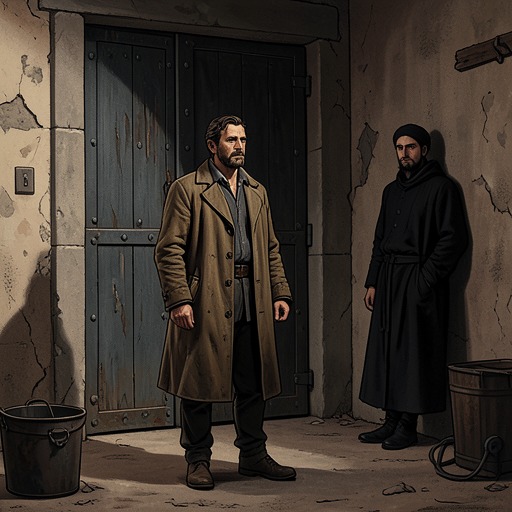
The physical aftermath emerges in a later conversation about a room that seems to contain an imprisoned echo. It is identified as the room where Aldrete was hanged long ago. Afterward, the door was sealed until his body dried out, so that his corpse could not find rest. The person hearing this account wonders how anyone entered: there is no key that opens the door. The answer is that Eduviges Dyada had opened it and offered it as the only room available.
That ordinary explanation of access makes the room’s history more unsettling, not less. A lodging described as the only available room turns out to be the site of a concealed corpse; a locked and sealed door has not kept its past contained. The episode does not narrate the hanging as a fully witnessed scene. Instead, the account arrives through the room’s history and through the cries heard there, so that the dead man’s confinement is disclosed after the event and its sound seems to persist beyond it.
Aftermath and Narrative Significance
The memory of Aldrete’s death is entangled with Fulgor’s repeated approaches to his patron’s house. About fifteen days after an earlier visit, Fulgor strikes the door with his whip handle and remembers having waited there before. He again notices black ribbons hanging from the lintel; this time he no longer comments on the addition of another ribbon, one faded and one shining like silk despite being dyed scraps of cloth. On the earlier visit, he had waited so long that he thought the house empty, until don Pedro appeared and invited him inside. The recalled details place Fulgor’s work within a recurring pattern of waiting on his patron, though they do not specify what the ribbons commemorate.
The episode’s structure binds together a formal accusation, a private exchange, a closed room, and a voice that cannot be laid to rest. Aldrete’s mockery suggests that the paper cannot command belief, yet the sequence associated with it culminates in confinement and death. In Comala, the legal record may be dismissed as useless, but the violence surrounding it remains materially present—in the sealed doorway, the dried body, and the cries heard by those who come afterward.