Alex’s recurring back spasms
People We Meet on VacationAlex’s recurring back spasms are a persistent physical problem that complicates his ordinary routines and, during a reunion trip, turns a quiet morning into an episode of acute pain. The condition also marks time the friends spent apart: when Alex explains that the spasms began after the Croatia trip, Poppy recognizes them as one of the developments in his life she had not known about. His pain is not merely an obstacle to the trip; it exposes how readily he assumes responsibility for inconvenience and how Poppy’s care has to meet a condition she is only now learning to understand.
Pattern and Possible Causes
Alex dates the onset to a couple of months after the Croatia trip. By the time he tells Poppy about it, the spasms have recurred four or five times. He says they happen less often when he exercises regularly, while prolonged sitting on a plane or in a car can contribute to a flare. The trip’s low cot-like bed provides another possible trigger, though he does not present it as the underlying cause of the condition.
His account of the longer pattern makes clear that the problem is not confined to a single dramatic episode. For about a year, he has found it difficult to bend down for his shoes until he has been awake and moving for at least half an hour. He connects his symptoms tentatively to hunching over books or a computer. A massage therapist suggested that shortened hip muscles might be pulling on his back; his doctor prescribed muscle relaxants, but Alex says the doctor left before he could ask questions. These details establish what Alex has been told and what he suspects, without supplying a definitive medical explanation.
The Morning Flare
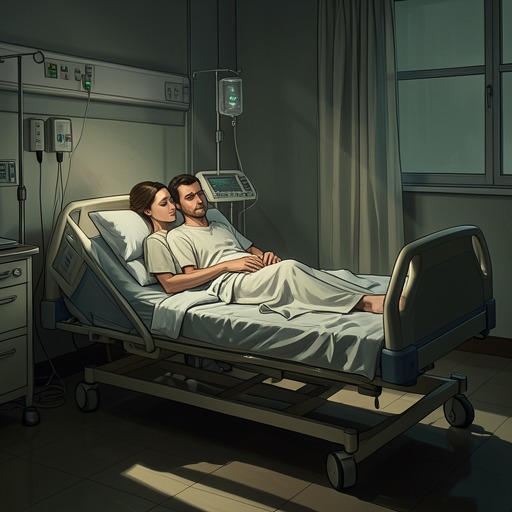
During the trip, Alex wakes at about five thirty intending to go for a run. He thinks that sitting up awkwardly or too quickly brings on the spasm. He is gasping and in pain when Poppy notices him, and she helps him reach the bed. Sitting eases some of the pain, but getting up and down is especially difficult when a spasm occurs. Poppy stacks pillows against the headboard so he can recline gradually; his face remains contorted as he lowers himself onto them.
The episode makes the condition’s practical severity visible through ordinary movements: rising from a low sleeping place, bending, and changing position become consequential. Alex is upset not only by the pain but by what he sees as his failure to anticipate it. He says he should have remembered the low bed could provoke a spasm and apologizes for having disrupted the trip. Poppy challenges that self-blame, pointing out that he could not have known this particular flare would happen. Her gentle teasing about his impulse to act like a hero does not immediately dispel his misery, showing the distance between her reassurance and his conviction that he has caused trouble.
Care and Management
Poppy takes an active role in responding to the episode. After buying two ice packs, she puts them in the freezer and plugs in a heating pad. She positions the pad across Alex’s midback, using the pillows to support him as he leans back. Her plan is to apply warmth first and switch to an ice pack after half an hour in an effort to reduce inflammation. She has also read about back spasms in the fluorescent-lit aisles of a drugstore, making her care a combination of immediate physical help and information gathered on his behalf.
Alex says he is doing better, but Poppy can see that he is still in pain. That mismatch matters: he is less successful at concealing physical distress than emotion, and his reassurance does not end the work of caring for him. The scene gives his recurrent condition a routine dimension as well as an acute one. Managing it involves attention to how he moves, what helps him settle, and the possibility that sitting through travel or sleeping on a low bed may worsen symptoms.
Estrangement and Narrative Significance
For Poppy, learning about the spasms also means discovering how much of Alex’s recent life has unfolded beyond her view. When he says the problem began a couple of months after Croatia, the timing lands forcefully: the physical history belongs to the period in which they were no longer sharing the ordinary details of one another’s lives. His recurring pain thus makes their estrangement tangible without being reducible to it. The condition has its own reported pattern, possible triggers, and attempted treatments; at the same time, Poppy’s surprise registers the intimacy and knowledge their separation interrupted.
The episode also reveals a recurring tension in Alex’s behavior. He tries to protect Poppy from discomfort and then treats the consequences as his fault, even when the flare was not foreseeable. Poppy’s response is practical rather than abstract: she helps him move, arranges pillows, applies heat, and plans to use ice. Through these specific acts, the spasms become a test of the renewed closeness between them. They require Poppy to attend to a vulnerable part of Alex’s life, while his apologies show how easily care becomes entangled with his fear of being a burden or spoiling their time together.