Cats
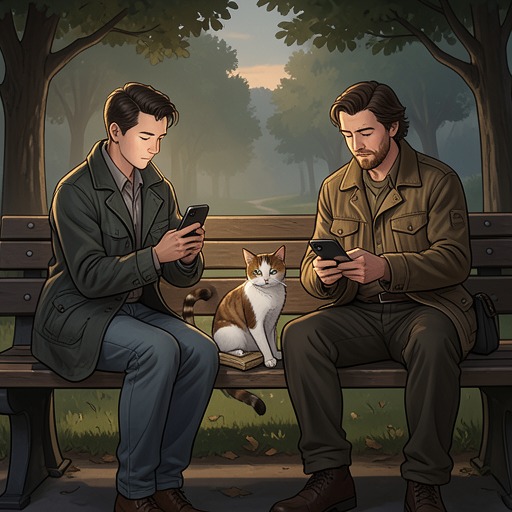
People We Meet on VacationCats in the novel are more than background pets: they are particular, cared-for animals whose needs, preferences, and habits shape the relationships around them. Alex Nilsen’s attachment to a cat becomes a running source of teasing and tenderness, while cats in Poppy Wright’s family and in her illness-bound dreams give form to contrasting ideas of companionship and isolation.
Identity and Recurring Presence
The cats appear in several distinct contexts. Alex refers to a cat whose specialized medical needs make it difficult for him to get away; elsewhere, Poppy learns that a cat he adored has died. Later, during a period when Alex and Poppy speak far less often, he finds a tiny black cat in a dumpster behind his apartment complex. The cat is fully grown, according to the veterinarian, but unusually small. Alex eventually calls her Flannery O’Connor, a name also associated earlier with the cat whose death he had not told Poppy about. The narrative does not explain the relationship between those references, but it makes clear that cats remain a sustained part of Alex’s life.
The animals are described through specific needs and habits rather than as interchangeable symbols. One requires specialized care; another is characterized by her shyness and her response to Poppy; the tiny black cat turns up in shoes, hats, bowls, cupboards, and on top of bookshelves. That attention gives the cats presence beyond their usefulness to the human plot: their care and behavior set the terms of the interactions around them.
Flannery O’Connor and Alex’s Attachment
Alex’s affection for Flannery O’Connor is evident even when Poppy treats their relationship as comic evidence that he should get back into dating after Sarah Torval broke his heart. Poppy warns him not to bring up his codependent relationship with his cat when a woman approaches him at a bar. Alex rejects her characterization of the cat as an asshole, insisting that she is shy. He says the cat simply does not like Poppy, who has strong dog energy.
Their disagreement turns on the difference between Poppy’s intention and the cat’s apparent response. Poppy says all she has done is try to pet her and wonders why someone would keep a pet that does not want to be petted. Alex counters that the cat does want affection, but that Poppy approaches with a wolfish gleam. The exchange is playful, yet it gives the cat a preference of her own: Alex understands her as shy and receptive on her own terms, while Poppy’s eager overtures do not guarantee a welcome.
The joke also reveals how naturally Alex’s care for animals fits into his character. Poppy sees him as clean, particular, and organized, but his devotion to a cat is not a contradiction to be corrected. Her suggestion that he move on after Sarah instead exposes the persistence of her own closeness to him: she can tease him about intimacy with a pet while assuming the role of confidante about heartbreak.
Death, Care, and a Breach in the Friendship
In an earlier exchange, Alex says that even if he lived where Poppy assumes, he could not easily get away because his cat has medical needs requiring specialized care. Poppy misreads his explanation as referring to a death and offers sympathy for his supposed bereavement. Alex’s puzzled response reveals the misunderstanding. The moment links the practical burden of animal care with the difficulty of reading what the other person means, a recurring feature of their intimacy.
A later text exchange reverses the situation. Poppy asks after Flannery O’Connor, and Alex replies that the cat is dead. When Poppy clarifies that she means the cat rather than the author, he says that the cat is dead too. Poppy is shocked not only by the loss but by the fact that Alex had not told her. She knew how much he adored the cat, despite their mutual dislike, and describes the omission as a clean, devastating cut. Her apology recognizes the life the cat had with him and the depth of his attachment. Alex answers only with thanks.
That brevity matters. The cat’s death is a real loss for Alex, but the delayed disclosure also makes it evidence of distance between the friends: Poppy has to discover an important event after it has happened, and her sympathy cannot undo the fact that she was not included. The animal’s place in Alex’s life makes the silence legible without requiring him to explain it.
The Tiny Black Cat and a Narrow Channel of Contact
During another strained period, Alex and Poppy’s friendship contracts to occasional calls, often only about fifteen minutes every couple of weeks, with almost no texting, messaging, or email. One of the few subjects that passes between them is the tiny black cat Alex found in the dumpster behind his apartment complex. He sends pictures of her sitting in shoes, hats, and bowls, adding that the objects show her scale. Poppy understands that the pictures also express his delight in the cat’s small acts of exploration.
Alex takes his time naming her. Because she is already grown, he says he wants to know her before settling on a name; in the meantime he calls her cat, tiny sweetie, or little friend. Sarah wants to call her Sadie, but Alex does not think that name fits and waits. The naming question conveys an attentive approach: he treats naming not as a label to impose immediately, but as something that should follow familiarity with this particular animal.
The cat becomes nearly the only subject Alex and Poppy discuss. Their limited contact does not restore their former ease, and Poppy knows that Sarah feels strange about the upcoming summer trip. Still, the photographs offer a small, repeatable point of connection. Alex shares what he finds adorable, and Poppy receives it with affection for both the cat and the person who keeps taking pictures of her.
Flannery, the Trip, and the Nightmare
In the weeks before the trip, Alex and Poppy text incessantly, though they avoid discussing the trip itself, which Poppy is planning as a surprise. Instead, he sends photographs of the black cat, now identified as Flannery O’Connor, among shoes and cupboards or stretched across bookshelves. He says she reminds him of Poppy. Poppy proposes possible resemblances involving claws, teeth, and fleas; Alex replies that she is a tiny fighter. The comparison gives the cat a private vocabulary through which Alex can express affection for Poppy indirectly.
As the trip approaches, Alex sends a picture of Flannery sitting in his already packed suitcase. Poppy answers by calling the cat a tiny fighter, echoing their established exchange. When Alex says he loves her, Poppy understands that he means the cat, yet the declaration still brings back the warm, fluttery feeling she associates with Alex. The cat’s presence lets an ordinary expression of fondness carry emotional force without turning it into an explicit declaration between the friends.
Cats also enter the novel in a less comforting form when Poppy is very ill. In restless sleep, she dreams of a giant black cat with hungry eyes pursuing her in circles until she can hardly breathe, then pouncing and jolting her awake. The repeated dream resumes whenever she falls asleep again. This threatening image sharply contrasts with the small, familiar cat in Alex’s photographs: in the nightmare, the cat becomes part of an exhausting, bodily experience of illness, not a companion offering comfort. Across these contrasting appearances, cats mark both the attentiveness that sustains relationships and the vulnerability that intimacy cannot always protect against.