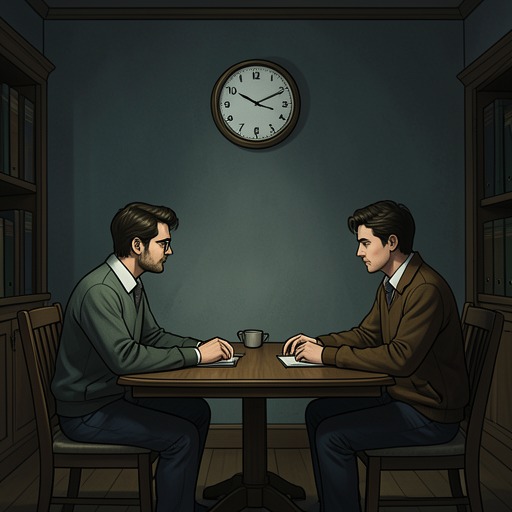
Poppy and Alex grow distant after their kiss
People We Meet on VacationPoppy Wright and Alex Nilsen’s distance after their kiss grows from a familiar habit of holding back into a new, painful silence. After years of friendship, they cross a physical boundary, then try to protect what they have by calling the encounter a mistake and insisting that nothing needs to change. Their efforts to return to normal instead make the relationship harder to name and harder to maintain.
Reconnection and the old hesitation
After a period of estrangement, Poppy Wright considers contacting Alex Nilsen. His number remains at the top of her favorites, preserved by hope for so long that deleting it now feels like an unbearable final act. She types that she has been thinking about him, erases it, tries a casual invitation to get out of town, and deletes that too. The difficulty is not simply finding an opening; it is the awkwardness of pretending they can still plan a trip as if the friendship had never been damaged. She finally sends only a greeting.
Alex replies with the same single word. Poppy is startled enough to nearly answer as though he had initiated the exchange, then recognizes that the reply offers no natural next step. The tiny, symmetrical greeting captures the problem between them: both are in contact, but neither has yet made the conversation safe enough to continue.
Their reunion also brings the losses and withheld news that accumulated during their separation into view. When Poppy learns that Betty has died, she is overcome and tells Alex she wishes he had told her about Betty and Flannery O’Connor. Alex explains that he had not been sure Poppy wanted to hear from him. As he folds straw wrappers into precise little squares, his controlled gesture contrasts with Poppy’s rising emotion; her reaction makes clear that the distance has not erased her attachment to the people important to him.
Distance within renewed closeness
Even as the two reconnect, their conversations expose unresolved complications. When Alex speaks uncertainly about Sarah Torval, Poppy asks whether Sarah wants to resume the relationship or whether he does. Alex says he does not know, then asks not to be chastised: dating feels grim, and he and Sarah have a long history. Poppy counters that the history is sordid and points out that they have broken up twice. The exchange shows Poppy acting as a confidante while also confronting the limits of that role; their intimacy gives her access to Alex’s romantic uncertainty, but it does not settle what either wants from their own relationship.
After Tuscany, they both step back without discussing the change. Daily texts become occasional catch-ups, spaced weeks apart. Poppy understands that resuming their former ease would be too easy in one sense and too consequential in another: she cannot simply return to that closeness with Alex or with Trey. Instead, she throws herself into work and takes trips, sometimes one after another. Travel initially suits her and Trey, who thrive on horseback and camelback, hikes up volcanoes, and cliff-jumping. Eventually, though, the constant movement feels less like freedom than flight. Their disagreements over waking early, walking pace, flirting with a waitress, and browsing shops turn the life of perpetual vacation into another source of strain.
The kiss and its immediate aftermath
Poppy waits two and a half months for a conversation with Alex in which they can speak plainly, without tiptoeing around each other or trying not to touch. The chance finally comes on a trip where Bernard is also present, joining them for sunset kayaking, a tour of family wineries, and nightly seafood dinners. His unflagging presence means that even this opening for candor unfolds around a third person; Alex jokes that Bernard might be God, and Poppy laughs into her wine.
One night, after both have been drinking, Poppy and Alex kiss intensely. When Poppy reaches for his belt, Alex catches her wrist and pulls back. He says, “We can’t do this,” then revises the reason: they should not continue because they are drunk and not thinking clearly. Poppy challenges the distinction between being able to make out and being unable to sleep together, but Alex’s explanation is broader than the immediate question: he believes the encounter should not have happened at all. The abrupt stop turns desire into embarrassment before either can say what the kiss means to them.
Poppy moves away, smooths down her pajama shirt, and tells him he is right. She quickly tries to contain the consequences, proposing that they treat the night as insignificant because they had each had about three bottles of wine and were not thinking clearly. Alex asks whether she can really do that. Poppy insists that their longer history matters more than one drunken night, but her reassurance also works as a repair attempt: she wants to prevent the kiss from becoming the event that breaks their friendship.
Silence, memory, and an unfinished return
The effort to dismiss the encounter does not make it disappear. Poppy paces, then lies awake reliving both the excitement of kissing Alex and the humiliation of the conversation that followed. In the morning, she briefly hopes she dreamed it, until a hickey in the bathroom mirror confirms what happened. She decides not to raise the subject, reasoning that pretending to have forgotten will prove she is fine and that their relationship need not change.
At the airport, Bernard’s absence gives Poppy and Alex their first moment alone that day. Alex apologizes, acknowledging that he started the encounter and that it should not have happened that way. He also says he believes Poppy is not over Trey. Poppy asks whether they are all right, wanting the reassurance to be true. Bernard returns with a story about an airport bathroom covered in toilet paper, and the two friends barely look at each other. The interruption leaves their central question unanswered rather than resolved.
Once home, Poppy waits for Alex to text first so that she can know they are okay. After a week, she sends a casual message about a funny T-shirt she has seen on the subway; he replies with a brief laugh but does not extend the exchange. Two weeks later, she asks whether he is all right. He says he has been busy and asks if she is okay. She answers that she is, and both remain occupied. Poppy interprets the ensuing quiet as proof that the boundary they had maintained existed for a reason: after crossing it, Alex cannot seem to look at her or write back as before. She experiences the loss as ten years of friendship thrown away for the knowledge of what Alex tastes like.
The relationship’s next visible contact remains tentative. When Poppy arrives where Alex is with other teachers, both appear shocked; she walks toward his table as the others look up. Alex manages a near-whispered greeting, Poppy returns it, and she waits for more words that do not come. The exchange offers no clear reconciliation, only a face-to-face counterpart to their earlier one-word texts. Their distance is therefore defined not by a single final break but by repeated attempts to resume contact that stop just short of the conversation their history requires.