
Kawashima’s Creative Work
PiercingThis thread traces Kawashima’s development as an artist and advertising designer, showing how his visual imagination moves between private habits, professional success, and the cover story for his disappearance.
increasing Bearing strength in each event
 decreasing
Bearing strength in each eventdecreasingRoads in the Dark
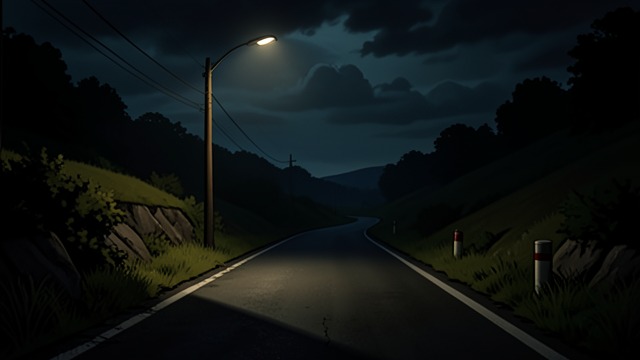
Roads in the Dark
An Early Subject
After his placement in the Home, Kawashima begins drawing. From the start, his pictures repeatedly show narrow roads at night, a subject that connects his artistic habit to memories of isolation and fear.
The image is spare and persistent: a road receding into darkness, with no reassuring destination in view. Drawing gives his inner experience a form that can be repeated without his having to explain it aloud.
Art as a Private Language
Kawashima continues to return to this motif as a child and later as an adult. It becomes less a conventional artistic theme than a durable visual language for states of mind that are difficult for him to communicate.
The drawings also show how his creative life begins alongside the strategies he develops to endure childhood. Art offers a way to represent loneliness while keeping it at a controlled distance.
The Ginza Sketchbook

The Ginza Sketchbook
A Meeting at the Gallery
Kawashima meets Yoko at an exhibition in Ginza. He is carrying a sketchbook, and she opens their conversation by asking whether he is an artist.
They go to a coffee shop together, where Yoko studies his drawings. When a small crumb falls onto one of the pictures, she carefully removes it with a napkin; her attention to the work makes Kawashima feel unexpectedly happy.
A New Subject
Until then, his drawings have focused on moonlit roads. Near the end of summer, he draws Yoko’s face from memory and gives her the sketch on a later date.
The portrait marks a departure from his narrow established subject. It also becomes part of the courtship: the drawing communicates attention and affection in a form more natural to Kawashima than a direct declaration.
Return to Drawing

Return to Drawing
Rebuilding a Life
Kawashima eventually leaves the Home and later returns to school, takes up drawing again, and finds work. The sequence describes a gradual reconstruction of ordinary adult identity after an unstable and abusive childhood.
His creative practice persists alongside employment rather than replacing it. Drawing is both a personal outlet and a recognizable part of how he understands himself.
An Uncertain Identity
By the time he is married, Kawashima sometimes feels almost unrelated to the teenager he once was. He cannot decide whether the person who endured the past or the adult who has built a family is the more authentic version of himself.
His professional and artistic progress therefore brings stability without erasing the earlier self. The tension between these identities later shadows his attempt to divide his life into a respectable present and a violent past.
The Jazz Festival Campaign
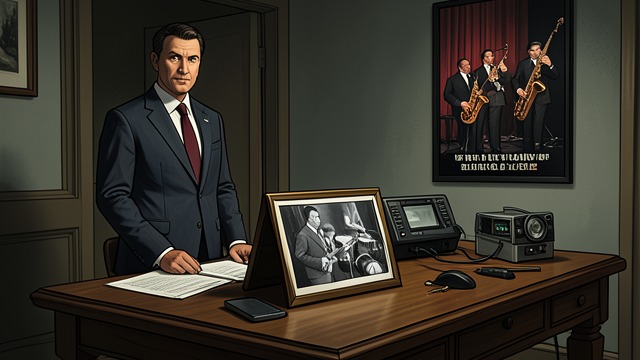
The Jazz Festival Campaign
A Designer’s Instinct
Kawashima is preparing a presentation for the Yokohama Jazz Festival. He considers using black-and-white photographs of fashion models from the 1940s rather than images directly connected to jazz.
That indirect approach reflects his professional specialty: he likes graphics that do not simply illustrate the product. An earlier campaign for indoor ski slopes, built around the line “There’s a first time for everything,” had made him a minor success at the office.
Work as a Measure of Competence
The jazz-festival work demonstrates that Kawashima can plan, select images, and present a persuasive idea in a competitive professional setting. His colleagues recognize the skill even when the work feels distant from the crisis consuming him.
As he begins to contemplate violence, he notices that thinking about a victim’s appearance can feel like choosing a photograph for a poster. The comparison reveals how easily his trained compositional eye can be recruited by a destructive purpose.
Vacation as Research

Vacation as Research
A Plausible Project
Kawashima tells Yoko that he wants to use a company vacation to observe salarymen in a major Tokyo hotel. He links the proposed research to an upcoming campaign for an imported car aimed at men in their thirties.
The explanation fits his occupation. His career already involves studying audiences and choosing images that can communicate to them, so the fabricated project sounds like an extension of his design work.
Professional Cover
The firm has a real mandatory-vacation system and provides an expense fund. Kawashima uses these facts to support his plan to stay away from home while concealing his intended attack.
His professional identity thus serves as protective camouflage. The credibility he has earned through ordinary work makes it easier for both Yoko and his colleagues to accept an absence that has a far more dangerous purpose.
During Kawashima’s childhood
Early summer, six years before the main events
After Kawashima leaves the Home and enters adult life
Before Kawashima’s planned vacation
The morning Kawashima asks for time away from work
